By Ramachandran Rajeev Kumar — 2025-12-24
The Squire Bleeds, The Shadows Smile: A Modern Fable
Once upon a time, in a land not so far away...
The Cast of Characters
There lived a knight of questionable sanity whom the locals called The Pangla Kangla. He rode a horse so sickly it had forgotten how to gallop, wore armor held together by rust and delusion, and carried weapons that had seen better centuries. His greatest talent? Convincing others to fight his battles while he posed dramatically from a safe distance.
His faithful squire, The Bangla Pingla, was a portly fellow with more enthusiasm than sense. He had recently joined the knight's service - a decision made in haste during difficult times. The squire had fallen on hard times - his pantry was empty, his roof leaked, and his children asked uncomfortable questions about dinner. But rather than fix his own crumbling house, he had become convinced that all his problems stemmed from one source: the bear sleeping in the adjacent forest.
And then there was The Watching Ingla - a bear of magnificent proportions, with fur so thick that mosquitoes gave up in despair and claws that could reshape geography. But here's the thing about this particular bear: it preferred sleeping. Not out of weakness, mind you, but because it had learned long ago that patience was the ultimate predator. One eye remained perpetually cracked open, tracking every movement in the forest with the casual awareness of something that knew it could end any confrontation but found the whole affair rather tedious.
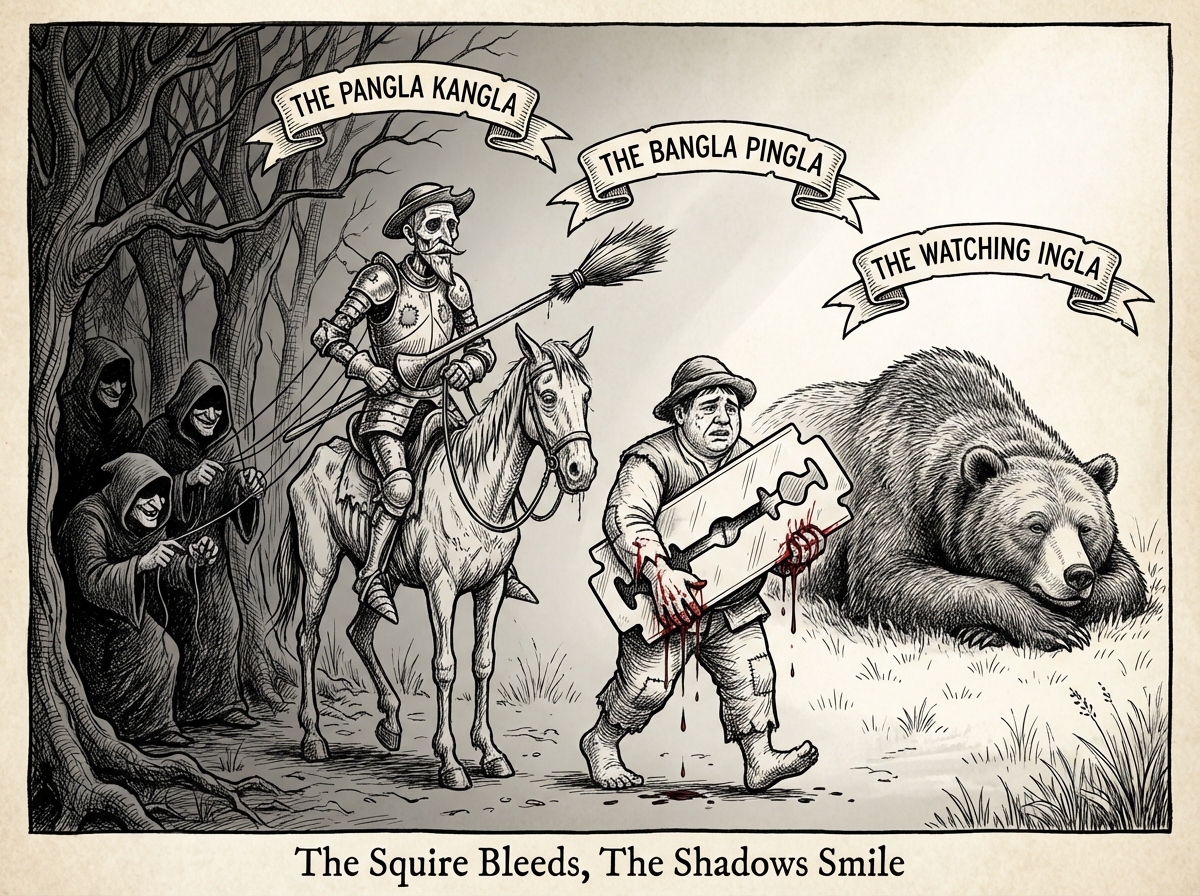 Editorial Cartoon: The Pangla Kangla, The Bangla Pingla, and The Watching Ingla
The Peculiar Weapon
Now, The Pangla Kangla had given his squire a weapon. Not a proper sword, mind you - those cost money, and the knight spent his budget on dramatic capes and propaganda pamphlets. No, he had handed The Bangla Pingla something far more... innovative.
It was a blade. Just a blade. No handle. No hilt. No grip.
"But sire," the squire had protested, examining the rusty slab of metal, "how am I supposed to hold this?"
"With your HANDS, you fool!" the knight declared from horseback. "Wrap your palms around it! Show the bear your commitment!"
And so the squire did. Because when you're desperate and someone offers you a purpose - even a blade-shaped one - you tend not to ask too many questions.
The Puppet Strings
What neither the knight nor the squire noticed - or perhaps chose not to notice - were the puppet strings.
They descended from the shadows between the trees, where figures with too many teeth and too few scruples watched the proceedings with barely contained glee. These Manipulators had their own reasons for wanting the bear disturbed. Some sought to profit from chaos. Others nursed ancient grudges. A few simply enjoyed watching fools bleed.
The strings were attached to The Pangla Kangla's back. Every dramatic gesture, every rousing speech about slaying the "terrible beast," every command to charge - all choreographed by hands hidden in darkness.
The knight thought he was directing a crusade. He was merely a marionette in a play he didn't write.
The Charge
"CHARGE!" screamed The Pangla Kangla, from the safety of horseback, pointing his broken lance at the sleeping bear.
The Bangla Pingla charged. He gripped his handleless blade tighter - and immediately regretted it. The sharp edge bit into his palms. Blood welled up, ran down the rusty metal, and dripped onto the forest floor.
But he kept going. He had to. He had announced to his entire village that he would slay the bear. He had burned bridges, made enemies of old friends, and staked his reputation on this moment.
Drip. Drip. Drip.
His blood marked his path like breadcrumbs leading nowhere good.
The Bear's Response
The Watching Ingla... watched.
One massive eye tracked the approaching squire with the mild interest a cat shows a particularly stupid moth. The bear's nostrils flared once, taking in the scent of rust and desperation and manipulated foolishness.
It did not move.
Not because it couldn't. The bear could have ended this farce with a single swipe. It could have risen like a furry mountain and reminded everyone present why its ancestors were worshipped as gods. It could have roared loud enough to shake the puppet strings loose from their hidden masters.
But why bother?
The squire was already bleeding. The knight was already broke. The shadows would eventually turn on each other, as shadows do. And the bear? The bear had learned that some problems solve themselves if you simply let fools be foolish long enough.
The Moral
The squire reached the bear. He raised his handleless blade. Blood ran freely from his palms now, and his grip was slippery with it.
He stabbed.
The blade bounced off fur so thick it might as well have been armor. The bear's one open eye blinked slowly.
The squire's hands, however, slid forward on the blade as he thrust. The edge sliced deep into his fingers. He screamed - not a war cry, but a cry of someone who had finally realized the nature of his weapon.
Behind him, the knight was already turning his horse around, composing a speech about "strategic withdrawal."
In the shadows, the Manipulators smiled. The chaos was profitable, even if the bear remained undisturbed. There would be other squires. Other handleless blades. Other fools who needed a monster to blame for their empty pantries.
And the bear? The bear closed its eye and went back to sleep.
Some windmills aren't worth tilting at. Some bears aren't worth poking. And some blades hurt the wielder more than the target.
The End.
Or rather, the beginning of a very long and very preventable recovery period for a squire who should have invested in a proper handle.
The views expressed in this fable are entirely fictional and any resemblance to actual geopolitical situations involving neighbors who share rivers, history, and an unfortunate tendency toward mutual irritation is purely coincidental. The author accepts no responsibility for readers who see parallels where none were intended. Or were they?