By Ramachandran Rajeev Kumar — 2026-01-30
The Southeast Pivot
India's Defense Diplomacy Reshapes the Indo-Pacific
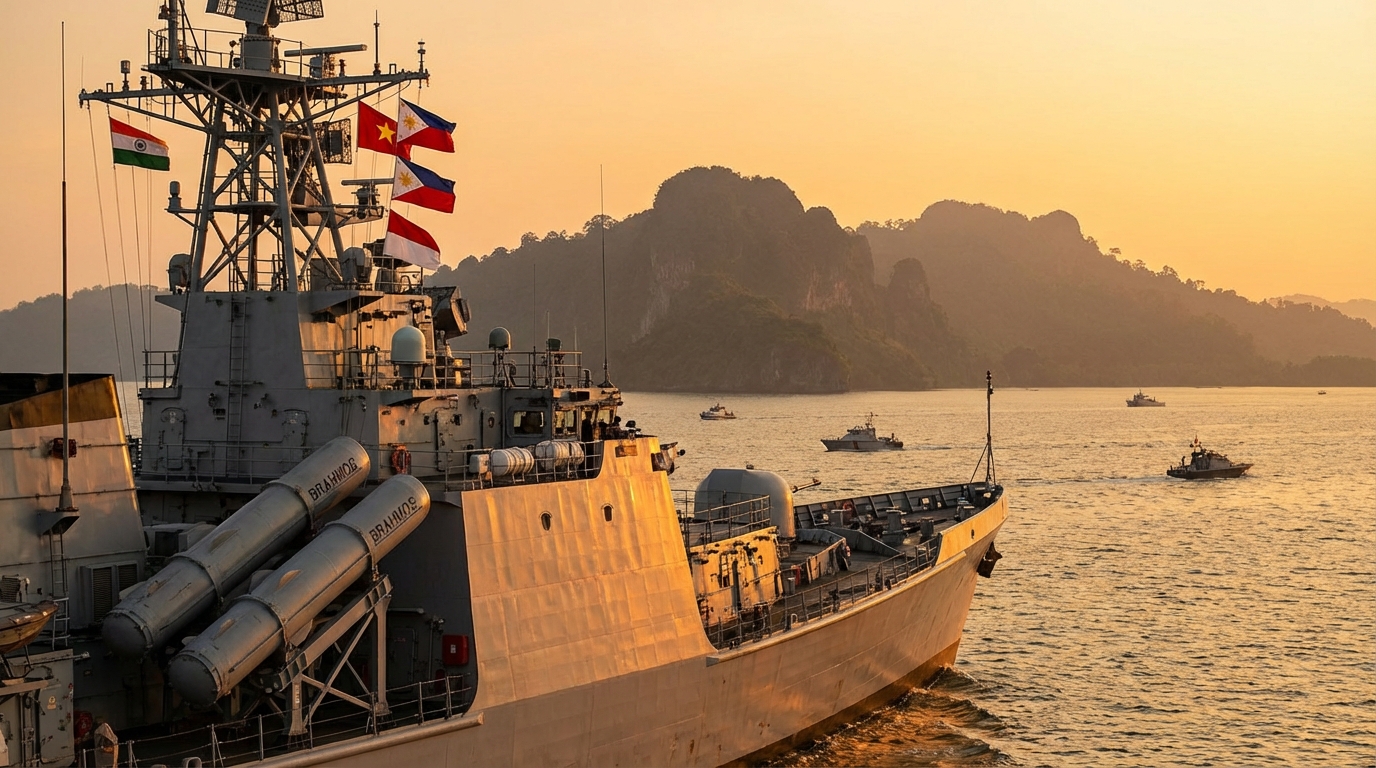
On April 20, 2025, a ship carrying BrahMos supersonic cruise missiles docked in the Philippines. It was the second battery of a $375 million deal signed in 2022—India's first major defense export to a Southeast Asian nation.
The third battery arrives before year's end. And the Philippines wants more.
President Marcos has announced plans to procure additional BrahMos missiles. The Philippine Army is planning a Land-Based Missile System Acquisition Project for 2027. What started as a single sale has become a strategic partnership.
But the Philippines is just one front in a broader transformation. India's Act East Policy has evolved from economic engagement into something far more significant: military diplomacy that positions India as a security provider across Southeast Asia.
The BrahMos Doctrine
The BrahMos supersonic cruise missile—a joint development between India and Russia—flies at Mach 2.8 to 3.0. At that speed, defenders have seconds to react. Against naval targets, it's a ship-killer that changes the calculus for any fleet operating within range.
For small nations facing maritime pressure, it's a great equalizer.
The Philippines deal was the breakthrough. Vietnam is now finalizing a $700 million agreement to acquire the system—making it the second Asian customer. Indonesia discussed a $450 million purchase during President Prabowo Subianto's visit to India in January 2025.
The pattern is unmistakable: nations facing pressure in the South China Sea are turning to India for asymmetric capabilities.
This reverses decades of Indian defense trade dynamics. India has traditionally been an arms importer—buying from Russia, France, Israel, the United States. The BrahMos exports mark a transition to defense supplier, with all the strategic relationships that entails.
Buyers of weapons don't just get hardware. They get training. Maintenance support. Spare parts supply chains. Intelligence sharing on target systems. The relationship extends far beyond the initial sale.
The Indonesia Partnership
Indonesian President Prabowo Subianto's selection as chief guest for India's Republic Day 2025 wasn't ceremonial. It was strategic.
Five agreements were signed covering health, maritime security, culture, and digital cooperation. More significantly, Indonesia welcomed India's proposal to establish a Joint Defence Industry Cooperation Committee—a framework for technology transfer, joint research, and supply chain integration.
In November 2024, Prabowo ratified defense cooperation laws with five countries. India was on the list alongside France and the UAE.
The $450 million BrahMos discussion is part of a larger pattern: Indonesia's military modernization increasingly includes Indian options. Joint exercises—Super Garuda Shield, Garuda Shakti, Samudra Shakti—are expanding. Air maneuver drills are planned.
Indonesia doesn't face the same direct pressure from China that the Philippines experiences. But as the largest nation in ASEAN, its strategic choices shape regional dynamics. That Indonesia is deepening defense ties with India matters.
The Vietnam Connection
India's deepest defense partnership in Southeast Asia is with Vietnam—another country with direct territorial disputes with China.
The 15th Defence Policy Dialogue in November 2025 produced two landmark agreements: a Memorandum on Mutual Submarine Search and Rescue Support, and a Letter of Intent on Defence Industry Cooperation covering technology transfer, joint research, and industrial ventures.
This builds on India's $500 million line of credit for Vietnamese defense purchases, which has supported acquisition of patrol vessels, training programs, and capacity building.
The $700 million BrahMos deal, if finalized, would be Vietnam's largest single defense purchase from India. It would also position Indian-made missiles on both sides of the South China Sea—in the Philippines to the east and Vietnam to the west.
The 16th Defence Policy Dialogue will be hosted by India in 2026. The relationship is accelerating.
The Maritime Architecture
Prime Minister Modi declared 2026 the ASEAN-India Year of Maritime Cooperation—more than rhetoric.
India will assume the Chair of the Indian Ocean Naval Symposium (IONS) for 2025-2027. The first India-ASEAN maritime exercises took place in 2023 and are now institutionalized. India has emerged as a significant voice in the East Asia Summit, ASEAN Regional Forum, and ADMM-Plus.
In March 2025, Modi announced the MAHASAGAR vision—Mutual and Holistic Advancement for Security and Growth Across Regions—expanding India's 2015 SAGAR doctrine to encompass the broader Global South.
The practical implementation includes an advanced underwater sensor network India is deploying at the Andaman and Nicobar Islands, Bay of Bengal, and Ninety East Ridge. Hydroacoustic arrays integrated with satellite data provide real-time tracking of submarine movements.
This isn't just about India's defense. It's about contributing to a regional maritime surveillance architecture that benefits partners across the Indo-Pacific.
The China Factor
None of this happens in isolation from great power competition.
About 55% of Indian trade passes through the Strait of Malacca. Indian company ONGC Videsh maintains joint ventures with Vietnamese firms for oil and gas exploration in the South China Sea. India has direct economic interests in regional stability.
But the strategic logic goes deeper.
China's Belt and Road Initiative has created infrastructure dependencies across Southeast Asia. Its military modernization has shifted the regional balance. Its assertiveness in the South China Sea has created anxiety among ASEAN states.
India offers a third option.
Not a formal alliance like the United States provides. Not infrastructure loans that become debt traps. Not demands for basing rights or exclusive relationships. Instead: advanced military technology, joint exercises, capacity building, and support for ASEAN centrality.
It's a "non-coercive security partner" model. Countries can deepen ties with India without choosing sides in the U.S.-China rivalry.
The 2026 Inflection Point
The Philippines assumes the ASEAN chair in 2026 amid continuing tensions in the South China Sea. Code of Conduct negotiations with China remain stalled. India's IONS chairmanship runs through 2027.
The question for India: how explicitly to engage on South China Sea disputes?
India's traditional posture has been "strategic restraint"—supporting freedom of navigation and ASEAN centrality without directly challenging Chinese claims. But as defense partnerships deepen and military capabilities transfer, maintaining that distance becomes harder.
The Philippines, Vietnam, and Indonesia will expect more than rhetoric from a country selling them missiles and training their forces. They'll expect diplomatic support when pressure intensifies.
India's Act East Policy began as economics. It evolved into military diplomacy. In 2026, it may have to become something more: a willingness to take positions that matter in the region's most dangerous territorial dispute.
From arms importer to arms exporter. From strategic observer to security provider. The transformation is underway.
The question is how far India is willing to go.
India's defense diplomacy in Southeast Asia represents a strategic shift from arms importer to defense supplier, with BrahMos exports to the Philippines and Vietnam marking a new phase in Indo-Pacific engagement.