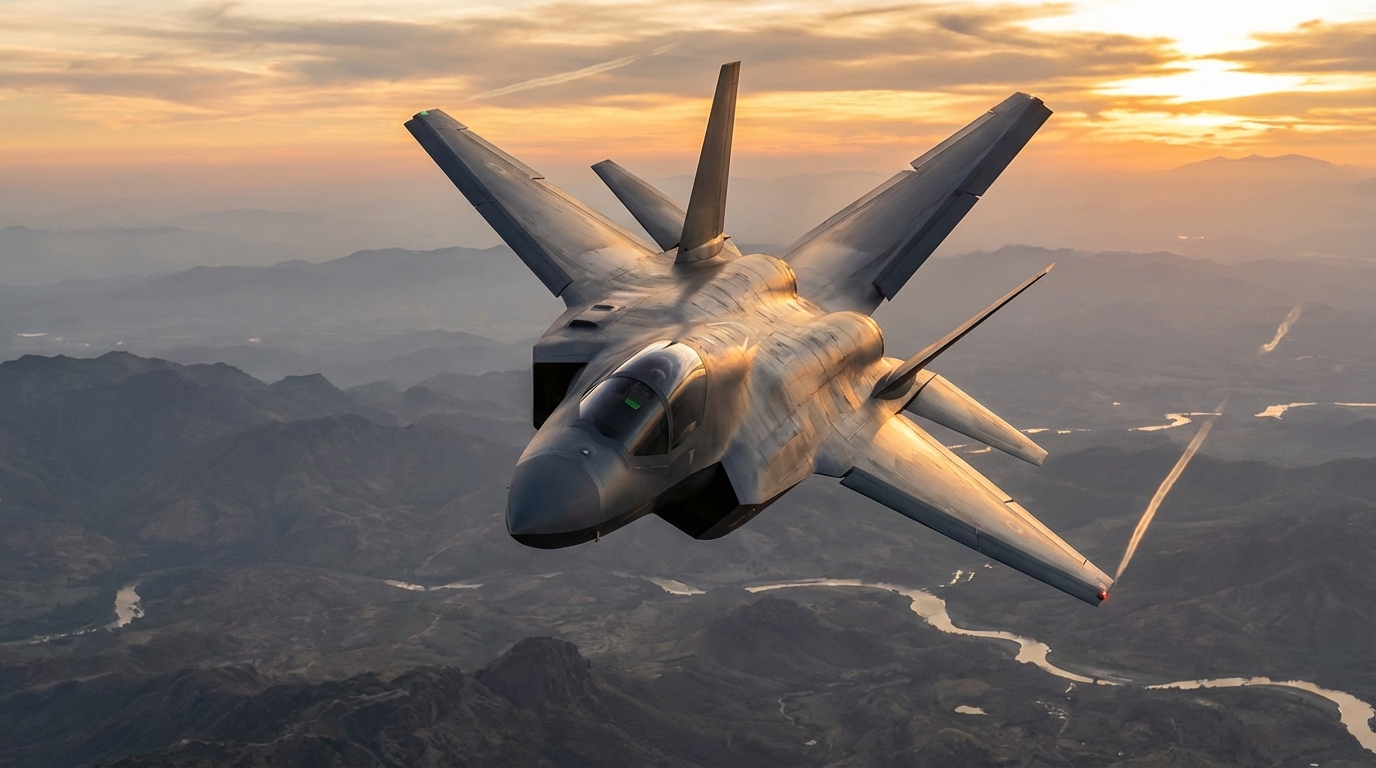
By Ramachandran Rajeev Kumar — 2026-01-30
The Sixth Generation
India's AMCA Program and the Race for Air Supremacy
On May 27, 2025, India formally approved development of the Advanced Medium Combat Aircraft—its first indigenous stealth fighter. But buried within that announcement was something far more significant: DRDO had successfully demonstrated morphing wing technology, a capability mastered by only a handful of nations on Earth.
The AMCA isn't just another fighter jet program. It's India's declaration of aerospace sovereignty in an era where air dominance will be decided not by who flies fastest, but by who thinks fastest.
The Shape-Shifter
In a nondescript facility in Bangalore, engineers at DRDO's Aeronautical Development Establishment achieved what seemed impossible just a decade ago. Using Shape Memory Alloys—lightweight smart metals that contract when heated—they created a wing segment capable of morphing at 35 degrees per second under full aerodynamic load.
Response time: 0.17 seconds from zero to maximum droop.
Energy penalty: Just 5.6% more than fixed wings.
This isn't incremental improvement. This is the kind of breakthrough that separates generations of aircraft. Morphing wings allow real-time geometric adjustments during flight—optimizing for dogfighting one moment, long-range cruise the next, ground attack after that. The pilot doesn't select a mode; the aircraft adapts.
Two Jets, One Vision
The AMCA program actually encompasses two distinct variants:
AMCA Mk-1 arrives first, targeted for production by 2035. Powered by twin GE F414-INS6 engines producing 196 kN of thrust, it's a true fifth-generation stealth fighter with an estimated radar cross-section comparable to the F-35. Internal weapons bays. Serpentine air intakes hiding engine compressor blades. The works.
Estimated unit cost: $40-50 million—roughly half the price of an F-35.
AMCA Mk-2 follows around 2040, and this is where it gets interesting. India is finalizing a $7.2 billion partnership with France to co-develop a sixth-generation engine producing 120 kN thrust. This variant will incorporate directed energy weapons, full autonomous flight capability, and control of 4-6 unmanned loyal wingman drones simultaneously.
The Mk-2 isn't just a fighter. It's a command node for an aerial swarm.
The Global Race
India enters a crowded field. The United States already flew its NGAD demonstrator—now designated F-47—though the program was paused over runaway costs reportedly exceeding $300 million per airframe. China has been photographed testing not one but three sixth-generation prototypes: the tailless, three-engine J-36, the J-50, and what appears to be a loyal wingman drone.
The UK, Italy, and Japan are collaborating on the Tempest program under GCAP, targeting 2035 service entry. Europe's FCAS program, involving France, Germany, and Spain, continues to struggle with political disputes over workshare.
Where does India fit?
On cost, India wins decisively. The combined development budget for the LCA Mk2, naval TEDBF, and AMCA programs totals approximately $4.6 billion—a fraction of what other nations spend on single programs.
On timeline, India trails. First flight isn't expected until 2028-2029, with Mk-1 production beginning in 2035.
But on strategic necessity, India has no choice. The Indian Air Force operates roughly 30 squadrons against a sanctioned strength of 42. MiG-21s and Jaguars are retiring. China is building toward 1,000 J-20 stealth fighters by 2034, while simultaneously testing sixth-generation platforms.
The AMCA isn't optional. It's survival.
The Real Innovation
Perhaps the most significant aspect of AMCA isn't its stealth coating or AI copilot. It's the industrial ecosystem being built around it.
HAL received responses from 28 companies for consortium partnership. A committee chaired by the Defence Secretary is finalizing the production model. Adani, L&T, Tata, Mahindra, and Bharat Forge are all competing for roles in what will become India's largest aerospace manufacturing program.
The planned procurement of 200-250 aircraft over 15 years will create more than 15,000 direct jobs and support over 100 MSMEs in the supply chain.
Technology sovereignty isn't just about building your own jet. It's about controlling the entire value chain—from design to maintenance—so no foreign power can ground your air force with sanctions or export restrictions.
What Comes Next
The first AMCA prototype is scheduled to roll out in late 2026 or early 2027. First flight follows 12-18 months later. Between now and then, India must finalize the French engine partnership, select consortium partners, and build the manufacturing infrastructure.
DRDO Chairman Dr. Samir V. Kamat expects the engine agreement within months. The test facilities are being prepared. The supply chain is mobilizing.
For sixty years, India has depended on foreign fighters—MiGs, Mirages, Sukhois, Rafales. The AMCA represents something different: a platform designed from inception to Indian requirements, built by Indian hands, controlled by Indian interests.
The sixth generation isn't just about technology. It's about who gets to decide what happens in the skies over Asia for the next fifty years.
India has made its choice.
The AMCA program represents India's largest indigenous aerospace development effort. First prototype rollout is expected in late 2026.