By Ramachandran Rajeev Kumar — 2026-02-08
The Dress Rehearsal Nobody Should Ignore
Nine months ago, the Indian Air Force did something it hadn't done in decades: it fought an actual air war. Over 88 hours in May 2025, Operation Sindoor saw Indian missiles flatten nine terrorism-linked targets inside Pakistan and Pakistan-occupied Kashmir, Indian fighters establish air superiority over large swathes of Pakistani airspace, and the Pakistan Air Force lose between four and ten fighter aircraft--including American-supplied F-16s--before Islamabad requested a ceasefire.
Now the IAF is doing something arguably more provocative than the operation itself. On February 27, at the Pokhran Air-to-Ground Range near Jaisalmer, Rajasthan--barely a stone's throw from the Pakistani border--it will conduct Vayu Shakti 2026, its largest firepower demonstration since Sindoor. And this time, it has invited an audience.
The Exercise That Rewrites the Script
Vayu Shakti exercises are not new. The IAF has conducted them periodically in the Thar Desert to showcase firepower and validate doctrine. But Vayu Shakti 2026 is different in three fundamental ways.
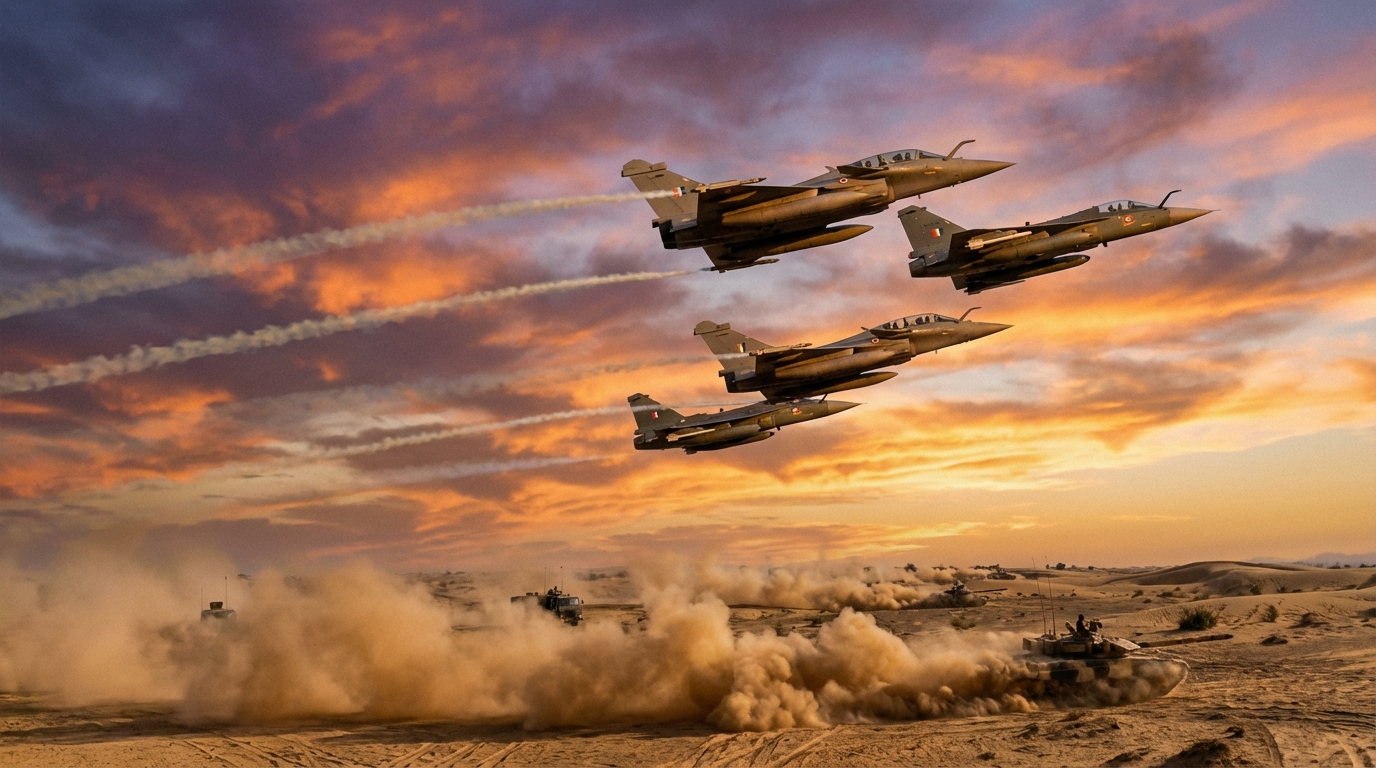
First, it is explicitly modelled on Operation Sindoor. Not inspired by, not vaguely referencing--modelled on. The exercise scenarios, target profiles, and mission packages are being drawn directly from the May 2025 playbook. Almost every aircraft and weapons system that participated in the actual operation will fly in the exercise. This is not a generic war game. This is the IAF rehearsing the specific war it just fought, in full view of the world.
Second, the aircraft roster reads like a catalogue of Indian air power's evolution. Rafale jets, which proved decisive in Sindoor's beyond-visual-range engagements. Sukhoi-30MKIs, the heavy-hitter air dominance platforms. The indigenous Tejas Mark 1, quietly building its combat reputation. MiG-29s, Jaguars, and Mirage-2000s--the workhorses that carried the weight of close air support and deep strike missions. And critically, the Prachand light combat helicopter, which will demonstrate rocket-firing capabilities in a live exercise for the first time.
Third, there is one aircraft conspicuously absent: the MiG-21. After more than five decades of service and a tragic legacy of crashes that earned it the grim nickname "flying coffin," the MiG-21 has been retired from the Indian Air Force. Vayu Shakti 2026 will be the first major IAF exercise in modern history without a single MiG-21 in the sky. The old guard has left the stage. The message is unmistakable.
The Night Assault Card
Among the exercise's planned demonstrations, one detail stands out: the C-295 tactical transport aircraft will perform a night assault landing drill for the first time at a Vayu Shakti exercise.
This matters more than it sounds. Night assault landings involve putting a transport aircraft onto an unprepared or semi-prepared surface in complete darkness, disgorging troops and equipment, and departing before the enemy can react. It is one of the most dangerous and operationally critical manoeuvres in modern air warfare--the kind of capability that turns a defensive air force into an offensive one.
The C-295, built by Airbus and now being manufactured in India by Tata Advanced Systems, replaces the ageing Avro fleet that the IAF operated for decades. Its inclusion in a night assault role at Vayu Shakti signals that the IAF is not merely defending airspace. It is practising the rapid deployment of ground forces deep into contested territory under cover of darkness.
Alongside the C-295, the C-130J Super Hercules--the platform that has become the IAF's special operations workhorse--will also participate, along with Chinook heavy-lift helicopters, Mi-17s, and Advanced Light Helicopters. The exercise integrates drones and loitering munitions that were operationally deployed during Sindoor, adding the unmanned dimension that proved critical in the May operation.
The IACCS Factor
Perhaps the most significant technical detail is that Vayu Shakti 2026 will be monitored and controlled through the Integrated Air Command and Control System--IACCS.
During Operation Sindoor, it was the IACCS that tracked every Pakistani jet, missile, and drone in real time, providing the situational awareness that allowed Indian fighters to establish and maintain air superiority. The system integrates radar feeds, satellite data, electronic warfare inputs, and communications networks into a single operational picture that gives air defence commanders the ability to see the entire battlespace simultaneously.
By running Vayu Shakti through the same IACCS architecture, the IAF is doing two things at once: stress-testing the system in a complex, multi-aircraft environment, and demonstrating to anyone watching that the digital backbone of Operation Sindoor is not a one-time capability but a permanent feature of Indian air operations.
This is the difference between an air force that got lucky in one engagement and an air force that has institutionalised the lessons of war into its command architecture. The IACCS makes the latter case convincingly.
The Audience
Here is where Vayu Shakti 2026 crosses the line from exercise to strategic communication.
Approximately 40 officials from friendly countries' embassies in New Delhi have been invited to attend. In military diplomacy, inviting foreign observers to a firepower demonstration is never casual. It is a calibrated message delivered at the speed of sound.
The invited nations will see, firsthand, what the IAF can put in the sky on short notice. They will see the diversity of platforms--from Western Rafales to Russian-origin Sukhois to indigenous Tejas fighters--operating in a single integrated battlespace. They will see loitering munitions and drones operating alongside manned aircraft. They will see the Prachand firing rockets. And they will connect all of this to what happened nine months ago, when these same platforms delivered real ordnance against real targets across a real border.
For Pakistan, the message is blunt: the operation was not an anomaly. It was a template. For friendly nations--particularly those exploring defence partnerships with India--the message is equally clear: this is what interoperability with India looks like.
The Post-Sindoor IAF
Operation Sindoor did something that decades of procurement debates and parliamentary speeches could not. It validated the Indian Air Force as a combat-tested force with demonstrated beyond-visual-range capability, precision strike capacity, electronic warfare competence, and the command-and-control architecture to fight an air campaign against a nuclear-armed adversary.
The IAF's losses during Sindoor were real--India has acknowledged aircraft losses in the initial phases, a rare and significant admission of transparency. But the Swiss think tank analysis published in late 2025 concluded that the IAF achieved clear air superiority over Pakistan, effectively coercing Islamabad into requesting a ceasefire by the operation's third day.
Vayu Shakti 2026 builds on that foundation. It takes the lessons of a real war and converts them into institutional doctrine, training protocols, and operational readiness. The fact that it is happening at Jaisalmer--closer to Pakistan's border than most Pakistani air bases are to India's--is not lost on anyone.
The Defence Budget Context
This exercise does not happen in a vacuum. India's defence budget for 2026-27 stands at Rs 7.85 lakh crore, a 15.2% year-on-year increase, with capital expenditure surging 20.1% to Rs 2.31 lakh crore. That is the largest defence allocation in Indian history, and a significant portion is earmarked for air force modernisation.
The IAF is in the middle of its most aggressive procurement cycle in decades. Additional Rafale orders are under negotiation. The Tejas Mark 2 programme is accelerating. The Advanced Medium Combat Aircraft--India's fifth-generation fighter programme--is moving from design to prototype. The S-400 air defence system, already operational, adds a defensive umbrella that extends deep into Pakistani airspace.
Vayu Shakti 2026 is the physical manifestation of what those budget numbers mean. It is not a paper exercise or a procurement wish list. It is over 100 aircraft in the sky, firing live ordnance, rehearsing the war they just fought, controlled by the system that won that war.
What Happens on February 27
When the first Rafale screams across the Pokhran range at low altitude, releasing precision-guided munitions onto simulated targets, the assembled diplomats will reach for their phones. When the Prachand demonstrates its rocket-firing capability, the defence attaches will begin drafting cables to their capitals. When the C-295 touches down in darkness on an unprepared strip, the message will be impossible to misread.
India's Air Force is not resting on the laurels of Operation Sindoor. It is codifying the operation into repeatable doctrine, validating it in full-scale exercises, and advertising the result to the world. The dress rehearsal is, in many ways, more revealing than the performance itself--because it shows this is not improvisation. It is institutionalised capability.
The last time India demonstrated air power on this scale, it was across a border, at night, with real consequences. This time, the consequences are purely diplomatic. But in the grammar of military signalling, Vayu Shakti 2026 says what needs to be said.
The IAF has been to war. It has come back. And it is rehearsing.