By BarathVector Editorial — 2026-03-07
The Silicon Promise: Forty Years of Announcing Chip Fabs
Part 3 of "The Delivery Deficit" series
By BarathVector Editorial | March 7, 2026
In 1983, the Government of India established the Semiconductor Complex Limited in Mohali, Punjab. It was a visionary move -- one of the first dedicated semiconductor facilities in the developing world. India, under Indira Gandhi's government and later accelerated by Rajiv Gandhi's technology-forward vision, recognised that chips would define the future.
Four years later, in 1987, Morris Chang founded TSMC in Hsinchu, Taiwan.
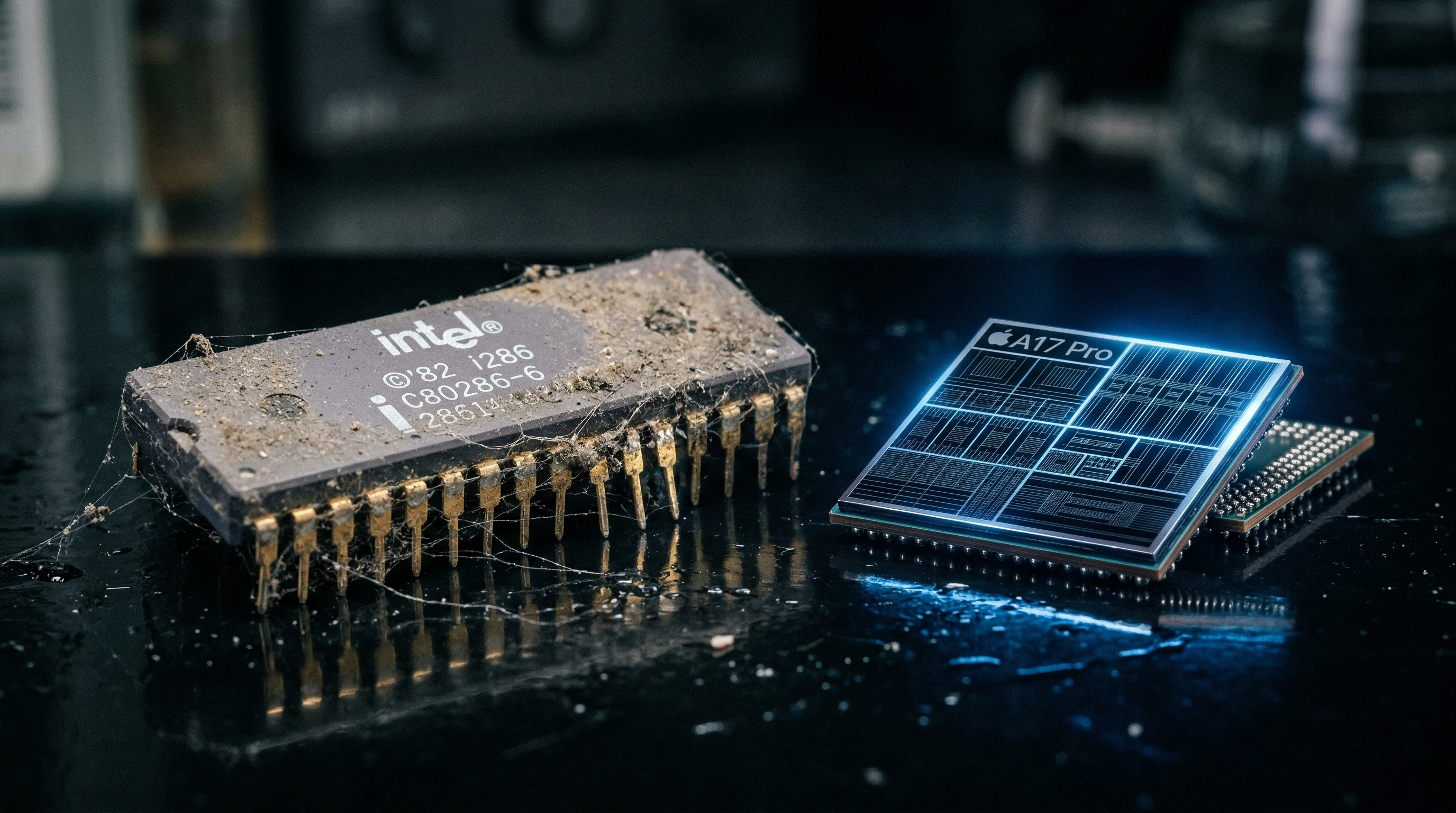
Forty years on, TSMC is the most strategically important company on earth, fabricating over 90 per cent of the world's most advanced semiconductors at geometries of 3 nanometres and below. Its market capitalisation exceeds one trillion dollars. Nations court it. Presidents call its chairman.
SCL Mohali fabricates chips at 180 nanometres -- a node the rest of the world retired before the first iPhone was sold. It serves ISRO and the defence establishment with the technological equivalent of a rotary phone in a smartphone age. Its clean room was destroyed by fire in 1989 and rebuilt, slowly, without ever being upgraded to competitive geometries.
The same country. The same starting decade. Opposite outcomes.
The Graveyard of Announcements
The history of India's semiconductor ambitions reads like a chronicle of funerals:
2007: SemIndia proposes a USD 3 billion fab in Hyderabad. It collapses -- unable to secure financing, land, or sustained government commitment.
2014: Jaiprakash Associates and IBM consortium announce a fab in Uttar Pradesh. It evaporates -- a casualty of land acquisition complexity and shifting political priorities.
2014-15: HSMC (Hindustan Semiconductor Manufacturing Corporation) is announced with considerable fanfare and a Hebrew-Indian partnership narrative. It goes nowhere -- mired in disputes over technology transfer and funding.
2020: The government announces the India Semiconductor Mission with a Rs 76,000 crore incentive package. Applications are invited. Proposals are submitted. Evaluation takes years.
2023: Micron announces a USD 2.75 billion facility in Gujarat -- an assembly, testing, and packaging (ATP) plant. It is celebrated as India's semiconductor moment. It is not fabrication.
2024-25: Tata Electronics announces a fab with Taiwan's PSMC in Dholera, targeting 28nm to 110nm wafers. Ground has been broken. Production is "slated for 2026." As of March 2026, the plant needs to move from "advanced discussions" to actual commercial output.
Each announcement followed the same arc: political fanfare, international media coverage, confident timelines -- and then silence, delay, or quiet redefinition of what "semiconductor manufacturing" means.
The Rs 1,000 Crore Question
The Union Budget 2026 allocated Rs 1,000 crore for India Semiconductor Mission 2.0. The mission's stated shift -- from assembly to full-scale manufacturing, equipment production, and ecosystem development -- is directionally correct.
But Rs 1,000 crore is approximately USD 115 million.
For context:
- TSMC's 2025 capital expenditure: USD 30 billion
- Intel's fab investments across the US and Europe: USD 100+ billion over the decade
- South Korea's semiconductor support package: USD 470+ billion
- Samsung's semiconductor capex in 2025: USD 37 billion
India's Rs 1,000 crore does not appear on the same chart as these numbers. It does not appear on the same planet. It is a rounding error in the ledgers of nations that actually fabricate chips.
The ten approved semiconductor projects, representing Rs 1.60 lakh crore in total investment, are more meaningful. But the majority of this investment is in assembly, testing, and packaging -- the lower-value segments of the semiconductor chain. India is entering the supply chain from the bottom, at precisely the moment when the technopolar order is being determined by whoever controls the top.
What Went Wrong
Three structural failures explain the gap:
Patient capital. Semiconductor fabs take 10-15 years to reach profitability. Indian electoral cycles run on five-year horizons. No government wants to commit tens of billions to a project whose ribbon-cutting will happen under a successor's watch. Taiwan's ITRI incubated TSMC for fifteen years of consistent support. India's semiconductor policy has been rewritten, renamed, and relaunched at least six times since the 1990s.
Technical literacy at the decision-making level. When politicians approve a highway, they can drive on a highway. When they approve a hospital, they have visited a hospital. When they approve a 5nm fab proposal, they are evaluating something they have never seen, cannot visualise, and whose economics they must accept on faith from consultants. The result is either paralysis (nothing gets approved) or gullibility (the wrong things get approved for the wrong reasons).
The software seduction. The 1991 liberalisation made a fateful choice: software over hardware. Services over manufacturing. The logic was irresistible -- software required minimal capital, India had English-speaking engineers, and margins were extraordinary. Bangalore became a global back office. Nobody asked who would make the chips the back office ran on.
The Honest Assessment
India's semiconductor ecosystem is not zero. Micron is operational. Tata is building. Kaynes and CG Power are entering the space. The India Semiconductor Mission exists. Talent is available -- Indian-origin engineers lead semiconductor companies worldwide.
But the gap between announcement and fabrication is measured in nanometres and decades. India is not fabricating 3nm or 5nm chips. It will not fabricate them this decade. The assembly plants coming online are necessary but not sufficient. And the funding levels -- however improved -- remain orders of magnitude below what is required for sovereign chip capability.
India's semiconductor story is not one of absence. It is one of chronic insufficiency -- of doing just enough to announce progress, never enough to achieve it.
The silicon has been promised for forty years. The promise remains unfabricated.
This is Part 3 of "The Delivery Deficit" series examining India's announcement-execution gap.
Sources: Carnegie Endowment, CSIS, Techovedas, India Semiconductor Mission, Trading Economics