By Ramachandran Rajeev Kumar — 2026-01-16
By Ramachandran Rajeev Kumar
The Numbers That Should Terrify You
Taiwan started its semiconductor journey in 1974. By 2007—33 years later—it became the world's second-largest microchip supplier. Today, TSMC alone accounts for 60% of global foundry revenue.
South Korea started in the 1980s. It took Samsung and SK Hynix 30+ years to reach global leadership in memory chips.
China has spent over $150 billion in the last decade trying to catch up. It still trails Taiwan and Korea by two generations in cutting-edge chips.
India's Semiconductor Mission launched on December 15, 2021.
We're 4 years in. And we're already declaring victory.
What We've Actually Achieved
Let's be honest about where we stand in January 2026:
The "Wins"
1. Micron (USA) - Packaging, Not Fabrication
- $2.75 billion ATMP facility in Gujarat
- Packages and tests chips—doesn't make them
- Target: 6.3 million chips per day by January 2026
- First packaged chip shipped October 2025
2. Tata + PSMC (Taiwan's Minor League)
- $10 billion fab in Dholera, Gujarat
- Partner: PSMC (Powerchip), not TSMC
- Target: 50,000 wafers/month starting 2027
- Making 28nm-110nm chips—technology from 2010-2000
3. Foxconn + HCL Joint Venture
- ₹3,700 crore ($446 million) fab in UP
- High-voltage chips (650V-3,300V)
- Specialty application, not mainstream chips
4. Kaynes Semicon
- First commercial shipment: 900 multi-chip modules, October 2025
- Small scale, niche market
The Reality Check
Sounds impressive—until you realize:
- TSMC's single Arizona fab: $40 billion
- Intel's Ohio facility: $20 billion
- China's annual semiconductor investment: $30 billion+
We're celebrating $18B. The big boys spend that on one advanced fab.
The Taiwan Problem: Why TSMC Won't Come
Here's what nobody wants to admit: Participation from Taiwan's TSMC and South Korea's Samsung is not yet anticipated, though India is in plans to partner with TSMC.
Translation: TSMC isn't coming. Samsung isn't coming. We got PSMC—Taiwan's seventh-largest foundry—and declared victory.
Why Taiwan's Giants Say No
1. Cumbersome Administrative Structures Every approval requires 17 ministries, 42 clearances, and infinite patience. Taiwan's companies are used to "single window" systems where approvals take weeks, not years.
2. Lack of Experienced Engineers India has brilliant chip designers (Qualcomm, Intel, Nvidia employ thousands here). But fabrication engineers—the specialists who run fabs—are rare. Taiwan offers advanced courses in nano-engineering and chip design, but India hasn't built equivalent programs at scale.
3. High Tariffs on Electronics Component Imports Fabs need hundreds of specialized components—high-purity gases, photolithography chemicals, precision equipment. India's import duties make these 20-30% more expensive than Taiwan or China.
4. Inadequate Infrastructure This is the killer.
India's status:
- Power: Frequent voltage fluctuations in industrial zones. Fabs need rock-stable 24/7 supply.
- Water: Chip-making requires gallons of ultrapure water daily. Gujarat's water scarcity is well-documented.
- Cleanrooms: Only a handful of Indian industrial zones approach "fab-ready" standards.
- Supply Chain: India still faces an underdeveloped supply chain for crucial raw materials like silicon wafers and high-purity gases.
5. Complex Labor Laws, Environmental Regulations, Import/Export Restrictions Taiwanese companies are hesitant to invest in India due to these regulatory burdens.
What Taiwan Did Right (And We Haven't)
Taiwan didn't become Silicon Island by accident. Here's the playbook:
1. Government Commitment—Actual, Not Rhetorical
In 1974, Taiwan's government launched the RCA Project, facilitating critical technology transfer from the U.S. They didn't just offer subsidies—they sent engineers to RCA in New Jersey for two years, learned the technology, brought it back, and built a demonstration fab at ITRI.
By end of 1977, the fab had 70% yield rate—surpassing RCA's own facilities.
India's approach? Subsidies and hoping foreign companies will teach us.
2. Talent Pipeline—Built Systematically
Taiwan created specialized semiconductor engineering programs in the 1980s. Every major university taught cleanroom processes, lithography, yield optimization.
India's Chips to Startup (C2S) Program aims to train 85,000 engineers—but it started in 2024, three years after the Semiconductor Mission launched. We're training engineers for fabs that don't exist yet.
3. Infrastructure—Built Before Fabs, Not After
Taiwan built Hsinchu Science Park in 1980—before major fabs arrived. Guaranteed power, water, cleanrooms, specialized logistics. Companies could move in and start manufacturing immediately.
India announced fabs in 2023 and is still building infrastructure around them. Dholera is a greenfield site—no power substation, no water treatment plant, no worker housing when Tata announced the project.
4. Supply Chain Ecosystem—Developed Locally
Taiwan didn't wait for global suppliers. It built a domestic ecosystem:
- Chemical suppliers for photoresists and etchants
- Equipment maintenance firms
- Packaging and testing companies
- Logistics specialists for cleanroom transport
For semiconductor fabs to succeed, they require numerous suppliers for raw materials and components, as well as an unlimited power supply. India is still importing 90%+ of these from Taiwan, Korea, and Japan.
The 7 Things India Must Fix—Now
If we're serious about attracting Taiwan's big players (or at least keeping PSMC happy), here's what must change:
1. Single-Window Clearance—For Real This Time
Current Reality: Cumbersome administrative structures slow every decision.
What Taiwan Sees: Apply for fab approval in Taiwan → 6 weeks. Apply in India → 6 months (if you're lucky).
Fix: Create a Semiconductor Fast-Track Authority with:
- Single point of contact for all approvals
- 30-day approval timeline (legally mandated)
- Authority to override state and central bureaucracy
- Penalties for officials who delay
Model it on Singapore's Economic Development Board—which can green-light a $5 billion fab in 45 days.
2. Unified Incentive Package—Stop Fragmented Negotiations
India needs to present investors with a seamless term sheet that combines ISM incentives, state-level subsidies, and committed utility access, avoiding the fragmented negotiations that slow project closure.
Current Problem: Companies negotiate with:
- Central government (ISM subsidy)
- State government (land, power, water)
- Multiple ministries (import duties, environmental clearance, labor permits)
Each entity makes separate promises. Nothing is binding until all sign. Timeline: infinite.
Fix: One contract, three signatures (ISM, state, company). Everything else pre-approved.
3. Zero Import Duties on Fab Equipment and Materials
High tariffs on electronics component imports hurt competitiveness.
Reality: A lithography machine costs $150 million. Add 20% import duty = $180 million. Your competitor in Taiwan pays $150 million.
Fix: Exempt all semiconductor manufacturing equipment and materials from import duties—permanently. We're not "protecting" any domestic industry (we have none). We're just making ourselves uncompetitive.
4. Fab-Ready Industrial Parks—Build Before Announcing Projects
Current Approach: Announce fab → scramble to build infrastructure → delay by 2-3 years.
Taiwan's Approach: Build infrastructure → invite companies → start production in 18 months.
Fix: Designate 5 "Semiconductor Zones" with:
- Guaranteed 24/7 stable power (99.99% uptime)
- Ultrapure water treatment plants (capacity: 50,000 wafers/month minimum)
- Class 1 cleanroom-ready buildings
- Specialized chemical storage and transport infrastructure
- Worker housing within 10km
Build these first. Then invite companies.
5. Talent Development—Technical Collaborations with Taiwan
Accelerate This:
- Send 1,000 Indian engineers to Taiwan annually for 2-year fab training programs (government-funded)
- Invite Taiwanese professors to set up semiconductor engineering departments at IITs and NITs
- Create "Taiwan-India Semiconductor Institute" modeled on ITRI (Industrial Technology Research Institute)
Goal: 10,000 fab-ready engineers by 2028. Not designers—fabrication specialists who know yield optimization, defect analysis, and cleanroom protocols.
6. Supply Chain Localization Incentives
Fix: Create a Semiconductor Supply Chain PLI Scheme for:
- High-purity gas suppliers (nitrogen, argon, hydrogen fluoride)
- Photoresist and chemical suppliers
- Silicon wafer producers
- Packaging material manufacturers
Incentive: 50% capital subsidy for first 5 companies in each category.
By 2030, we should source 50% of inputs domestically. Right now it's <10%.
7. Regulatory Streamlining—Environmental and Labor
Taiwanese companies are hesitant to invest due to complex labor laws, environmental regulations.
Specific Fixes:
- Environmental clearance: Pre-approve all semiconductor projects under "strategic industry" category (like defense). Monitoring continues, but no delays.
- Labor laws: Create special "Semiconductor Economic Zones" with flexible labor laws (like SEZs for IT). Not exploitative—just predictable.
- Import/export: Semiconductor components should be exempt from routine customs inspections. Every hour stuck in customs is yield lost.
The Realistic Timeline
Let's be brutally honest about what's achievable:
By 2027:
- Micron's packaging facility at full capacity
- Tata's PSMC fab producing 28nm chips (legacy technology)
- India becomes a backend player (packaging, testing, older chips)
By 2030:
- If we fix infrastructure and talent: 2-3 more fabs operational
- Still making legacy chips (28nm-65nm)—profitable, but not cutting-edge
- Supply chain 40-50% localized
By 2035:
- Optimistic scenario: One advanced fab (7nm-14nm) operational if TSMC/Samsung finally commits
- India captures 5-8% of global semiconductor manufacturing
- Realistic scenario: We're a strong player in mature nodes and packaging, but not competing with Taiwan/Korea/China in advanced chips
The Truth: Taiwan took 33 years (1974-2007) to reach global leadership. We're not leapfrogging that timeline. The best we can do is accelerate by learning from their playbook.
The Choice: Be Taiwan or Be Vietnam?
Two models for late-stage semiconductor entrants:
Model 1: Taiwan (Fab Powerhouse)
- Control cutting-edge manufacturing
- Capture high margins
- Takes 30-40 years, $200B+ investment, massive government commitment
Model 2: Vietnam (Packaging Hub)
- Focus on backend (packaging, testing)
- Attract assembly operations from Intel, Samsung
- Takes 10-15 years, $30-50B investment, emphasis on infrastructure and labor
India is trying Model 1 with Model 2 resources.
Recommendation: Do both—but sequence correctly.
2025-2030: Vietnam Model
- Perfect packaging and testing (Micron pathway)
- Build fab infrastructure and train engineers
- Attract more backend operations
2030-2040: Taiwan Model
- Leverage backend experience to move into fabrication
- Start with mature nodes, graduate to advanced
- By 2040, compete in cutting-edge if we execute flawlessly
Trying to do advanced fabs immediately = failure. We don't have the talent, infrastructure, or supply chain.
The Political Reality Nobody Discusses
Here's the inconvenient truth: Semiconductors are a geopolitical weapon, not just an industry.
Taiwan controls 60% of global chip production. China wants to invade Taiwan. The U.S. wants to diversify supply chains. India is useful—but we're not replacing Taiwan.
What this means:
- The U.S. will support our packaging and legacy fab efforts (reduces China dependence)
- The U.S. will not allow cutting-edge technology transfer to India (we're not a treaty ally)
- Taiwan will send PSMC and smaller players (keeps India friendly, doesn't threaten Taiwan's dominance)
- Taiwan will not send TSMC (that's their insurance policy against China)
Conclusion: India can become a strong secondary player—not the leader. And that's fine. 8% of global semiconductor manufacturing = $60B annual revenue = 500,000 jobs. That's worth chasing.
But let's stop pretending TSMC is coming. They're not.
The Brutal Summary
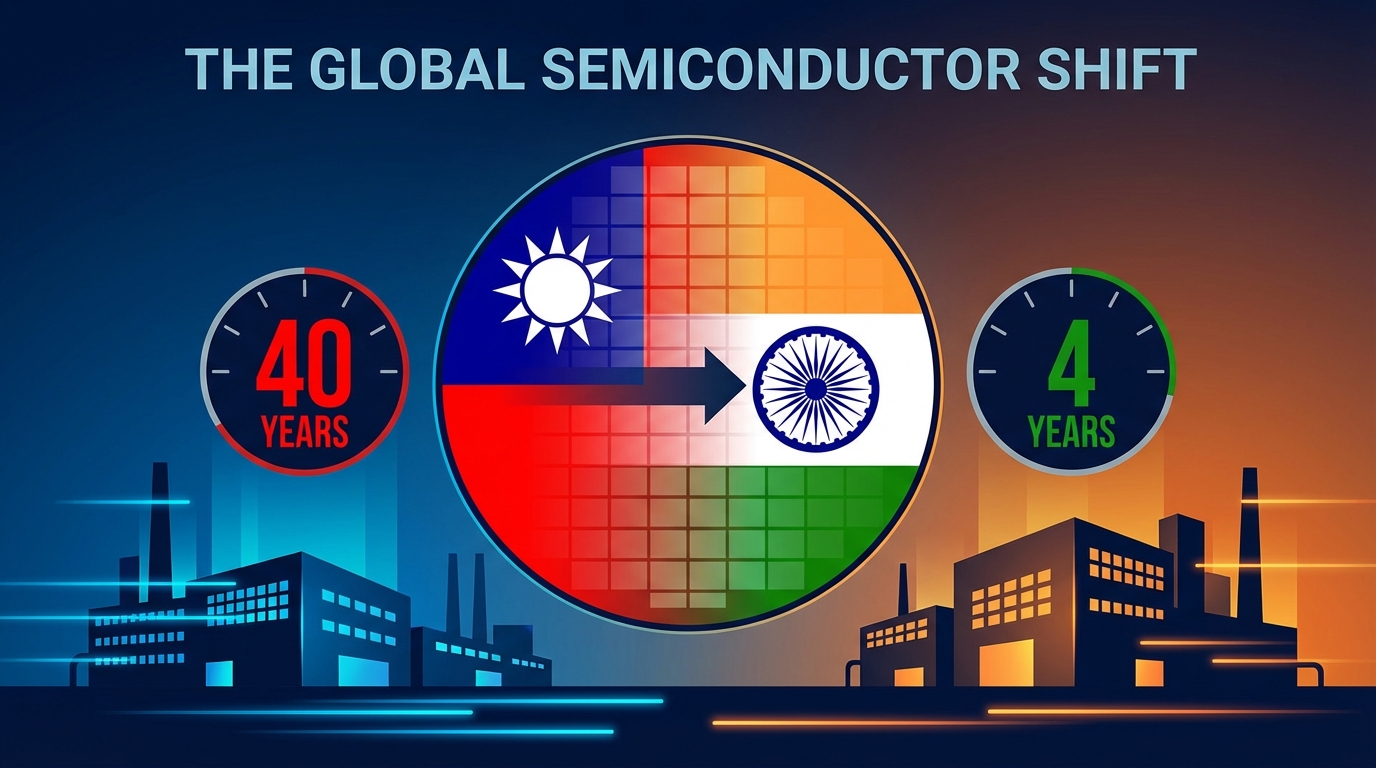
Where We Are: 4 years into a 40-year journey, celebrating packaging plants and legacy fabs.
Where We're Headed: Respectable backend player by 2030 if we fix infrastructure, talent, and regulatory issues. Marginal fabrication player by 2035.
Where We Could Be: Significant global player by 2040 if we stop overpromising, start executing, and accept that Taiwan's playbook takes decades—not years.
What We Must Do Now:
- Fix infrastructure (power, water, cleanrooms) before announcing more fabs
- Train 10,000 fab engineers through Taiwan partnerships
- Streamline regulations to Taiwan/Singapore speed
- Zero import duties on semiconductor equipment
- Build domestic supply chain with aggressive subsidies
- Accept we're building for 2035-2040, not 2027
The Mantra: Under-promise. Over-deliver. Stop chasing TSMC. Make PSMC successful. The rest will follow.
Sources:
- Al Jazeera: Can India catch up in the global chip race?
- Carnegie Endowment: Taiwan-India Chips Cooperation
- Global Taiwan Institute: Beyond the Strait - Taiwan's Role in India's Semiconductor Rise
- CSIS: Semiconductor Clusters in India
- Wikipedia: Semiconductor industry in Taiwan
- Taiwan Insight: Short History of Semiconductor Technology in Taiwan
- Modern Diplomacy: India's Semiconductor Dream
- Drishti IAS: Modified Incentive Scheme for Semiconductor Chip-Making
Ramachandran Rajeev Kumar is the founder of BarathVector. Agree? Disagree? The debate continues in the comments.