By BarathVector Editorial — 2026-03-07
The Self-Reported Shield: Defence Indigenisation's Audit Gap
Part 5 of "The Delivery Deficit" series
By BarathVector Editorial | March 7, 2026
There are two ways to read India's defence story. Both are true. They are also irreconcilable.
Story One: India's defence production has grown from Rs 46,429 crore in 2014-15 to over Rs 1.5 lakh crore in 2025 -- a tripling in a decade. Defence exports have surged thirtyfold, crossing Rs 23,622 crore in 2024-25, reaching over 100 countries. The Tejas light combat aircraft is operational. The Pinaka multi-barrel rocket launcher is battle-tested. BrahMos missiles are being exported to the Philippines, Vietnam, and beyond. India has moved from being purely a buyer to being a credible seller of defence equipment.
Story Two: India remains the largest arms importer in the world, accounting for 11 per cent of global arms imports during 2018-22 according to SIPRI. In 2023-24, India imported significant quantities of combat aircraft, submarines, air defence systems, and naval platforms from Russia, France, the United States, and Israel. The S-400 missile system, Rafale fighters, P-8I maritime patrol aircraft, and Scorpene submarines -- the backbone of India's current military modernisation -- are all imports.
Both stories are documented. Neither is exaggerated. Together, they describe a nation that has made genuine progress in defence manufacturing while remaining fundamentally dependent on foreign platforms for its most critical military capabilities.
The Audit Problem
The draft Defence Acquisition Procedure 2026, released in February 2026, contains a quiet but devastating admission. It shifts the framework from "Made in India" to "Owned by India" -- from where equipment is assembled to who owns its design, intellectual property, and source code.
This shift implicitly acknowledges what defence analysts have said for years: under the previous framework (DAP 2020), indigenous content claims were largely self-reported. Manufacturers declared their own indigenisation percentages. There was no rigorous, independent audit mechanism to verify these claims. A company could import components, assemble them in India, and declare the product "indigenous" under Buy (Indian) category without meaningful scrutiny.
The new framework attempts to close this gap by emphasising intellectual property ownership, design rights, and source code control. It introduces categories like "Buy (Indian-Owned Design)" and requires demonstrable ownership of core technology, not just final assembly location.
This is progress. It is also an admission that the previous decade's indigenisation numbers were, at minimum, unverified -- and at maximum, inflated.
The Platform Dependency
Consider the Indian Air Force. Its frontline combat fleet in 2026 comprises:
- Rafale -- French (Dassault)
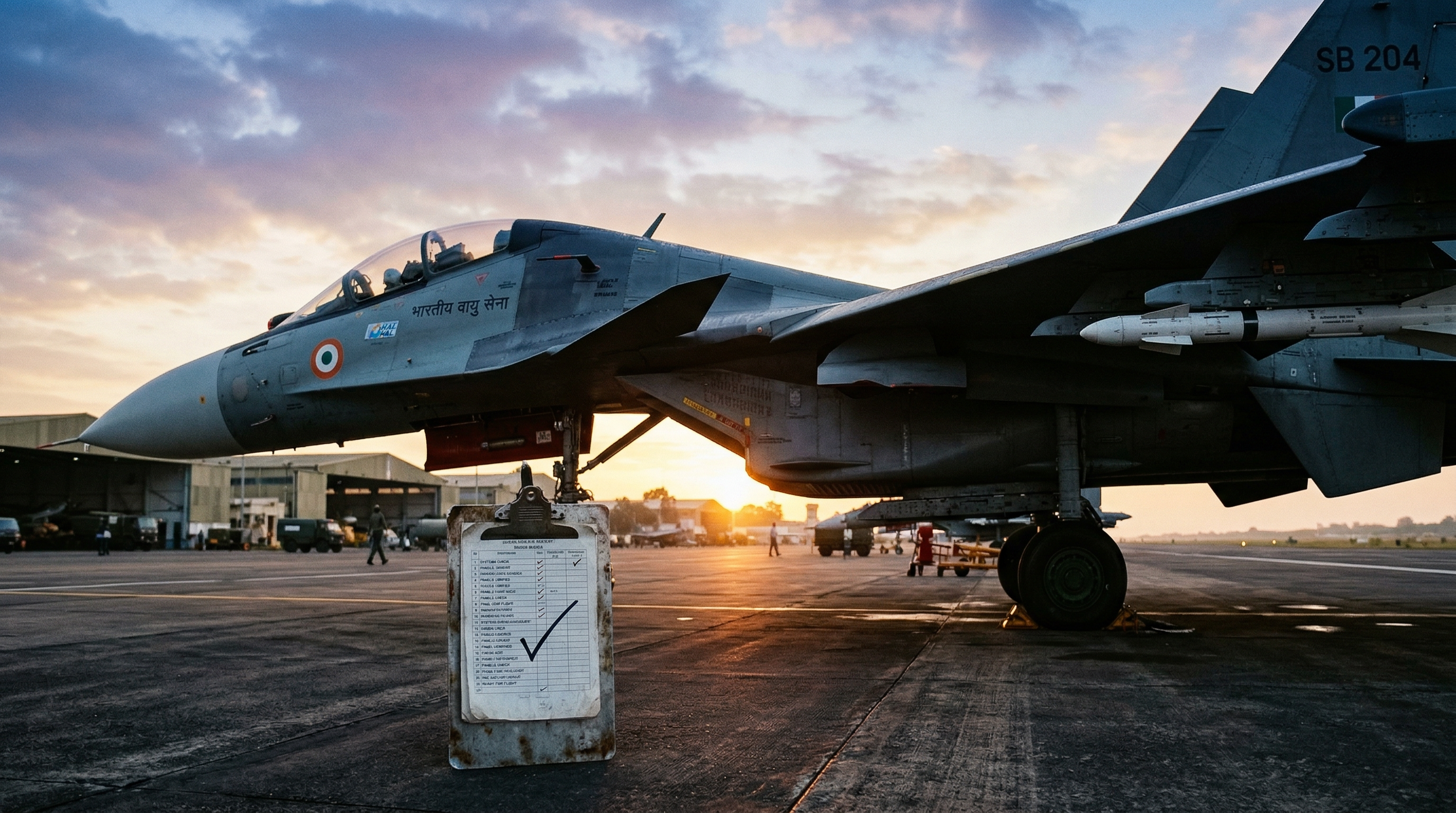
- Su-30MKI -- Russian (Sukhoi), licensed production by HAL
- Tejas Mk1 -- Indigenous (HAL), but with a GE F404 engine (American), Elta radar (Israeli), and Martin-Baker ejection seats (British)
- MiG-29 -- Russian
- Mirage 2000 -- French
The Tejas is genuinely indigenous in airframe design. Its engine is not. Its radar was not (until the AESA radar development programme). Its ejection seats are not. Indigenous content in defence is not a binary. It is a spectrum. And India sits further down that spectrum than official claims suggest.
The AMCA (Advanced Medium Combat Aircraft) -- India's fifth-generation fighter programme -- is in development. It will be a genuine leap if delivered. It is also at least a decade from operational induction, and it will likely depend on a foreign engine (Safran, in current negotiations) for its initial variants.
The Thirtyfold Export Story
Defence exports are the brightest spot in the Atmanirbhar narrative, and they deserve credit. India has gone from a negligible exporter to a credible one. BrahMos to the Philippines. Tejas interest from multiple countries. Akash missile system exports. The Defence India Startup Challenge has produced companies like Tonbo Imaging and Grene Robotics that are globally competitive.
But context matters. India's Rs 23,622 crore in defence exports (roughly USD 2.7 billion) represents a fraction of the global arms trade. The United States exported USD 238 billion in arms agreements in 2023. Russia, France, and the UK each export significantly more than India. The thirtyfold growth is real -- from a near-zero base. In absolute terms, India remains a minor exporter relative to its ambitions.
The Budget Signal
The FY2026-27 defence budget of Rs 7.85 lakh crore is the highest ever. The capital allocation for modernisation -- Rs 2,19,306 crore -- signals serious intent. But how much of that capital allocation flows to indigenous producers versus foreign OEMs?
The answer is not transparently available. Defence procurement data in India is classified or opaque. The proportion of capital expenditure going to imports versus domestic procurement is not published in a format that allows independent verification. This opacity is itself part of the problem. A nation claiming self-reliance should be willing to publish, in clear terms, what percentage of its military equipment spending goes to domestic producers versus foreign ones.
The Honest Assessment
India's defence sector has improved more than perhaps any other domain covered in this series. The growth is real. The exports are real. The policy direction is correct. The private sector is being allowed to participate in ways that were unthinkable two decades ago.
But "improved" is not "self-reliant." India remains dependent on foreign platforms for its most critical capabilities. The indigenisation metrics of the previous decade were self-reported and unaudited. The world's largest arms importer cannot credibly claim Atmanirbhar status without closing the gap between rhetoric and independently verified reality.
DAP 2026's shift from "Made in India" to "Owned by India" is the right move. It is also an implicit confession that what came before was not enough.
This is Part 5 of "The Delivery Deficit" series examining India's announcement-execution gap.
Sources: ORF, SIPRI, Indian Defence News, PIB India, Outlook Business