By Ramachandran Rajeev Kumar — 2026-02-28
The Roadshow Trap: When the PM's Motorcade Overshadows His Milestones
By Ramachandran Rajeev Kumar
On February 28, Narendra Modi landed in Ahmedabad to inaugurate one of the most consequential industrial facilities in India's post-independence history -- Micron Technology's semiconductor ATMP plant in Sanand, a Rs 22,516 crore facility that will produce memory chips on Indian soil for the first time. The plant will house half a million square feet of cleanroom space, create 5,000 direct jobs, and mark India's genuine entry into the global semiconductor supply chain.
It was the kind of deliverable that speaks for itself. The kind of milestone that editorial boards, market analysts, and foreign investors would have amplified without any help from the BJP's event management machinery.
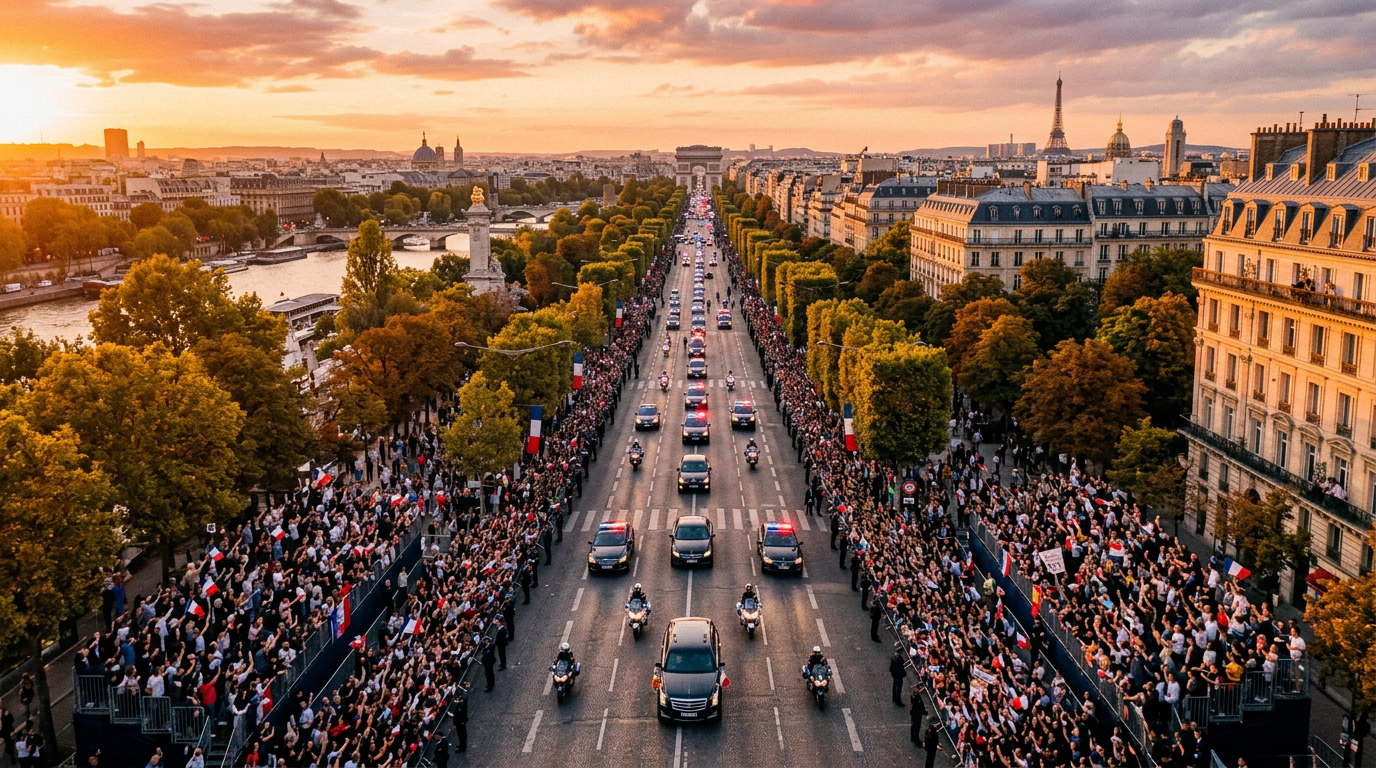
Instead, the Prime Minister held a roadshow.
Flowers were showered. Flags were waved. Crowds lined the Sanand GIDC route. The visuals were, as always, spectacular. And as always, the spectacle consumed the headline -- not the semiconductor.
This is the roadshow trap. And a Prime Minister in his third term should know better than to walk into it.
The Deliverable That Needed No Decoration
Let us be clear about what happened in Sanand. India's first operational semiconductor unit -- approved under the India Semiconductor Mission, backed by 50 percent fiscal support from the Union Cabinet, and built by a company that manufactures memory for half the world's devices -- began its journey toward commercial production. Micron's ATMP facility will process advanced DRAM and NAND wafers shipped from its global factories and convert them into finished memory products. SSD drives. RAM modules. The silicon backbone of the digital economy.
This is not a foundation stone ceremony. This is not a promise. This is a factory, built, equipped, and staffed with 2,000 workers already on the floor.
In any rational information economy, this should have been the story of the week. Electronics manufacturing in India has grown nearly six-fold in the past decade. Mobile phone production has surged 28 times. Exports have risen a hundredfold. The Sanand plant is the logical next chapter in that trajectory -- and a vindication of the Make in India programme that critics have long dismissed as sloganeering.
The roadshow buried all of it beneath confetti.
The Bandwidth Argument
Here is the uncomfortable arithmetic that no one in the BJP's war room wants to confront: a Prime Minister's time is finite, and every hour spent on a motorcade is an hour not spent governing.
Modi's schedule on February 28 alone illustrates the problem. After Gujarat, he was scheduled to fly to Tamil Nadu for an overnight halt before a packed March 1 itinerary -- the inauguration of AIIMS Madurai's first phase, the launch of Rs 4,400 crore worth of infrastructure projects, the dedication of eight upgraded railway stations under the Amrit Bharat scheme, the unveiling of the 750-acre Karasur-Sedarapet Industrial Estate in Puducherry, and a public address. Then on to Puducherry for Rs 2,700 crore more in project launches, electric buses, smart city infrastructure, and affordable housing.
That is governance. That is the tangible machinery of a developing nation being assembled, piece by piece, by a Prime Minister who -- when he is not in a motorcade -- clearly understands what needs building.
The question is not whether Modi can do both. He evidently can. The question is whether he should. Whether the two hours consumed by a Sanand roadshow -- the security arrangements, the route clearances, the crowd management, the event choreography -- could have been spent in a longer, more substantive engagement with Micron's leadership, with semiconductor policy advisors, with the state officials responsible for replicating the Sanand model elsewhere.
Lee Kuan Yew did not hold roadshows. He held briefings. He held policy reviews. He held foreign investors to account in meetings that ran until the details were right. Singapore's transformation was not televised through motorcades -- it was built in conference rooms where a head of state demanded precision from every minister and every contractor.
The comparison is not entirely fair. India is not Singapore. India's democratic scale demands visibility, accessibility, and the occasionally theatrical reassurance that the man in charge is present. But there is a spectrum between invisibility and spectacle -- and Modi, at this stage of his tenure, has more to gain from the former.
The Optics Paradox
There is an irony embedded in the BJP's reliance on roadshows that the party's own strategists should examine. Modi is popular. Genuinely, measurably, historically popular. He commands approval ratings that most democratic leaders would regard as fictional. He has won three consecutive general elections. He addressed the Israeli Knesset three days before this roadshow -- the first Indian PM to do so -- and received a standing ovation and the Knesset Medal.
A leader at this level of political dominance does not need roadshows to demonstrate popularity. The roadshow, in fact, does the opposite of what it intends. It signals that the party still operates in campaign mode -- that the machinery of electoral mobilisation has not been stood down even in the absence of an imminent election.
Gujarat's next assembly election is not until December 2027. The Lok Sabha polls are in 2029. The Rajya Sabha elections on March 16 are procedural, not theatrical. There is no electoral fire that requires the PM to be out on a motorcade in Sanand on a Saturday afternoon.
What the roadshow does communicate -- to opposition parties, to media, to foreign observers -- is that the BJP treats governance events as campaign opportunities. Every inauguration becomes a rally. Every policy launch becomes a photo opportunity. Every deliverable is wrapped in the aesthetics of a political event rather than presented as the sober output of administrative competence.
This is a choice. And it is the wrong one.
What Results Sound Like
The four state assembly elections scheduled for 2026 -- Assam, Kerala, Tamil Nadu, and West Bengal -- will test the BJP's southern and eastern strategies. Tamil Nadu, in particular, is the battleground where the AIIMS Madurai inauguration carries genuine political weight. Chief Minister M.K. Stalin has criticised the Centre for years over the facility's delays. The NDA wants to convert that inauguration into political capital.
Fair enough. But the most effective political capital is not generated by rallies. It is generated by the facility actually working. By students moving from the temporary Ramanathapuram campus to the permanent Madurai campus. By OPDs opening. By the first patients being treated. By the academic session beginning. Those outcomes -- visible, felt, reported by local media and experienced by local families -- will do more for the BJP in Tamil Nadu than any stage, any podium, any motorcade.
Consider the semiconductor story again. When Micron's Sanand plant begins shipping finished memory products -- when "Made in India" appears on an SSD drive for the first time -- that will be a national event that no opposition party can diminish and no editorial can undercut. The plant's existence is the argument. The jobs are the argument. The export numbers will be the argument.
The roadshow adds nothing to that argument. It distracts from it.
A Third-Term Discipline
Modi's first term was defined by ambition -- the audacious reimagining of India's economic and diplomatic posture. The second term was defined by consolidation -- the constitutional and legislative changes that reshaped the country's institutional architecture. The third term, if it is to be remembered for anything lasting, must be defined by delivery.
Delivery is quiet. Delivery is a semiconductor plant humming with activity. Delivery is an AIIMS campus admitting its first batch. Delivery is a four-laned national highway cutting travel time in half. Delivery is an industrial estate creating jobs that young graduates can actually take.
None of these need a roadshow. All of them need a PM's sustained attention, follow-through, and the kind of grinding administrative oversight that does not photograph well but compounds into national transformation.
Modi has, by any objective accounting, delivered more infrastructure in a decade than most Indian governments have in a generation. The irony is that the roadshow -- the very instrument designed to showcase those deliverables -- is the thing that cheapens them. It converts a governance achievement into a campaign prop. It makes the semiconductor plant a backdrop rather than the headline.
At 75, commanding a parliamentary majority, holding the Knesset Medal and the strategic respect of every major power, Narendra Modi does not need the roadshow. The roadshow needs him. And that distinction matters.
Results do not need an audience. They need bandwidth. The motorcade is impressive -- but the factory floor is where history is actually made.