By Ramachandran Rajeev Kumar — 2026-01-10
On December 21, 2025, President Droupadi Murmu signed into law the Viksit Bharat - Guarantee for Rozgar and Ajeevika Mission (Gramin), or VB-GRAM-G. With that signature, the Mahatma Gandhi National Rural Employment Guarantee Act, which had provided legal right to work for nearly two decades, ceased to exist.
The government calls it an upgrade. The opposition calls it an assault on constitutional rights. Multiple state governments are preparing legal challenges.
Welcome to India's newest federal flashpoint.
What Changed
On paper, VB-GRAM-G offers more than MGNREGA. Employment days increase from 100 to 125 annually. The scheme integrates with PM Gati Shakti for infrastructure development. Four focus areas - water security, rural infrastructure, livelihood assets, and climate resilience - replace the earlier demand-driven approach.
But the structural changes matter more than the numbers.
Funding shift: MGNREGA was 100% centrally funded. VB-GRAM-G operates on a 60:40 Centre-State split (90:10 for Northeast and Himalayan states). States must now bear 40% of wages, materials, and administrative costs.
Model change: MGNREGA was demand-driven - workers had a legal right to demand work, and the government was obligated to provide it within 15 days. VB-GRAM-G is supply-driven and budget-capped. The Centre decides what work gets done, where, and for whom.
Legal transformation: Under MGNREGA, employment was a justiciable right. If denied work, citizens could approach courts. Under VB-GRAM-G, employment becomes a discretionary welfare program.
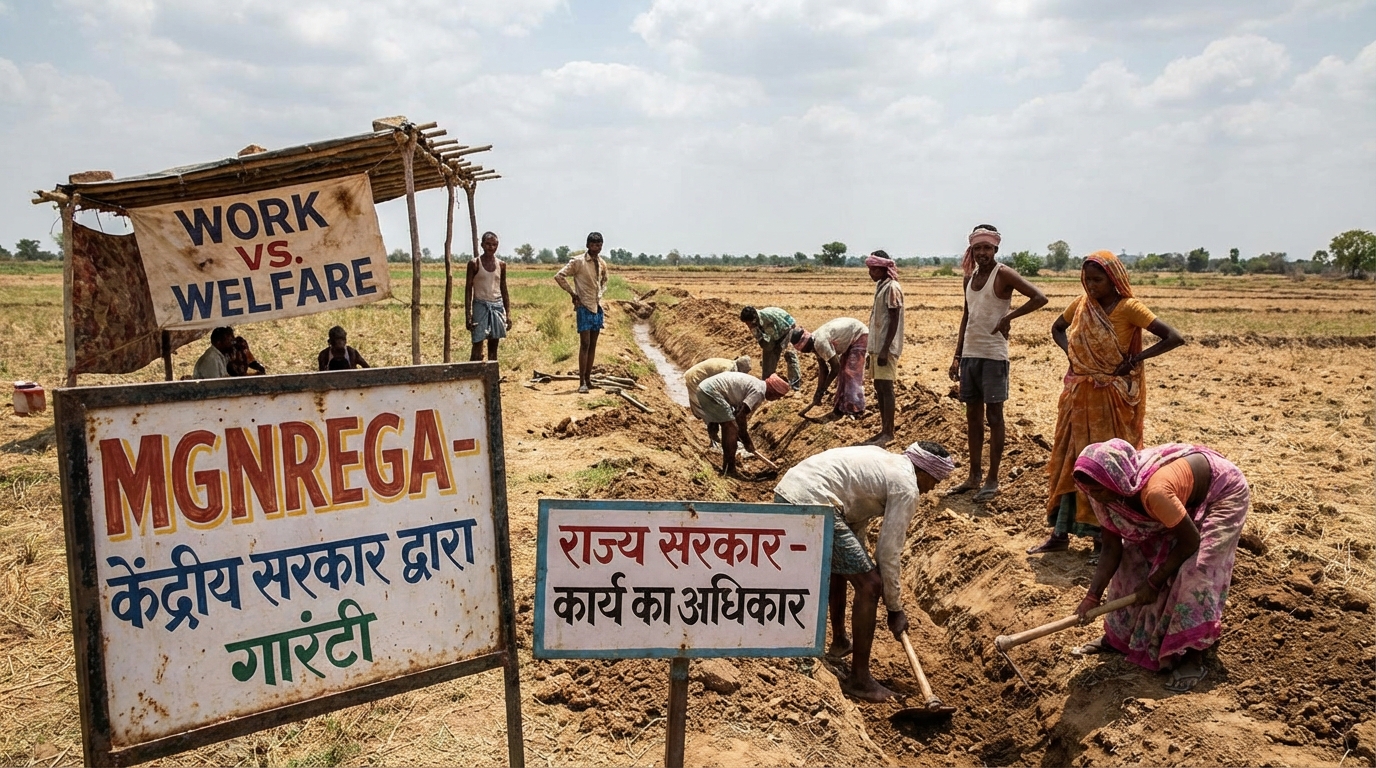
This distinction - right versus welfare - is the heart of the battle.
The Opposition Mounts
Karnataka moved first. On January 8, the state cabinet unanimously voted to reject VB-GRAM-G and challenge it in court. Chief Minister Siddaramaiah promised a "major agitation" if necessary.
"The bill destroys the federal structure, where consultation is important," said Karnataka IT Minister Priyank Kharge. "It violates Article 21."
Tamil Nadu's Chief Minister M.K. Stalin wrote formally to the Prime Minister, warning that the bill "would jeopardise livelihoods of crores of rural poor" and strain Centre-State relations.
Stalin's critique carried particular weight: Tamil Nadu achieved the best poverty reduction record nationally under MGNREGA. Under the new funding formula, it will receive proportionally less - "punished for success," as state officials put it.
The Telangana BRS called VB-GRAM-G a "direct attack on India's federal structure." Punjab, Jammu & Kashmir, Tripura, and Uttarakhand have joined the opposition.
Even TDP, a BJP ally, has expressed concerns and may push for Parliamentary Committee examination.
The Constitutional Arguments
Opposition states are marshaling constitutional artillery:
Article 21 (Right to Life): Multiple legal scholars argue that the right to livelihood is embedded in the right to life. By converting a legal entitlement to discretionary welfare, VB-GRAM-G may violate Article 21.
Article 258 (Centre-State Cooperation): The Constitution requires the Union to consult states when implementing parliamentary laws that affect them. Congress leader Jairam Ramesh argues VB-GRAM-G was "pushed through without consulting states or other stakeholders, in violation of Article 258."
Federal Structure: The 60:40 funding formula imposes financial obligations on states without their consent. Can Parliament mandate that states pay for a central scheme? The constitutional question is unresolved.
Section 22 Concerns: Legal analysis in The Wire identified potential constitutional problems with Section 22 of the new Act, relating to implementation authority.
The Government's Defense
The Centre has its own narrative.
"MGNREGA suffered deep structural flaws," BJP statements argue. "This is not just rebranding, but a necessary legal reset to build a cleaner, stronger framework."
UP Chief Minister Yogi Adityanath praised VB-GRAM-G as a "transformative step towards strengthening the rural economy, ensuring transparency and guaranteeing employment."
Madhya Pradesh Chief Minister Mohan Yadav declared 2026 "Agriculture Welfare Year" and called the law "revolutionary for rural transformation."
The government points to the increased 125-day guarantee, the integration with national infrastructure planning, and provisions for climate-resilient assets.
Notably, the 60-day annual pause during peak farming seasons - intended to prevent labor shortages during sowing and harvesting - is framed as farmer-friendly, though critics see it as limiting worker choice.
The Street Campaign
Congress has launched "MGNREGA Bachao Sangram" (Save MGNREGA Struggle), a 45-day nationwide campaign structured in three phases:
Phase 1 (January 8-11): State-level mobilization, district press conferences, one-day fasts at district headquarters near Gandhi and Ambedkar statues.
Phase 2 (January 12-30): Village-level panchayat meetings, distribution of letters from Congress president, and crucially - draft resolutions against VB-GRAM-G to be moved in gram sabhas nationwide on Republic Day, January 26.
Phase 3 (January 31 - February 25): District-level dharnas at DC/DM offices, state-level gheraos of Vidhan Sabha buildings, and four zonal AICC rallies across the country.
Workers' organizations are organizing separately. The NREGA Sangharsh Morcha and Samyukt Kisan Morcha (the farmers' coalition from the 2020-21 protests) are coordinating phased resistance.
"What was once a people's right has become a centrally controlled scheme," one organizer said. "We're seeing the dismantling of a demand-driven guarantee."
What's Actually at Stake
The VB-GRAM-G debate is ostensibly about rural employment. It's actually about three larger questions:
First, federalism: Can the Centre impose financial obligations on states without their consent? Can it restructure a national program without state consultation? The answers will shape Centre-State relations for years.
Second, rights versus welfare: MGNREGA represented a philosophical commitment that employment is a right, not charity. VB-GRAM-G converts that right into a program. The difference matters - rights are enforceable, programs can be cut.
Third, centralization: By controlling what work gets done and where, the Centre gains enormous discretionary power over rural expenditure. Opposition states fear political favoritism - resources flowing to supportive states, not needy ones.
Historical Echo
Shashi Tharoor called VB-GRAM-G "an assault on the very spirit and philosophical foundation of MGNREGA."
That foundation was laid by the UPA government in 2005, building on ideas dating to the 1970s right-to-work debates. The premise was radical: that the state owed citizens employment, not just the opportunity to seek it.
MGNREGA became one of the world's largest public works programs. It provided income security to over 150 million rural households. It empowered women, who constituted over half of workers. It created durable assets in villages.
It also became synonymous with corruption allegations, middleman rent-seeking, and political patronage.
The Modi government has long viewed MGNREGA skeptically. Finance Minister Nirmala Sitharaman once called it a "monument to your failures" (addressing Congress). The philosophical divide runs deep.
What Happens Next
The immediate timeline:
- Congress campaign escalates through January and February
- Karnataka prepares constitutional challenge
- Gram sabhas debate resolutions on January 26
- State assemblies in opposition-ruled states may pass resolutions
- Legal challenges may reach High Courts, potentially Supreme Court
The political timeline extends to 2029. Rural employment affects tens of millions of voters. How VB-GRAM-G plays in villages will shape electoral calculations for both BJP and opposition.
For now, India's rural poor are caught in the crossfire - their employment guarantee transformed, their legal rights uncertain, their livelihoods a battleground in a larger war between Centre and states, between rights and welfare, between competing visions of what government owes its citizens.
The name has changed. The days have increased. But has the guarantee survived? That question will be answered in courts, in villages, and ultimately in voting booths.