By Ramachandran Rajeev Kumar — 2026-01-16
By Ramachandran Rajeev Kumar
The War Everyone Missed
For years, the media obsessed over: Amazon vs Reliance. E-commerce vs Traditional Retail. Flipkart vs JioMart.
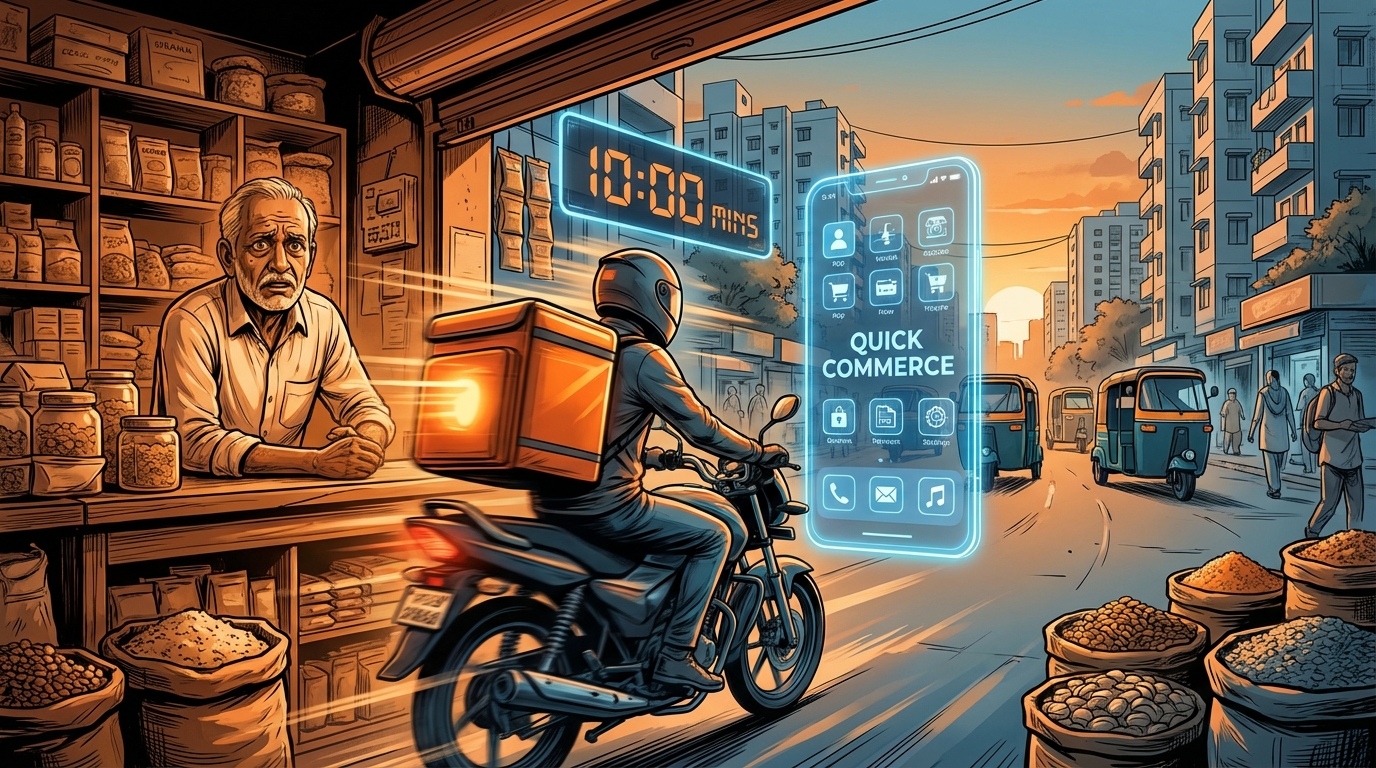
Meanwhile, Blinkit, Zepto, and Swiggy Instamart quietly built 85% control of a $15+ billion quick commerce market—and started killing kirana stores at scale.
The numbers:
- 200,000 urban kirana stores already shut
- 25% of India's kiranas could close by 2030
- Blinkit valued at $15 billion—bought by Zomato for $570 million just 3 years ago
- Zepto filed a $1.2 billion IPO at $7 billion valuation
- Quick commerce growing at 17% in 2025—fastest in the world
The retail revolution isn't Amazon vs Reliance. It's 10-minute delivery vs everything else.
And everything else is losing.
The Kirana Fortress (Still Standing—For Now)
The Numbers That Shock
India has 12.8-13 million traditional kirana stores. These tiny shops—100-1,000 square feet, most under 500—dominate India's $1.06-$1.4 trillion retail market.
Kirana market share:
Translation: While Amazon and Flipkart fought for e-commerce supremacy (60% market share between them), kiranas still controlled 9 out of 10 rupees spent on groceries.
Why Kiranas Survived E-Commerce
1. Hyperlocal Proximity
Your neighborhood kirana is 2 minutes away on foot. Amazon's delivery? 1-2 days. Flipkart? Same. Even JioMart's same-day delivery can't match walking distance.
2. Credit (Udhar)
Kiranas offer informal credit. Buy ₹500 worth of groceries, pay next week. No questions, no interest, no credit score checks. Try that with Amazon.
3. Personal Relationships
The kirana store owner knows your family, your preferences, your financial situation. He'll deliver on credit during emergencies. Amazon's algorithm doesn't care if you lost your job.
4. Immediate Fulfillment
Need one onion at 11 PM? Kirana delivers. Amazon won't.
Result: E-commerce grew to $136 billion by 2025 (8% of retail), but kiranas held 75%. The fortress stood.
Until quick commerce arrived.
The Quick Commerce Blitzkrieg
What Is Quick Commerce?
10-minute delivery. Groceries, snacks, medicines, household items—ordered on an app, delivered in 10 minutes.
How it works:
- Dark stores (micro-warehouses) in every neighborhood
- Delivery partners on bikes, stationed nearby
- AI-optimized routing
- Pre-stocked high-demand SKUs
Key players:
- Blinkit (Zomato): 46% market share by end of 2025, $15 billion valuation
- Zepto: $7 billion valuation, filed $1.2B IPO
- Swiggy Instamart: ~40% of Swiggy's $12 billion valuation
Combined: 85%+ of India's quick commerce market.
Why Quick Commerce Is Killing Kiranas
1. Proximity Without the Store
Kirana: 2-minute walk. Quick commerce: 10-minute delivery to your door.
You don't even need to change out of pajamas.
2. Prices Lower Than Kirana's Cost
A Nescafe coffee jar costs kiranas ₹622 to buy wholesale. Quick commerce platforms sell it at:
- Zepto: ₹514
- Swiggy Instamart: ₹577
- Blinkit: ₹625
How? Predatory pricing. Losses funded by VC money. Zepto's losses: ₹33.67 billion in FY25, up from ₹12.15 billion in FY24.
Kiranas can't compete. They buy at ₹622, sell at ₹650 (₹28 margin). Quick commerce sells at ₹514, loses ₹100 per jar, and calls it "customer acquisition."
3. Selection Without Space Constraints
Your neighborhood kirana: 500 sq ft, 500-1,000 SKUs. Blinkit dark store: 3,000+ SKUs, optimized for local demand.
Need obscure imported pasta? Blinkit has it. Your kirana doesn't.
4. Convenience Beats Relationships
Gen Z and millennials don't value the personal relationship with the kirana owner. They value:
- Not walking to the store
- Not carrying bags
- Not interacting with humans
- Paying digitally (no cash handling)
Result: 200,000 urban kirana stores already closed. 25% of kiranas could shut by 2030.
The fortress is crumbling.
The Battle No One Expected: Quick Commerce vs E-Commerce
Amazon and Flipkart Are Losing, Too
Amazon and Flipkart together control 60% of India's e-commerce market—$136 billion in 2025.
But quick commerce is eating grocery and daily essentials, which make up 30-40% of e-commerce GMV.
The problem for Amazon/Flipkart:
- Delivery time: 1-2 days (Amazon Prime: same day at best)
- Quick commerce: 10 minutes
For groceries, toothpaste, shampoo, snacks—speed beats selection.
Why wait 2 days for detergent when Blinkit delivers in 10 minutes?
Reliance's JioMart: The Kirana Strategy That's Failing
Reliance JioMart onboarded 2 lakh (200,000) kirana merchants across 3,500 cities, adding 1.5 lakh (150,000) every month.
The model: Customers order on JioMart app → Local kirana fulfills → Kirana makes commission.
The pitch: "We're not killing kiranas, we're empowering them!"
The reality:
- JioMart has 17% grocery e-commerce share, $15 billion GMV, 100M+ users
- But Reliance Retail's valuation fell from $125 billion (2022) to $50 billion (2025)
- Sales growth: 7.9% in FY2025, down from 17.8% in FY2024
- JioMart offers 30-minute delivery—not 10 minutes
Why JioMart is struggling:
- Kirana integration is slow: Onboarding 200K kiranas sounds impressive until you realize India has 12.8 million. That's 1.5% penetration.
- 30 minutes isn't fast enough: When Blinkit delivers in 10, JioMart's 30 feels slow.
- Kiranas lack inventory depth: A kirana with 500 SKUs can't compete with Blinkit's 3,000+ SKU dark store.
The brutal truth: Reliance tried to save kiranas by digitizing them. Quick commerce is killing kiranas and JioMart by replacing them entirely.
The Economics That Don't Add Up (Yet Will Reshape Retail)
The Unsustainable Model
Blinkit CEO Albinder Dhindsa warned of a bubble, saying quick commerce relies on "relentless fundraising" to cover steep losses.
The numbers:
- Zepto losses: ₹33.67 billion (2025) vs ₹12.15 billion (2024)—losses tripling
- Blinkit: Profitable on contribution margin, but burning cash on expansion
The math doesn't work:
- Sell coffee jar at ₹514 (bought at ₹622): -₹108 loss
- Delivery cost: ₹30-50 per order
- Total loss per order: ₹138-158
Multiply that by millions of orders per day. You're losing billions per quarter.
So why does it continue?
Because VCs believe: Whoever wins gets Amazon-level monopoly profits.
The Regulatory Reckoning
The Antitrust Case
The Competition Commission of India (CCI) is investigating quick commerce platforms for:
- Predatory pricing: Selling below cost to kill competition
- Dark store ownership: Platforms owning inventory violates marketplace laws
- Disrupting traditional retail: Forcing kiranas to close
- Not disclosing expiry dates: Consumer protection violations
The case brought by: All India Consumer Products Distributors Federation (AICPDF), representing kiranas and small retailers.
Their argument: "Predatory pricing makes it difficult for local kirana stores to survive".
The platforms' defense: "We're not selling below cost—we're passing on efficiency gains."
The truth: They're selling below cost, funded by VC billions, to capture market share.
What Regulation Could Do
Option 1: Ban predatory pricing
- Platforms must sell at or above wholesale cost
- Result: Quick commerce prices rise, kiranas survive, consumers lose convenience
Option 2: Restrict dark store density
- Limit number of dark stores per square kilometer
- Result: Slower delivery (20-30 minutes instead of 10), less threat to kiranas
Option 3: Mandate kirana integration
- Quick commerce must fulfill through kiranas (like JioMart)
- Result: Kiranas survive, but lose pricing power to platforms
Option 4: Do nothing
- Let market forces play out
- Result: Kiranas die, quick commerce consolidates to 2-3 players, they raise prices post-monopoly
India will probably choose Option 3 (kirana integration mandates). It's politically palatable—saves kiranas, doesn't kill innovation.
The Winners and Losers
Winners
1. Quick Commerce Platforms (Short Term)
- Blinkit, Zepto, Swiggy Instamart capturing market at record speed
- Valuations soaring: Blinkit $15B, Zepto $7B
- Funding flowing: Zepto's $1.2B IPO incoming
2. Consumers (For Now)
- Incredible convenience: 10-minute delivery
- Lower prices (while VC money lasts)
- Wider selection than kiranas
3. Urban Millennials and Gen Z
- No need to visit stores
- Digital payments only
- Seamless app experience
Losers
1. Kirana Stores
- 200,000 already shut
- 25% could close by 2030
- Can't compete on price, speed, or selection
2. Amazon and Flipkart
- Losing grocery category to quick commerce
- 1-2 day delivery irrelevant for daily essentials
- Late to quick commerce race
3. Reliance JioMart
- Valuation halved ($125B → $50B)
- Growth slowed (17.8% → 7.9%)
- Kirana integration strategy not fast enough
4. Consumers (Long Term)
- Once quick commerce monopolizes, prices will rise
- Loss of kirana credit (udhar) system
- Loss of personal relationships
The 2030 Prediction
Scenario 1: Quick Commerce Wins (60% Probability)
- 3-4 major players (Blinkit, Zepto, Swiggy, Amazon Quick)
- 40-50% of urban grocery market
- 50% of kiranas shut in Tier-1/2 cities
- Prices rise post-consolidation
- Profitability achieved by 2027-2028
Outcome: Convenient but expensive. Kirana extinction in cities.
Scenario 2: Hybrid Model (30% Probability)
- Regulation forces kirana integration
- Quick commerce fulfills through kiranas
- Kiranas survive as "fulfillment nodes"
- Slower delivery (20-30 minutes)
- Prices higher than pure quick commerce, lower than old kirana
Outcome: Compromise. Kiranas survive but lose independence.
Scenario 3: The Bubble Bursts (10% Probability)
- VC funding dries up
- Zepto, Blinkit can't achieve profitability
- Mass shutdowns, layoffs
- Kiranas reclaim market share
Outcome: Quick commerce collapses, kiranas win by default.
What Must Happen Now
For Quick Commerce Platforms
1. Prove Unit Economics Work
Zepto's $1.2B IPO will test this. If public markets punish losses, VC funding dries up.
2. Achieve Profitability
Blinkit is close (contribution margin positive). Zepto and Swiggy aren't. Race is on.
3. Defend Against Regulation
CCI antitrust case is real. Lose that, and the model collapses.
For Kiranas
1. Digitize or Die
Join JioMart, Flipkart Wholesale, or similar platforms. Don't fight alone.
2. Specialize
Offer what quick commerce can't: credit (udhar), personal service, ultra-local selection (specific regional brands).
3. Lobby for Protection
AICPDF's antitrust case is kirana's last stand. Win regulations that curb predatory pricing.
For Amazon, Flipkart, Reliance
1. Go Faster
10-minute delivery or bust. 30 minutes won't cut it.
2. Build Dark Store Networks
Catch up to Blinkit/Zepto. This is infrastructure war.
3. Accept Losses
Quick commerce won't be profitable for 3-5 years. VCs funding Zepto/Blinkit understand this. Do you?
The Brutal Reality
India's retail revolution isn't Amazon vs Reliance. It's 10-minute delivery vs 500-year-old kiranas.
- Kiranas survived British colonization, License Raj, and e-commerce.
- But they can't survive VC-funded delivery in 10 minutes at prices below wholesale cost.
The math is simple:
That's 3+ million kiranas facing extinction.
The question: Will India save them (regulation), let them die (market forces), or find a hybrid (kirana integration)?
The answer: Probably hybrid. India doesn't let massive job losses happen without intervention.
But even in a hybrid model, kiranas lose. They become "fulfillment nodes" for platforms, not independent businesses.
The retail revolution is here. And it's not a battle between giants. It's a massacre of the small by the fast.
Amazon and Reliance are learning: You can be big. You can have capital. You can have millions of customers.
But if you can't deliver in 10 minutes, you're losing to someone who can.
Sources:
- Invest India: Modernization of Kirana Stores in India
- Expert Market Research: India Retail Market Size & Share
- ORMS Today: Grocery Retail in India - Current Status and Future Scenarios
- Rest of World: India's rapid delivery companies threaten neighborhood stores
- CNBC: Zepto files for $1.2 billion IPO
- Mukund Mohan: State of Indian Quick Commerce Market 2025
- Business Today: Small retailers vs quick commerce antitrust case
- Rest of World: JioMart making a dent in Amazon and Walmart's stronghold
- Rest of World: Shein India struggles as Amazon, Flipkart dominate
- IBEF: India's E-commerce Boom
- Straits Research: Top 10 fastest growing quick commerce markets
Ramachandran Rajeev Kumar is the founder of BarathVector. Agree? Disagree? The debate continues in the comments.