By BarathVector Editorial — 2026-03-07
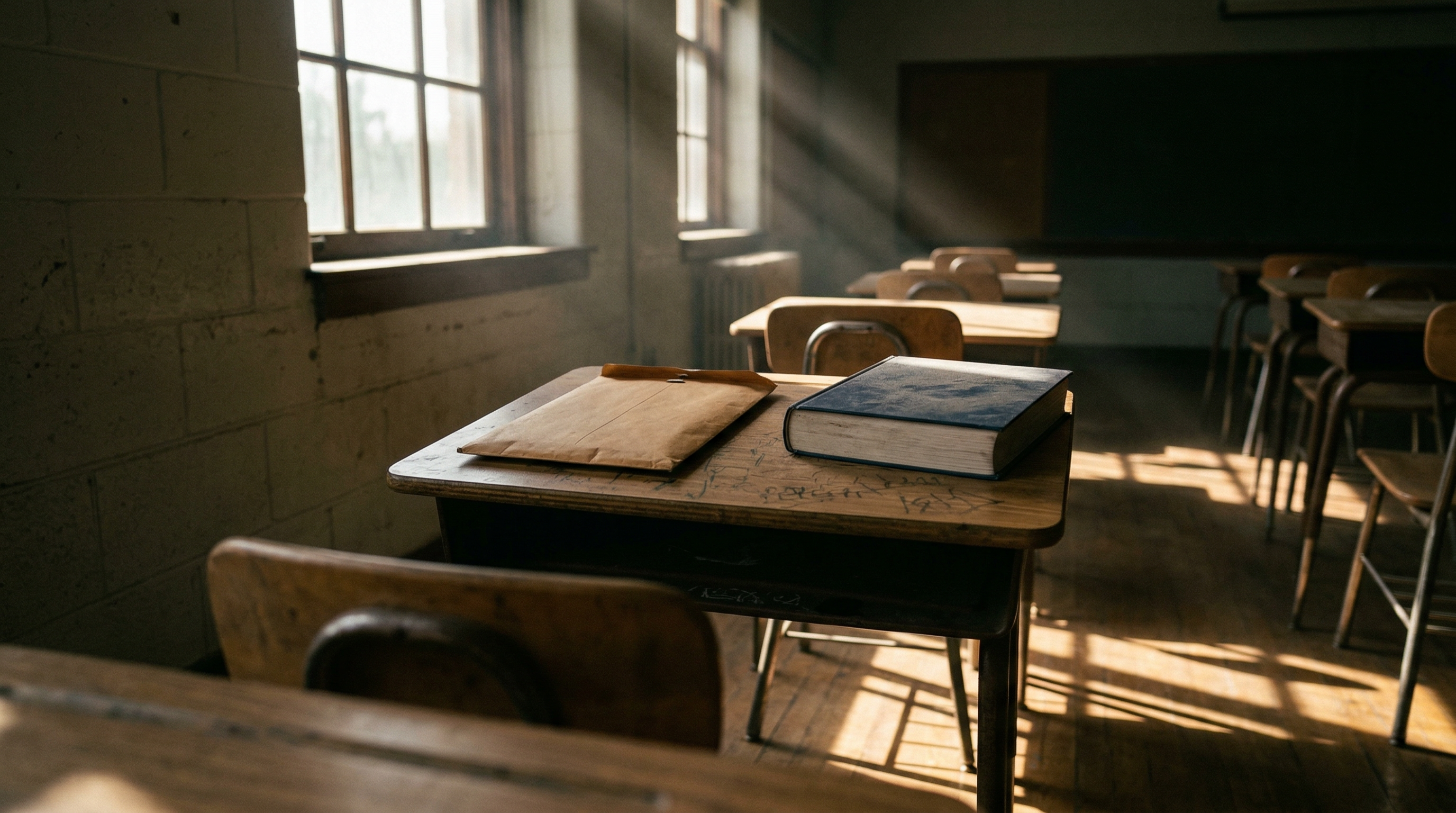
The Report Card We Won't Take: Education's Silent Crisis
Part 9 of "The Delivery Deficit" series
By BarathVector Editorial | March 7, 2026
Every ambition in this series -- semiconductor fabrication, sovereign AI, defence indigenisation, manufacturing at scale, technopolar relevance -- depends on a single input that cannot be imported, fast-tracked, or announced into existence: educated human beings.
India produces them. It also fails to educate them. Both statements are simultaneously true, and the tension between them is the deepest structural crisis in the country's development trajectory.
The Number India Buried
In 2009, India participated in the OECD's Programme for International Student Assessment -- PISA -- the global benchmark for educational quality. The results were catastrophic:
- Reading: 72nd out of 73 countries
- Mathematics: 73rd out of 73 countries
- Science: 73rd out of 73 countries
India finished second to last, ahead of only Kyrgyzstan in reading. It finished dead last in mathematics and science.
The government's response was not to fix the education system. It was to withdraw from PISA. India did not participate in the 2012 round. Or 2015. Or 2018. It announced participation in 2022, then withdrew citing COVID-19 disruption. There are no confirmed plans for the next round.
A nation aspiring to sovereign AI capability, advanced semiconductor manufacturing, and technopolar relevance has not allowed its education system to be independently measured in seventeen years. It is, in effect, a student who failed an exam and responded by refusing to take exams.
The Two Indias of Education
India's education system produces extremes. The top is extraordinary. The base is failing.
The top: IITs, IIMs, AIIMS, and a handful of elite institutions produce graduates who lead global technology companies, run major hedge funds, chair academic departments at the world's best universities, and drive innovation at Google, Microsoft, and OpenAI. The Indian diaspora's intellectual achievement is not a myth. It is documented, measurable, and transformative for the global economy.
The base: India has approximately 50,000 engineering colleges producing over 1.5 million engineering graduates annually. Industry surveys consistently report that 80-85 per cent of these graduates are not employable without significant retraining. The National Employability Report has documented this gap across multiple cycles. Recruiters at IT companies routinely test thousands of candidates to hire hundreds -- not because the candidates lack degrees, but because the degrees do not certify capability.
The gap between top and base is not a gradient. It is a cliff. IIT Bombay and a private engineering college in a tier-3 city nominally offer the same product -- a BTech degree. The actual educational experience bears as much resemblance as a Michelin-starred restaurant bears to a roadside stall. Both serve food. One nourishes; the other fills.
The Rote Memorisation Machine
The systemic problem is not funding, though funding is inadequate. It is pedagogy.
India's education system, from primary school through undergraduate study, is fundamentally organised around rote memorisation. Students are taught to reproduce textbook content in examinations. They are not taught to analyse, synthesise, critique, or create. The examination system rewards recall, not reasoning. A student who can reproduce a physics derivation from memory scores higher than one who can apply physics principles to an unfamiliar problem.
This produces a very specific kind of graduate: one who can pass examinations but cannot solve problems. One who can code a known algorithm but cannot design a novel one. One who can follow a procedure but cannot question whether the procedure is correct.
Semiconductor fabrication requires engineers who can troubleshoot novel problems in real time. AI development requires researchers who can reason about systems they have never seen. Defence technology requires designers who can innovate under constraint. None of these capabilities are produced by rote memorisation. All of them are produced by education systems that teach critical thinking, experimental reasoning, and creative problem-solving.
Finland -- the country whose president just told India it taught Europe that passivity is not a strategy -- ranked consistently in the top five on PISA. Finland achieves this with less homework, no standardised testing until age 16, and a pedagogy centred on understanding rather than memorisation. Every Finnish teacher has a master's degree. Teacher training in Finland is more competitive than medical school admission.
India produces more engineering graduates in a single year than Finland has citizens. The quantity is not the problem. The quality is.
NEP 2020: The Right Policy, Unimplemented
The National Education Policy 2020 is, on paper, a comprehensive and thoughtful reform document. It proposes:
- Multidisciplinary education replacing rigid stream segregation
- Critical thinking and experiential learning replacing rote memorisation
- A four-year undergraduate degree with multiple exit points
- Mother tongue instruction in early years
- A new National Research Foundation to fund academic research
- Autonomy for top institutions
The policy has been praised domestically and internationally. It is directionally correct on nearly every count.
Implementation is another matter. Six years after NEP 2020's announcement:
- The majority of state universities have not adopted the four-year degree structure
- Examination systems remain fundamentally unchanged -- boards and entrance exams still reward memorisation
- Teacher training has not been overhauled at scale
- The National Research Foundation was established but is in early stages of operation
- State-level adoption varies dramatically -- some states have embraced NEP, others have resisted or ignored it
The pattern is familiar. An excellent policy announcement. Partial, uneven implementation. And a system that continues to operate much as it did before the announcement was made.
The Brain Drain That Isn't Discussed
India does not merely produce world-class talent at the top. It exports it.
The United States, United Kingdom, Canada, Australia, and Singapore absorb India's best-educated graduates in technology, medicine, research, and finance. This is often framed as a point of pride -- "Indians run the world's biggest companies." It is equally a point of concern -- India's education system produces excellence that India's economy cannot retain.
The reasons are well-documented: inadequate research funding, poor university infrastructure, limited academic freedom, low faculty salaries relative to industry, and a bureaucratic environment that stifles innovation. An IIT graduate who stays in India to do AI research earns a fraction of what the same person would earn at Google DeepMind. The graduate who leaves is making an economically rational choice. The country that loses them is making a systemic failure visible.
If India wants sovereign AI, indigenous semiconductors, and technopolar relevance, it needs to retain the talent it produces. Retention requires not just salaries but research ecosystems, intellectual freedom, and the kind of institutional support that makes staying in India a competitive choice, not a charitable one.
The Honest Assessment
Education is the slowest domain to fix and the most consequential to get wrong. A policy implemented today will produce its first graduates in a decade. The effects of pedagogical reform take a generation to manifest. There is no PLI scheme for education, no summit that can shortcut the process, no MoU that substitutes for a well-trained teacher in a functioning classroom.
India's education system is not entirely broken. The IITs, IIMs, IISC, and select institutions demonstrate that excellence is possible within the Indian context. But these institutions serve the top 0.1 per cent. The other 99.9 per cent -- the engineers, technicians, teachers, and workers who will actually build the factories, operate the fabs, and maintain the AI infrastructure -- are produced by a system that has not been independently measured since 2009, and that scored 72nd out of 73 when it was.
Every ambition in the Delivery Deficit series ultimately depends on this: are the people who will execute these ambitions being educated to do so? The answer, for the vast majority of India's students, is no.
You cannot announce your way out of an education crisis. You can only teach your way out. And teaching requires something that Indian policy has been reluctant to provide: the humility to measure how badly the current system is failing, and the patience to fix it without claiming credit for the fix.
Take the exam. Read the results. Then, and only then, talk about sovereign AI.
This is Part 9 of "The Delivery Deficit" series examining India's announcement-execution gap.
Sources: OECD PISA, National Employability Report, NEP 2020, World Population Review, Drishti IAS