By Ramachandran Rajeev Kumar — 2026-03-17
The rank we earned: India dropped 13 places because it will not say the word 'coal'
By Ramachandran Rajeev Kumar
Three reports landed in quick succession between November 2025 and March 2026. Each measured something different. Together, they paint a picture that India's policy establishment would prefer not to hang on the wall.
The Climate Change Performance Index 2026, released at COP30 in Belem, dropped India 13 places -- from 10th to 23rd. The Germanwatch Climate Risk Index 2026 placed India ninth among countries most affected by extreme weather over three decades, in the same "continuous threats" category as the Philippines, Nicaragua, and Haiti. And the Centre for Science and Environment's State of India's Environment 2026, released in March, reported that seven of the nine planetary boundaries that sustain life on Earth have now been breached.
None of these reports contained surprises. They contained measurements.
What the CCPI actually measured
The Climate Change Performance Index, published annually by Germanwatch, NewClimate Institute, and the Climate Action Network, evaluates countries across four categories: greenhouse gas emissions, renewable energy, energy use, and climate policy. India's fall was driven primarily by two factors.
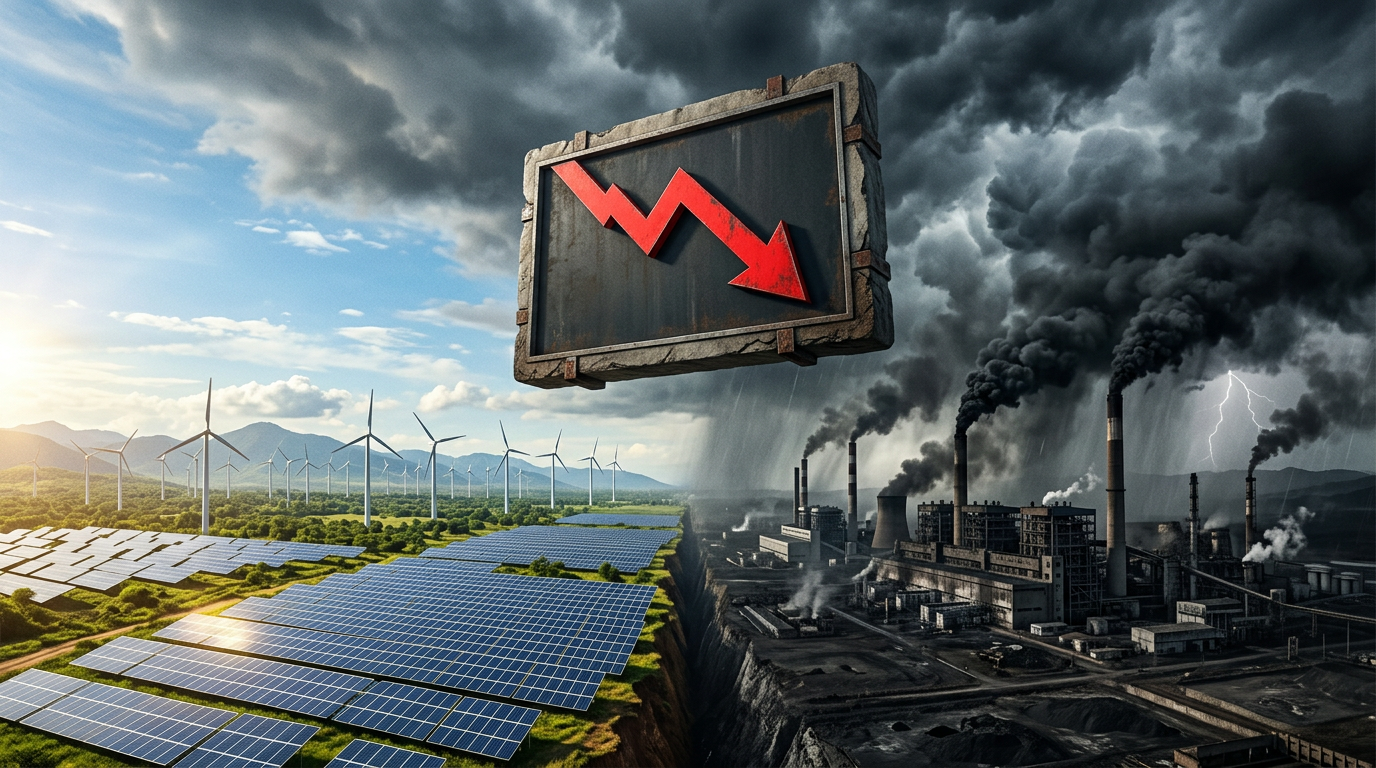
The first is coal. India has no national coal phase-out timeline. While dozens of countries have committed to specific dates for ending coal-fired power generation, India continues to auction new coal blocks. Coal-based power generation rose in absolute terms in 2024-25, even as renewable capacity additions -- particularly solar -- grew strongly. The CCPI measures both trajectories. India got credit for solar growth and was penalised for coal expansion. The net result was a sharp drop.
The second factor is absolute emissions. India's total greenhouse gas emissions continue to rise. The per capita numbers remain modest by global standards -- a fraction of American or European levels -- and the emissions intensity of GDP is declining. But the CCPI weights absolute emission trends, and India's trajectory is upward.
The Indian response to the ranking has been predictable. Officials point out that India's per capita emissions remain well below the global average, that India is the third-largest renewable energy producer, and that the country is on track to meet its Paris Agreement targets. All of these statements are true. None of them address the reason for the drop.
The reason is coal. India will not commit to ending it, and the CCPI measures that commitment. The ranking is not a misunderstanding. It is a measurement of a policy choice.
The coal arithmetic
India's relationship with coal is not a matter of inertia or ignorance. It is a calculated dependency rooted in economic reality.
Coal generates approximately 75 per cent of India's electricity. It directly employs over 400,000 people in mining alone, with millions more in downstream industries. The states most dependent on coal -- Jharkhand, Chhattisgarh, Odisha, West Bengal -- are among India's poorest, and coal royalties constitute a significant portion of state revenue. India's demand for electricity is growing at 6 to 7 per cent annually, driven by industrialisation, urbanisation, and a population that still lacks reliable power in many regions.
Shutting coal plants before alternatives are built would mean blackouts. Ending coal mining before alternative employment exists would mean economic devastation in some of India's most vulnerable communities. The developed nations that have committed to coal phase-outs -- the UK, Germany, Canada -- began with coal shares below 40 per cent and had decades of industrial decline that had already reduced coal employment. India is being asked to phase out coal while it is still expanding electricity access to hundreds of millions of people.
This is the argument India makes, and it has merit. But it does not answer the question the CCPI poses, which is narrower: does India have a plan to stop? Not today. Not this decade. But ever?
The answer, as of March 2026, is no. India has a plan to add renewables. It does not have a plan to subtract coal. The difference between those two things is the difference between 10th and 23rd.
The boundaries that do not negotiate
While the CCPI measures policy choices, the planetary boundaries framework measures physical reality. The CSE's State of India's Environment 2026 reports that seven of nine boundaries have been breached: climate change, biosphere integrity, land system change, freshwater change, biogeochemical flows, novel entities, and -- newly added to the breach list -- ocean acidification.
Surface ocean acidity has increased by 30 to 40 per cent since the industrial era began. Species extinction rates exceed 100 per million species-years against a safe threshold of 10. These are not projections. They are measurements of damage already done.
India did not cause most of this damage. The historical emissions that drove climate change and ocean acidification came overwhelmingly from industrialised nations. India's contribution to cumulative atmospheric CO2 remains in single digits. The planetary boundaries framework does not assign blame. It measures proximity to collapse.
But the consequences of breach do not distribute according to historical responsibility. They distribute according to geography, poverty, and exposure. And by those measures, India is among the most vulnerable countries on Earth.
The weather is already here
The Climate Risk Index makes this concrete. Over three decades, India experienced nearly 430 extreme weather events resulting in over 80,000 fatalities and approximately $170 billion in economic losses. In 2024, India ranked third globally for the number of people affected by extreme weather, behind only Bangladesh and the Philippines.
In 2025 alone, extreme weather events resulted in 4,419 deaths across India. Approximately 17.41 million hectares of crop area were affected -- an area larger than many European countries. Cyclones, floods, heatwaves, and unseasonal rainfall have become not exceptional events but recurring features of the Indian calendar.
India's categorisation as a "continuous threat" nation -- alongside Haiti, Nicaragua, and the Philippines -- means that the frequency of extreme weather events exceeds the recovery time between them. Each disaster hits before the previous one has been absorbed. Infrastructure is rebuilt and destroyed again. Agricultural cycles are disrupted repeatedly. Insurance markets, where they exist, begin to withdraw.
This is not a future scenario. It is the present condition.
The contradiction at the centre
India is simultaneously one of the world's most ambitious renewable energy builders and one of its most committed coal expanders. This is the contradiction that the CCPI ranking reflects and that Indian policy refuses to resolve.
In 2025, India added over 20 GW of solar capacity -- one of the largest expansions globally. The National Solar Mission has exceeded its targets. Wind capacity is growing. Green hydrogen pilots are underway. The production-linked incentive schemes for solar module manufacturing are attracting investment.
In the same period, Coal India produced record volumes. New coal blocks were auctioned. Thermal power plant utilisation rates increased. The coal cess, which was supposed to fund clean energy, was subsumed into the GST pool and its proceeds diluted across general expenditure.
Both of these trajectories are real. They coexist because India's electricity demand is growing fast enough to absorb both coal and renewables simultaneously. The additions are not substituting for each other. They are supplementing each other.
For the CCPI, this is the worst possible answer. A country that adds renewables while also adding coal is a country that has not made the structural commitment to transition. It is hedging, not transitioning. The index measures intent as well as action, and India's intent -- as revealed by coal block auctions and the absence of a phase-out date -- is to keep burning coal for as long as demand exists.
What honesty requires
The temptation is to dismiss these rankings as Western metrics applied unfairly to a developing nation. That response has some validity -- the CCPI's weighting methodology does not fully account for the development challenges that India faces. A country that has not yet electrified all its villages is not in the same position as Germany deciding to close its last coal plant.
But dismissal is not a strategy. The rankings measure something real. Coal dependency carries real costs -- not just in international reputation, but in air quality, water contamination, health outcomes, and climate vulnerability. The 4,419 extreme weather deaths in 2025 occurred in India, not in the countries that designed the index.
Honesty requires acknowledging that India's coal position is a choice, not a circumstance. The choice may be defensible on economic grounds -- for now. But it is a choice with measurable consequences, and those consequences are accumulating faster than the policy response.
A coal phase-out timeline does not mean closing plants tomorrow. It means committing to a date -- 2050, 2060, even 2070 -- by which India's power generation will be coal-free, and working backwards to build the renewable capacity, grid infrastructure, storage systems, and retraining programmes that make that date achievable. It means saying the word "coal" in the same sentence as "end."
Until India does that, the rank is earned. Not imposed. Earned.
Ramachandran Rajeev Kumar is the Chief Executive Officer of the Aarksee Group of Companies, based in Saudi Arabia.
Related reading: