By Ramachandran Rajeev Kumar — 2025-12-27
The Peacock's Beautiful Cage
An Editorial Fable
By Ramachandran Rajeev Kumar
The cage was meant to protect. But what happens when protection becomes the only life you know?
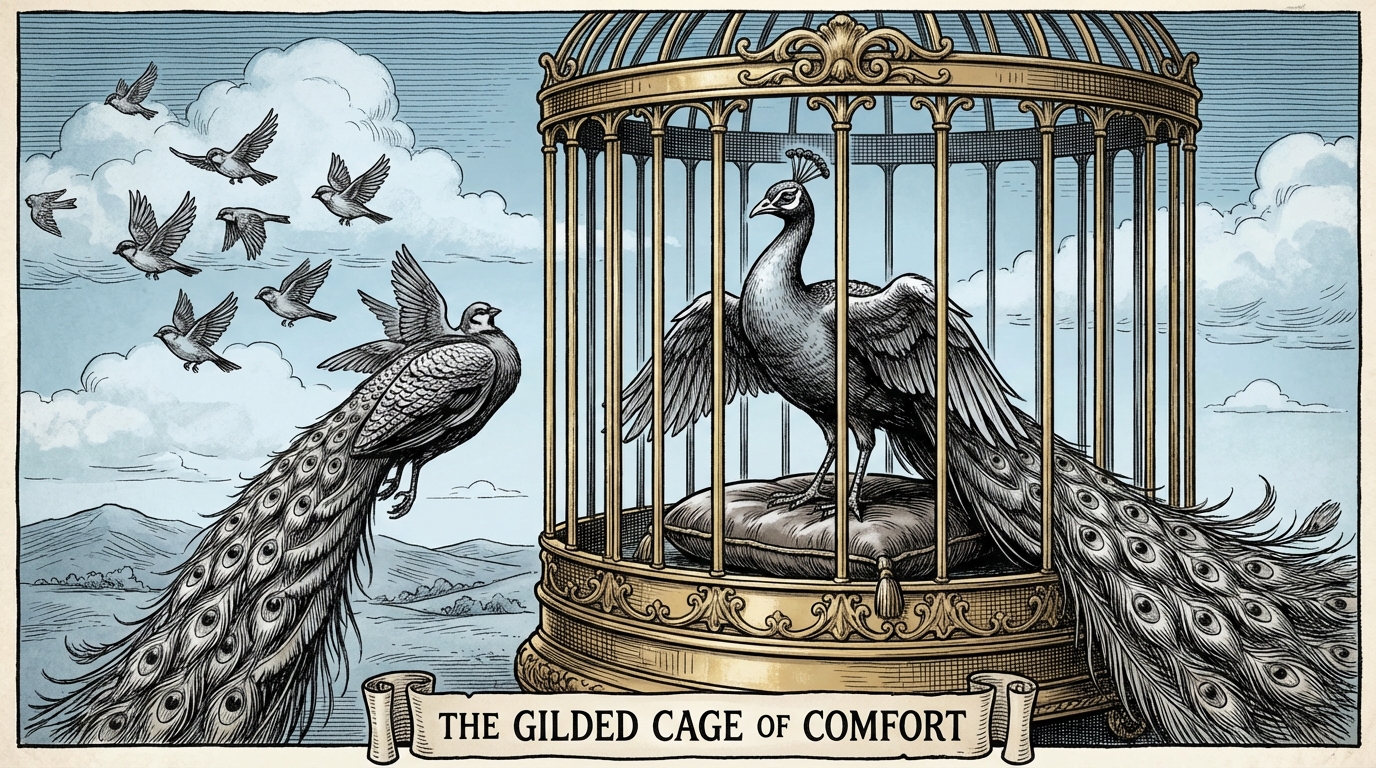
Once upon a time, in a great forest called Bharatvan, there lived a peacock of extraordinary beauty.
But the peacock had not always been beautiful. Generations ago, the peacock's ancestors had been among the most persecuted birds in the forest. Other birds had denied them water from the common pond. They were forbidden from perching on the higher branches. When food was scarce, they were the first to starve.
A wise old owl, seeing this injustice, devised a solution.
"Build a golden cage," the owl decreed. "Place the peacock inside. Give it guaranteed food, guaranteed water, guaranteed perching space. Let it heal from centuries of cruelty. After some time, when it has regained its strength, open the door and let it fly free."
The other birds agreed. The cage was beautiful, the intentions noble. The peacock entered gratefully.
The Comfortable Years
At first, the cage was medicine.
The peacock, freed from competition and cruelty, flourished. Its feathers grew magnificent. Its children were born healthy. They never knew the thirst of being denied water, the hunger of being last to eat.
But something subtle began to change.
The peacock's children, born inside the cage, never learned to search for food. Why would they? Food appeared daily through the golden bars. They never learned to defend themselves from predators. Why would they? The cage protected them. They never learned to fly long distances. Why would they? The cage was comfortable.
Generations passed. The peacock's wings, once strong, began to atrophy. Not from injury, but from disuse. The muscles that once powered flight across the forest grew weak from the luxury of never needing to fly.
Outside the cage, the sparrows watched.
The Sparrows' Journey
The sparrows had no cage. No guaranteed food. No reserved perching spots. Nothing was set aside for them.
And so the sparrows had to learn.
They learned to fly farther than any bird in the forest, searching for food in distant lands. They learned to build nests in the most precarious places, because the comfortable spots were already taken. They learned to survive winters that killed weaker birds. They learned to adapt, or die.
Many sparrows did die. The path was cruel. There was no owl to protect them.
But those who survived became strong. Their wings grew powerful from constant use. Their instincts sharpened from daily competition. Some sparrows flew so far that they crossed the great ocean and never returned, building new lives in forests where no one knew or cared about the politics of Bharatvan.
The sparrows became citizens of the world.
The peacock remained in its beautiful cage.
The Zookeeper's Dilemma
Every ten years, the animals of Bharatvan would meet to discuss the cage.
"It was meant to be temporary," some would say. "Surely it is time to open the door?"
But the peacock's descendants, born inside the cage, would protest.
"Our ancestors suffered for centuries! Ten years, twenty years, fifty years of protection is not enough to undo that harm. We need more time. The cage must stay."
And the zookeeper, who had inherited the responsibility from the wise old owl, would sigh and extend the cage's term.
"Ten more years," the zookeeper would declare. "Then we shall reconsider."
But when ten years passed, the same conversation repeated. The cage was extended again. And again. And again.
Seventy-five years passed.
The original peacock's great-great-great-grandchildren had never known life outside the cage. The very idea of flying free terrified them. What would they eat? Where would they perch? How would they survive?
The cage was no longer protection. It was home. It was identity. It was the only life they knew.
The Eagle's Letter
One day, a letter arrived from across the great ocean. It was from an eagle who had once been a sparrow in Bharatvan.
"I left because there was no place for me," the eagle wrote. "No cage, no protection, no guaranteed perch. I had to fly or die. I flew.
"Now I lead a great flock in a distant land. I have built things that birds in Bharatvan cannot imagine. My children have never known hunger. They fly wherever they wish.
"I sometimes wonder what would have happened if someone had built a cage for me. Would I have become this eagle? Or would I have remained a comfortable sparrow, my wings too weak to cross the ocean?
"Tell the peacock: the cage was meant to help you fly, not to replace flying."
The peacock, reading this letter, felt something it could not name. Was it anger? Envy? Or the faintest stirring of wings that had forgotten their purpose?
The Day The Door Opened
One morning, after seventy-five years, the zookeeper made an announcement.
"Today we open the cage. The peacock is free."
Panic spread through the cage. The peacocks huddled together, terrified.
"We cannot survive out there! The sparrows have been training for decades! They know how to find food, how to fight, how to fly. We know nothing but this cage!"
"Then learn," said the zookeeper gently. "You have the same wings they do."
"But we need more time! Our ancestors—"
"Your ancestors," the zookeeper interrupted, "would have been ashamed to see their descendants afraid of the sky."
Slowly, hesitantly, the peacocks approached the open door. Some stepped out, stretched their wings, and found they could still fly—awkwardly, painfully, but fly. These were the brave ones.
Others refused to leave. They huddled in the back of the cage, insisting the door would close again, that the world was too dangerous, that they were owed more protection.
The door remained open. But not all peacocks walked through.
The Moral
Which bird would you rather be?
The peacock, protected so thoroughly that it forgot its own strength? Or the sparrow, denied protection but forced to discover it had wings that could carry it across the world?
The cage was built with love. It was extended with compassion. But somewhere along the way, medicine became addiction. Protection became dependence. Help became hindrance.
The owl who built the cage was wise. But even the wise cannot foresee everything.
The tragedy is not that the cage existed. Injustice deserved correction. The tragedy is that the cage was never designed to open. That "temporary" became permanent. That "until you can fly" became "instead of flying."
The sparrows who crossed the ocean send money back to Bharatvan. They invent things. They lead companies. They win prizes.
The peacock's feathers are still beautiful. But what good are beautiful feathers if you have forgotten how to fly?
The Question We Do Not Ask
Every fable has a question beneath the surface, one the storyteller leaves for the reader.
Here it is:
If the cage was meant to help the peacock fly, and after seventy-five years the peacock still cannot fly without the cage, has the cage succeeded or failed?
If the answer is "failed," then what do we do?
And if the answer is "succeeded," then why is the peacock still inside?
The opinions expressed in this fable are those of the author. All characters are fictional and any resemblance to actual birds, living or stuffed, is entirely coincidental.