By Ramachandran Rajeev Kumar — 2026-01-09
An Opinion
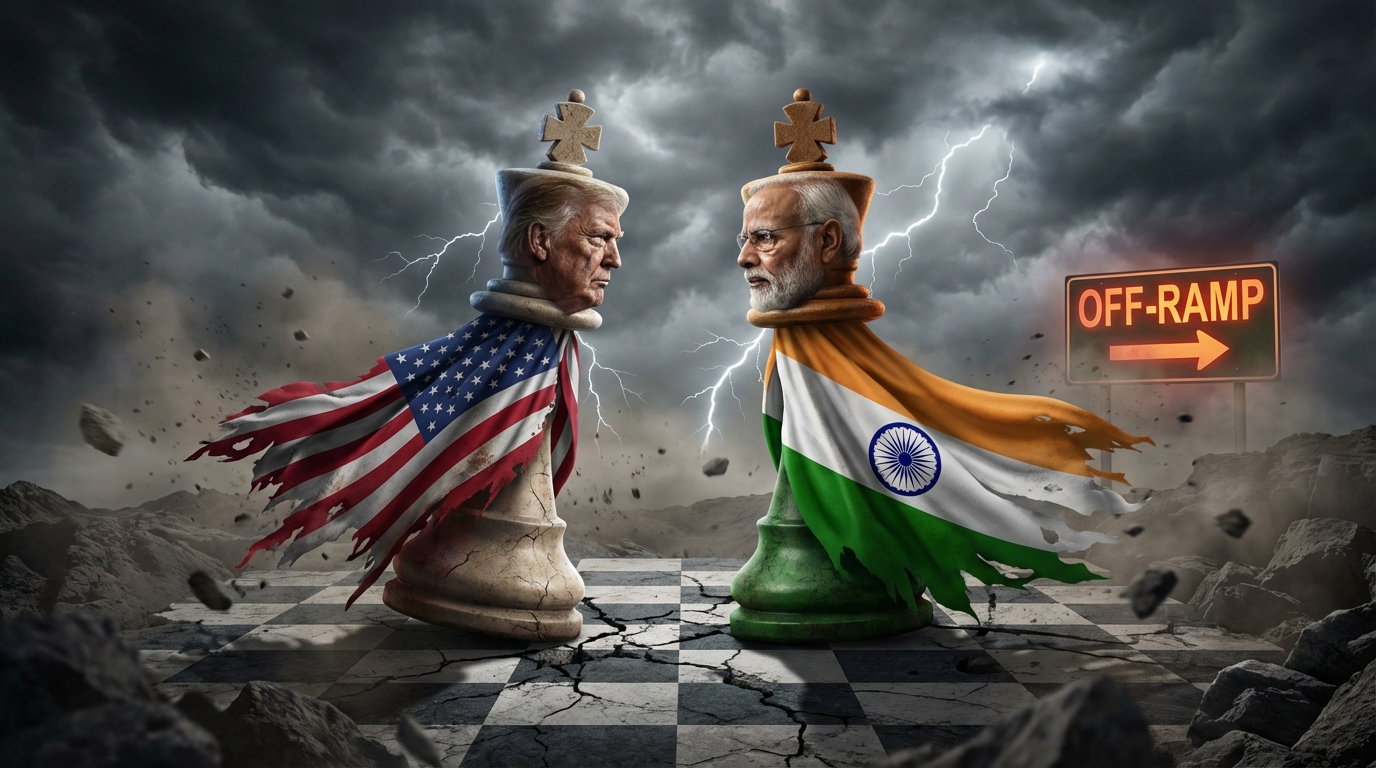
The Off-Ramp: Why Modi Must Swallow His Pride Before It's Too Late
In an irrational world, rational notions need recalibration.
Let us dispense with the comfortable fiction that the India-US standoff is primarily about tariffs, oil imports, or trade deficits.
It is not.
This is about ego. Two egos, to be precise - one wounded, one defiant. And unless one of them bends, India will pay a price far exceeding any tariff.
The Original Sin
The rupture between Donald Trump and Narendra Modi can be traced to a single moment: the denial.
When Trump claimed - over thirty-five times by his own count - that he personally brokered the India-Pakistan ceasefire in May 2025, Modi's response was unequivocal. "India does not and will never accept mediation," his government declared.
This was factually correct. India has always maintained that Kashmir is a bilateral issue. No third party, however powerful, gets a seat at that table.
But being correct and being wise are not the same thing.
Trump, a man whose self-image depends on being seen as history's greatest dealmaker, was publicly contradicted by an ally he had embraced at Houston's "Howdy Modi" rally. The narcissistic wound was deep. The retaliation has been proportionate to the perceived insult.
Fifty percent tariffs. Sanctions threats on Russian oil. The public mockery - calling India a "dead economy," suggesting we buy oil from Pakistan, describing Modi as "not that happy" with a condescending smirk.
This is not trade policy. This is revenge.
The Flattery Masterclass
While India stood on principle, Pakistan took notes.
Consider what Islamabad has achieved in twelve months:
Field Marshal Asim Munir is now Trump's "favorite field marshal," a "great, great guy," an "inspiring personality." Pakistani leaders are regular guests at the White House. A Nobel Peace Prize nomination for Trump was floated - from Islamabad, naturally. The ceasefire? Pakistan publicly credited Trump as the peacemaker, repeatedly and effusively.
The result? Lower tariffs than India. Fresh Raytheon missile shipments. A presidential visit to Pakistan. And most remarkably, a complete reversal from Trump 1.0, when he called Pakistan "deceitful" and cut military aid.
"He now likes Pakistan because Pakistan likes him," observed Husain Haqqani, Pakistan's former ambassador to Washington.
It really is that simple.
India, meanwhile, sits atop the high horse of multipolarity and strategic autonomy, watching Pakistan make hay with flattery, lobbying, and - let us be honest - selective truth-telling about who deserves credit for what.
In a rational world, India's position would be the stronger one. We are the larger economy, the larger market, the more reliable democracy, the more capable military partner.
But we do not live in a rational world. We live in Trump's world. And in Trump's world, the currency that matters is not GDP or military capability. It is adulation.
The Cost of Principle
What has India's principled stance achieved?
Our exports face a 50% tariff wall. Textile exports to the US fell 23% in Q4 2025. IT services companies are relocating to Mexico. The rupee has breached 87. If the "Sanctioning Russia Act" passes, we face 500% tariffs on any entity touching Russian oil.
Meanwhile, India offered Trump the best trade deal any US administration has ever received - zero tariffs on industrial goods, phased reductions on automobiles and alcohol, fixed energy and defense purchases. The response from Commerce Secretary Howard Lutnick? The deal collapsed because "Modi didn't call Donald Trump."
A phone call. That's what this has come down to. Not market access, not tariff schedules, not regulatory reform. A phone call that would have required Modi to acknowledge Trump's dealmaking prowess.
Pride prevented that call. Pride may cost India billions.
The Third-Term Horizon
Here is the calculation that should focus minds in South Block: Donald Trump is not going away.
The conventional wisdom that midterm elections will humble him deserves scrutiny. Yes, Democrats currently lead in polls. Yes, Trump's approval has dipped. But Trump has defied conventional wisdom before.
More importantly, Trump is already laying groundwork for a third term. The constitutional amendment has been proposed. His allies are discussing "methods." Steve Bannon has declared that "Trump is going to be president in '28, and people just ought to get accommodated with that."
Whether he achieves this through amendment, succession schemes, or sheer force of will, the possibility cannot be dismissed. This is a man who refused to accept an electoral loss in 2020. Why would he accept a constitutional barrier in 2028?
If India's strategy depends on waiting Trump out, that strategy may require waiting until 2032 - or longer.
Can India afford eight more years of this?
The Window Before November
Here is what Delhi seems to miss: Trump needs India too - at least until November.
The Indian-American diaspora is 4.4 million strong. They vote. They donate. They are concentrated in swing states - Texas, Georgia, Pennsylvania, Michigan. In 2020, Indian-Americans broke 72% for Biden. Trump wants them back.
A trade deal with India before the midterms is not just good economics for Trump - it is good politics. He can claim victory over the "unfair" Indian market. He can pose as the dealmaker who succeeded where Biden failed. He can court diaspora donors with the narrative that he fixed the relationship.
This is India's leverage. Use it.
A deal closed before November 2026 would see Trump go the full monty - the grand signing ceremony, the praise for Modi, the rally in Edison, New Jersey with cheering Indian-Americans. He needs the optics. He needs the votes. He needs to neutralize the narrative that his tariffs hurt the community.
After November? The calculus changes entirely. If Republicans hold Congress, Trump becomes untouchable - free to pursue vendettas without electoral consequence. If Democrats take the House, he becomes embattled and unpredictable, lashing out at perceived enemies.
The window is now. Nine months. That is how long India has to negotiate from a position of mutual need rather than supplication.
Every week Delhi delays is a week closer to that window closing.
The Asian Alternative That Isn't
Some in Delhi comfort themselves with visions of alternative architectures. BRICS is expanding. India chairs it in 2026. A multipolar world is emerging.
Let us examine this honestly.
A pan-Asian economic union - an Asian EU - would indeed shift the balance of power. If China, India, Japan, South Korea, and Southeast Asia achieved the level of integration that Europe has, American leverage would diminish dramatically.
A RIC axis - Russia, India, China - would shift not just economic but military advantage. Three nuclear powers, two of them with the world's largest and fourth-largest militaries, aligned against Western pressure.
But these are fantasies.
China is not a dependable partner. Beijing supported Pakistan during the May 2025 conflict. The border dispute remains unresolved. The Dalai Lama succession looms. Xi Jinping views India as a rival to be contained, not an ally to be embraced.
The Modi-Xi meeting in August 2025 produced "breathing room, not breakthrough." Trade ties are recovering, but strategic trust is not. Every step toward cooperation is shadowed by the reality that China's "all-weather friendship" is with Pakistan, not India.
An Asian union requires Asian trust. That trust does not exist.
BRICS is a talking shop, not a power bloc. It has no mutual defense commitment, no common currency, no regulatory alignment. It is useful for photo opportunities and communiqués. It is not a substitute for access to the American market.
The hard truth is this: India has no viable alternative to managed relations with the United States. Not in 2026. Perhaps not for a generation.
The Off-Ramp
So what should Modi do?
First, make the phone call. Find a formula that acknowledges "international support" for de-escalation without explicitly crediting Trump's mediation. Let Trump claim victory. The American president's ego is not worth India's economic future.
Second, accelerate the trade deal. The offer on the table is generous. Close it before the midterms, while Trump still needs a win. A signed agreement is harder to reverse than a tariff threat.
Third, recalibrate the Russian oil calculus. India has already reduced imports by 40%. Go further - not because America demands it, but because the leverage it provides to hostile actors is too great. Replace Russian crude with Gulf and American supplies. Yes, it costs more. Independence always does.
Fourth, stop expecting rationality. Trump does not operate on the logic of mutual benefit, alliance structures, or strategic partnership. He operates on the logic of transaction and tribute. India can bemoan this or adapt to it. Only one of these options produces results.
Fifth, play the long game on alternatives. Continue building ties with Europe, the Gulf, Southeast Asia. The EU FTA matters. The India-Middle East-Europe corridor matters. Diversification reduces dependence. But diversification takes decades. In the meantime, the American relationship must be managed.
The Lesson
There is no glory in being right and ruined.
India's position on mediation is correct. Our commitment to strategic autonomy is admirable. Our refusal to be bullied is honorable.
But honor does not pay for imports. Principle does not create jobs. Strategic autonomy means nothing if the economy it protects is strangled by tariffs.
Modi has built his image on strength - the 56-inch chest, the muscular nationalism, the leader who doesn't back down. That image now traps him. Backing down, even tactically, even temporarily, feels like defeat.
It is not defeat. It is strategy.
The great powers of history were not those who never retreated. They were those who knew when to advance and when to withdraw, when to fight and when to negotiate, when to stand on principle and when to pocket a deal.
China understood this when Deng Xiaoping counseled "hide your strength and bide your time." Japan understood this when it rebuilt under American occupation. Even Pakistan understands this, crudely, when it trades flattery for favor.
India must understand it too.
The off-ramp exists. The trade deal is there for the taking. The phone call can be made.
The only question is whether pride will let us take it.
The author is Founder & Editor-in-Chief of BarathVector.