By Ramachandran Rajeev Kumar — 2026-02-28
The Maple Reset: How Mark Carney Is Undoing Trudeau's Most Expensive Blunder
A relationship that should never have broken is finally being mended -- by an adult in the room
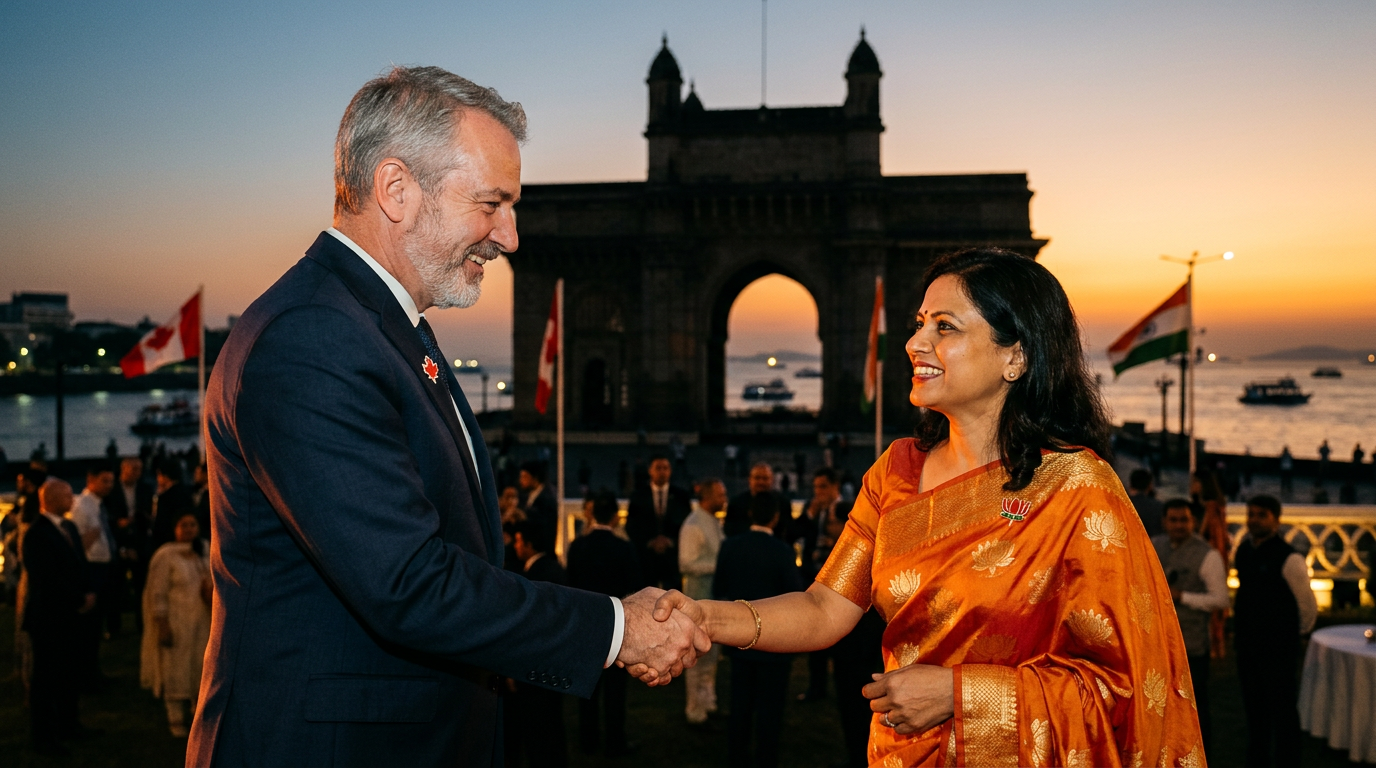
When Canadian Prime Minister Mark Carney stepped off his aircraft in Mumbai on February 27, he did something his predecessor never managed in nine years of power: he arrived in India looking like a leader with a plan rather than a tourist with a grievance.
The four-day visit -- Carney's first to India since taking office, and the most significant Canadian diplomatic engagement with New Delhi in over three years -- is being framed by both governments as a "reset." That word is diplomatic understatement at its finest. What Carney is actually doing is performing emergency surgery on a relationship that Justin Trudeau nearly killed through a toxic cocktail of domestic political calculation, intelligence theatre, and a fundamental misreading of how the world actually works.
The bilateral relationship between Canada and India was, for decades, one of the quieter success stories of democracy-to-democracy engagement. Two Commonwealth nations. A 1.9-million-strong Indian diaspora in Canada. Bilateral trade that, while modest by global standards, was steadily growing. Then Trudeau turned the whole thing into a bonfire -- and for what?
The Trudeau Wreckage
The timeline is worth recounting because the sheer speed of the deterioration was remarkable.
In September 2023, Justin Trudeau stood in the House of Commons and announced that Canadian security agencies had "credible allegations" linking agents of the Indian government to the killing of Hardeep Singh Nijjar, a Canadian citizen and prominent Khalistan activist, gunned down outside a gurdwara in Surrey, British Columbia three months earlier.
The accusation was extraordinary -- one democracy accusing another of orchestrating an extrajudicial killing on its soil. India denied the allegations categorically. The diplomatic fallout was immediate and catastrophic.
Both nations expelled diplomats. Canada recalled its High Commissioner. India demanded "parity" in diplomatic representation. Three Canadian consulates in India were shuttered. Travel advisories were issued in both directions. The Comprehensive Economic Partnership Agreement -- CEPA -- which had been under negotiation for over a decade, was frozen.
By October 2024, the escalation had reached absurd proportions. Canada expelled the Indian High Commissioner along with five other diplomats. India reciprocated. David Morrison, Canada's Deputy Minister of Foreign Affairs, named Indian Home Minister Amit Shah in connection with the allegations -- a move that crossed every convention of diplomatic restraint.
Bilateral goods trade, which had been around $8.7 billion, declined by thirteen percent in the first nine months of FY2026. Indian students -- who had been contributing nearly $5 billion annually to Canada's education economy -- began looking elsewhere. The people-to-people ties that had taken decades to build were fraying at the seams.
All of this -- all of it -- because one prime minister decided that domestic political theatre was worth more than a strategic relationship with the world's fastest-growing major economy.
Enter Carney: The Banker Who Understands Balance Sheets
Trudeau resigned as Liberal Party leader in January 2025. Mark Carney, the former Governor of both the Bank of Canada and the Bank of England -- a man whose entire career was built on understanding systemic risk and structural interdependence -- took office in March 2025.
The difference in approach was immediately apparent.
Where Trudeau led with accusation, Carney led with economics. Where Trudeau amplified the crisis for domestic consumption, Carney quietly de-escalated. Envoys were restored. Back-channel conversations resumed. Canadian officials began saying, almost sheepishly, that India was "no longer a security threat" -- a phrase that would have been unnecessary had the threat not been so recklessly manufactured in the first place.
Carney's India visit, stretching from February 27 to March 2, is the physical manifestation of this pivot. The itinerary tells the story. Mumbai first -- meetings with CEOs, innovators, and pension fund leaders. The message: this is about business, not posturing. Then New Delhi, where Carney will sit down with Prime Minister Modi on March 2 at Hyderabad House for delegation-level talks and a joint appearance at the India-Canada CEOs Forum.
The agenda is staggering in its ambition. A uranium supply agreement worth an estimated 2.8 billion Canadian dollars over ten years. CEPA negotiations relaunched with a target of doubling bilateral trade to $70 billion by 2030. Defence cooperation agreements. Partnerships on nuclear energy, oil and gas, artificial intelligence, quantum computing, and aerospace.
Bloomberg reported that an "immense" range of deals would be signed. India's External Affairs Ministry confirmed the broad sweep of discussions -- trade, energy, technology, AI, defence, talent, and culture. In diplomatic language, this is not a handshake -- it is an embrace.
The Trump Factor Nobody Is Ignoring
There is a reason Carney's pivot to India is happening now, and it has as much to do with Washington as with New Delhi.
Donald Trump's trade war has rattled Canada to its core. The 25% tariffs on Canadian goods, the open musing about annexation, the aggressive rhetoric about renegotiating NAFTA's successor -- all of this has concentrated Canadian minds on a reality that should have been obvious years ago: a nation that sends 75% of its exports to a single market is not diversified. It is dependent.
Carney understands this better than most. His entire economic philosophy is built on risk diversification. India, with its 1.4 billion consumers, its growth trajectory, its insatiable appetite for energy and technology -- is the obvious hedge against American unpredictability.
After India, Carney travels to Australia and Japan. The pattern is unmistakable: a systematic effort to build what he calls a "middle powers" trading order -- nations that share democratic values and economic ambition but refuse to be vassals of any single superpower.
India, for its part, is happy to receive. Uranium for its expanding nuclear programme -- including the ambitious reactor deployment under the SHANTI Act of 2025. Canadian LNG for its growing gas infrastructure. Critical minerals for its semiconductor ambitions. And most importantly, a demonstrated willingness from a major Western democracy to engage as an equal rather than lecture as a moral superior.
The Khalistan Question: An Excuse That Has Outlived Its Welcome
No honest analysis of the India-Canada relationship can avoid the Khalistan issue. It is the poison in the well, the convenient fiction that radical elements have exploited for decades to extract political concessions in Ottawa while contributing nothing of value to either country.
Let us be direct about what Khalistan actually is in the Canadian context.
It is not a mass movement. It is not a credible political project. It is not supported by the overwhelming majority of the nearly 800,000 Sikhs in Canada -- the largest Sikh community outside India. What it is, in practice, is a vehicle for a small number of individuals and organisations to gain political visibility, attract funding from diaspora sentimentality, and in some documented cases, to use the rhetoric of separatism as a pathway to immigration sympathy and citizenship claims.
The Khalistan Referendum campaign -- championed by outfits like Sikhs for Justice, a group banned in India as an unlawful association -- has never produced results that suggest anything close to majority Sikh support. The referendums held in various Western countries are non-binding, poorly attended relative to the diaspora population, and serve primarily as fundraising and recruitment tools.
More concerning is the documented intersection between pro-Khalistan networks and organised crime in Canada. The ties between Sikh gangs and pro-Khalistan movements have strengthened over the years, with several gang members simultaneously holding separatist affiliations. This conflation -- criminal enterprise cloaked in political cause -- is precisely what both Canadian and Indian intelligence agencies should be collaborating to dismantle, not what Canadian prime ministers should be weaponising for domestic political gain.
The Nijjar case, whatever its ultimate judicial resolution, exposed the dysfunction of Canada's approach. A man on India's wanted list for terrorism, who had been granted asylum and then citizenship in Canada, was elevated posthumously into a symbol of Canadian sovereignty. The investigation, the accusations, the diplomatic war -- all of it played into the hands of precisely the radical elements that both democracies should be united against.
Sikhs and India: The Bond That Separatism Cannot Break
Here is what the Khalistan narrative wilfully ignores: Sikhs are not foreigners in India. They are among its most valued, most visible, most accomplished communities.
The Sikh contribution to India's military is legendary and disproportionate to their two percent share of the population. From the world wars to Kargil, Sikh soldiers have defined Indian martial tradition. The Indian Army's Sikh Regiment is among the most decorated units in any modern military anywhere. Sikh generals, admirals, and air marshals have led India's armed forces. Manmohan Singh -- a Sikh -- served as Prime Minister for a decade.
The agricultural economy of Punjab, built overwhelmingly by Sikh farming families, feeds India. Sikh entrepreneurs run businesses across every sector. Sikh cultural and religious institutions are integral to India's fabric -- the Golden Temple in Amritsar is not just a Sikh shrine but a national treasure, visited by Indians of every faith.
Yes, 1984 happened. The anti-Sikh pogroms that followed Indira Gandhi's assassination were a national disgrace -- an eruption of violence that killed over 2,700 Sikhs, destroyed homes and gurdwaras, and left scars that endure four decades later. India should own that history without qualification. It was a failure of the state, a crime abetted by political actors, and a wound that the country's judicial system took unconscionably long to address -- with the first major conviction coming only in 2018.
But 1984 was an aberration, not the norm. It was a moment when the Indian state failed its own people -- as states sometimes do, tragically. It was not a reflection of how India sees its Sikh citizens, then or now. The Sardars of Punjab are kin. They are family. The separatist narrative that seeks to divorce Sikh identity from Indian identity is built on a selective reading of history, amplified by distance and diaspora grievance, and sustained by a small number of actors whose interests are served by keeping the wound open rather than letting it heal.
Canada -- under Carney, one hopes -- must come to understand this distinction. The Khalistan movement in its current form serves neither the Sikh community nor Canadian national interests. It provides cover for criminal elements, strains a vital bilateral relationship, and insults the millions of Sikhs who are proud Indians, proud Canadians, and proud citizens of both without any contradiction.
The Road Ahead: What a Real Partnership Looks Like
If Carney's visit delivers even half of what is being discussed, the trajectory of India-Canada relations will shift fundamentally.
Consider the uranium deal alone. India's nuclear programme -- critical to its net-zero ambitions and its energy security -- needs reliable, long-term fuel suppliers. Canada, which possesses the world's largest high-grade uranium deposits, is the natural partner. The proposed ten-year supply agreement would anchor the bilateral relationship in something far more durable than diplomatic niceties: structural economic interdependence.
CEPA, if concluded within the year as both sides hope, would be transformative. India is already Canada's seventh-largest trading partner in goods and services. A comprehensive free-trade agreement would unlock sectors currently hampered by tariff barriers -- pharmaceuticals, agriculture, technology services, financial services. The target of $70 billion in bilateral trade by 2030 is ambitious but achievable if political will holds.
Defence cooperation -- the most sensitive area, given the recent history -- signals that both governments are willing to look forward rather than backward. Joint exercises, technology sharing, and cooperation in the Indo-Pacific theatre would give the relationship strategic depth it has never had.
And then there is the people dimension. Nearly two million Canadians trace their heritage to India. Indian students remain among the largest international cohorts in Canadian universities. Indian tech professionals constitute the single biggest national group in Canada's technology workforce. These are not abstract statistics -- they are families, businesses, communities that need both governments to behave like responsible partners rather than petulant antagonists.
The Lesson Trudeau Never Learned
The deepest lesson of the India-Canada crisis is not about Khalistan, or intelligence operations, or trade deficits. It is about leadership.
Justin Trudeau treated a complex bilateral relationship as a domestic political instrument. He played to a gallery -- a narrow, vocal constituency that rewarded performative outrage -- and in doing so, damaged a relationship that served millions of Indians and Canadians who never asked for the fight.
Mark Carney, by contrast, appears to understand that the job of a leader is not to win applause from the loudest voices in the room but to build structures that serve the broadest possible interest over the longest possible timeline. His background in central banking -- where credibility is everything and rhetoric without substance destroys value -- may be precisely the temperament this bilateral relationship needs.
India, too, deserves credit for not burning bridges permanently. New Delhi's restraint, while imperfect, kept the door open for exactly the kind of re-engagement that is now unfolding. The Modi government's willingness to host Carney with full honours, to put an ambitious agenda on the table, and to treat the visit as a genuine turning point rather than a victory lap, reflects strategic maturity.
Two democracies, each imperfect in their own ways, have spent three unnecessary years locked in a crisis manufactured by one man's political vanity. The adults have arrived. The reset is underway. May this time, both sides remember what they forgot: that the distance between Ottawa and New Delhi is measured not in kilometres but in the will to choose partnership over posturing.