By BarathVector Editorial — 2026-03-04
The Compound Dividend: Uranium, Lithium, and the Architecture of India-Canada Interdependence
The deals have landed. The reset is no longer atmospheric -- it is contractual.
Four days ago, BarathVector published "The Maple Reset," our analysis of Mark Carney's arrival in India as the first Canadian Prime Minister to visit New Delhi in over three years. We called it a diplomatic emergency surgery -- a pragmatist's attempt to repair what his predecessor had vandalised through political vanity and intelligence theatre.
We were cautiously optimistic. The trajectory looked positive but the substance was still atmospheric. It was handshakes and optics, signal without contract.
That was four days ago.
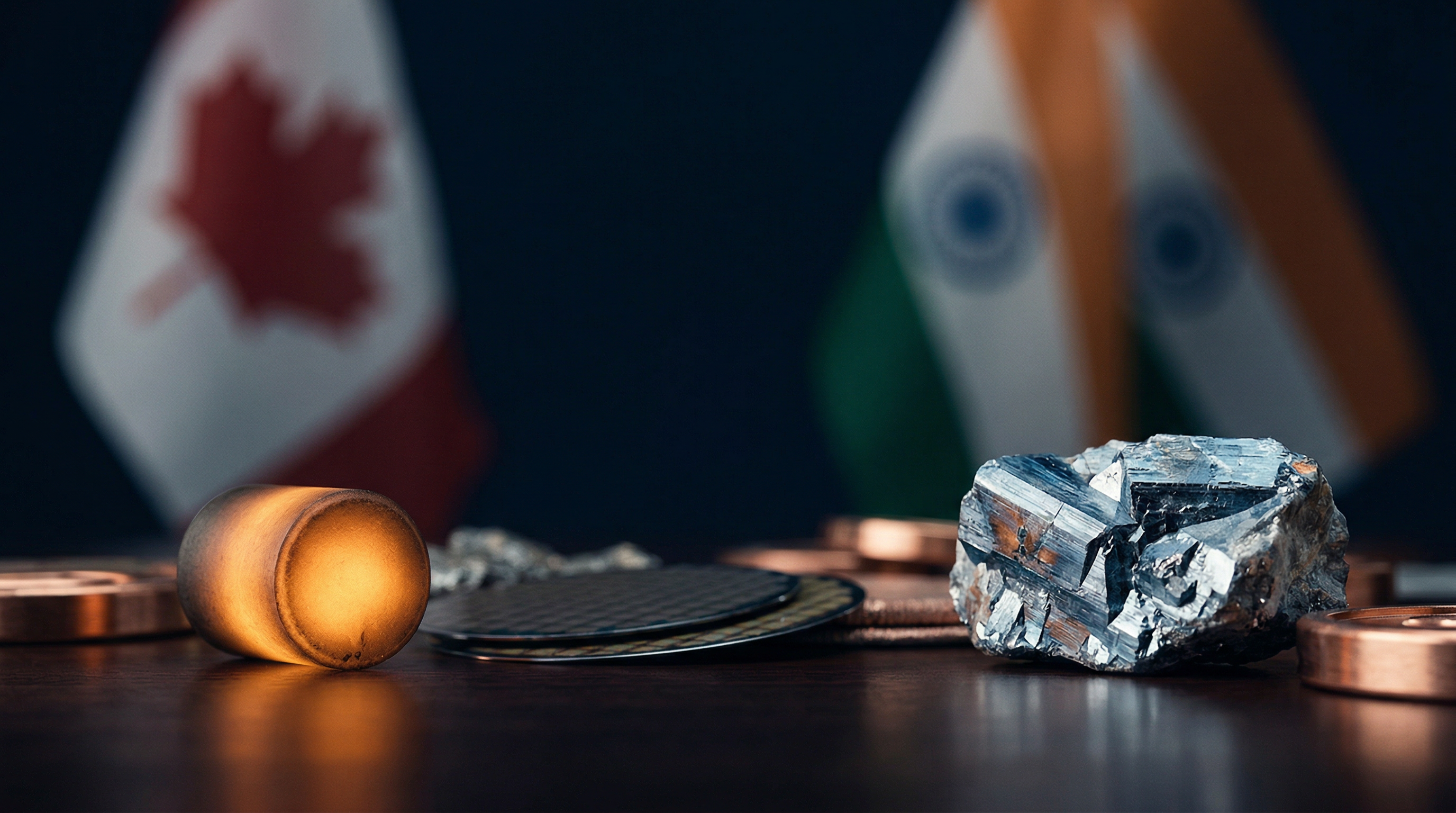
On March 2, 2026, Carney and Modi sat down at Hyderabad House and signed what can only be described as a strategic recalibration of the entire bilateral architecture. A CA$2.6 billion uranium supply agreement. A critical minerals pact covering rare earths, lithium, and cobalt. Space cooperation between ISRO and the Canadian Space Agency. A roadmap to $50 billion in annual bilateral trade by 2030 -- nearly four times the current $13 billion. A new strategic energy partnership spanning LNG, LPG, uranium, solar, hydrogen, and clean energy.
The Maple Reset is over. The Maple Dividend has begun.
The Uranium Contract: Nuclear Fuel in a Chokepoint World
Of all the agreements signed on March 2, the Cameco uranium deal deserves the most attention -- not because it is the largest in dollar terms, though at CA$2.6 billion over eight years (2027-2035) for nearly 22 million pounds of uranium ore concentrate, it is certainly substantial. It deserves attention because of what it means in the context of the Hormuz crisis.
As we detailed in our companion analysis -- "The Hormuz Chokehold" -- India imports 88.2 per cent of its crude oil, and roughly half of that transits through the Strait of Hormuz, which is now under de facto shutdown following Iran's IRGC closure. Oil prices have surged past $82 a barrel. The Sensex has crashed. Every macroeconomic assumption the RBI made six weeks ago has been invalidated.
In this environment, nuclear energy is not an aspiration. It is a survival strategy.
India currently operates 24 reactors with an installed capacity of approximately 8.8 GW. That is respectable but insufficient -- nuclear power accounts for barely 3 per cent of India's electricity generation. The government's Nuclear Energy Mission, anchored in the SHANTI Act passed in December 2025, targets 100 GW of nuclear capacity by 2047 -- a more than tenfold expansion that would require reliable, long-term uranium supply at industrial scale.
This is where the Cameco deal becomes existential rather than merely commercial.
Canada was historically India's uranium supplier. That supply chain was frozen after India's 1974 nuclear test -- the so-called "Smiling Buddha" -- when Canada suspended nuclear cooperation entirely. A cautious re-engagement began in 2015 with a five-year Cameco supply contract, but the Trudeau-Nijjar crisis froze that too.
Carney has now restored a half-century-old supply chain at precisely the moment India needs energy diversification most desperately. Nuclear energy is the bridge fuel that does not transit chokepoints. Uranium arrives by cargo ship or aircraft, not through contested straits. Canada's Saskatchewan province holds the world's largest high-grade uranium deposits. The logistics are straightforward, the supply is secure, and the political will -- at last -- is aligned.
Critical Minerals: The Second Strategic Dimension
The uranium deal captured the headlines, but the critical minerals memorandum of understanding may prove equally consequential over the next decade.
India's semiconductor ambitions -- anchored in the $10 billion India Semiconductor Mission -- require reliable access to rare earths, lithium, cobalt, and other strategic minerals currently dominated by Chinese supply chains. India's electric vehicle programme, which aims to achieve 30 per cent EV penetration by 2030, has the same dependency. Without secure mineral supply, both programmes remain hostage to Beijing's willingness to sell.
Canada is one of the few democracies with significant reserves of these minerals and the geological survey infrastructure to develop them. The MoU signed between India's Ministry of Mines and Canada's Department of Natural Resources covers exploration, mining, beneficiation, processing, investment promotion, and technical exchange.
This is not a token gesture. This is supply chain architecture for India's industrial future -- semiconductors, batteries, defence electronics, renewable energy hardware -- built on a foundation of democratic partnership rather than authoritarian dependency. If the uranium deal addresses India's energy present, the critical minerals pact addresses its technological future.
Space, AI, and the Innovation Corridor
The ISRO-CSA space cooperation agreement extends the partnership into domains where both nations have world-class capabilities. Earth observation -- where ISRO's satellite constellation is already among the most sophisticated globally -- will benefit from Canadian expertise in synthetic aperture radar and Arctic monitoring technologies. Quantum technology cooperation opens pathways in secure communications and computational science.
Artificial intelligence cooperation was also on the agenda, along with defence partnerships that signal both governments are willing to look forward rather than backward. Joint exercises, technology sharing, and cooperation in the Indo-Pacific theatre would give the relationship strategic depth it has never possessed.
The combined value of the partnerships announced exceeds $5.5 billion. But the real value lies not in the contracts themselves but in what they represent: a structural shift from transactional diplomacy to systemic economic interdependence. Carney, the central banker, understands that relationships denominated in supply chains and energy contracts are more durable than those denominated in diplomatic niceties. He is building a balance sheet, not writing a press release.
The CEPA Roadmap: From $13 Billion to $50 Billion
Perhaps the most ambitious commitment was the signed Terms of Reference to guide negotiations toward a Comprehensive Economic Partnership Agreement, with a target of concluding by end-2026.
CEPA has been under negotiation, in various forms, for over a decade. Under Trudeau, it was perpetually six months from conclusion and permanently stalled. The Nijjar crisis killed whatever momentum remained.
Carney and Modi have now set a public target of raising annual bilateral trade to $50 billion by 2030 -- up from the current $13 billion. Canada's total direct and indirect investment in India already surpasses $110 billion, suggesting the commercial appetite exists on both sides. What has been missing is political will.
If CEPA is concluded within the year, it would unlock sectors currently hampered by tariff barriers -- pharmaceuticals, agriculture, technology services, financial services, education. It would be the most significant trade agreement India has signed with a G7 nation in this decade.
The question is not whether the economics justify it. They do. The question is whether the political class in Ottawa can sustain the momentum beyond the honeymoon period. Carney has twelve months to prove that he can deliver substance where Trudeau delivered only speeches.
The Khalistan Elephant: Deprioritised, Not Resolved
No honest assessment of the Maple Dividend can avoid the issue that nearly destroyed the relationship in the first place.
Trudeau's relationship with India collapsed over the Hardeep Singh Nijjar assassination allegations in September 2023. Canada expelled Indian diplomats. India retaliated. Intelligence sharing froze. Trade talks died. The Khalistan separatist movement -- which India considers a terrorist threat and which Trudeau allowed to flourish for domestic political reasons -- became the defining issue of the bilateral relationship.
Has Carney resolved this? Not entirely. The investigation continues. India has rejected what it calls "baseless" allegations. The legal processes around Nijjar will run their course through judicial channels.
But Carney has done something Trudeau never could: he has deprioritised the issue. A senior Canadian government official told reporters, two days before Carney landed in New Delhi, that India was "no longer a threat" to Canadian security -- a formulation that effectively walked back three years of escalation without explicitly admitting the previous government had overreacted.
This is pragmatic diplomacy. The intelligence and legal processes will continue, but they will not be allowed to hold the entire bilateral relationship hostage. Carney has signalled that Canada's national interest lies in economic partnership with India, not in becoming a platform for separatist movements that have negligible traction in Punjab itself and serve primarily as vehicles for a small number of actors whose interests are served by keeping old wounds open.
Meanwhile, pro-Khalistani groups in Canada have been staging targeted protests aimed at sabotaging the reset. That these groups are actively trying to tear down a partnership that serves 1.8 million Indo-Canadians tells you everything about whose interests the separatist movement actually serves. The answer is not the Sikh community's.
The Education Corridor: Fourth Dimension of Partnership
There is a dimension of the India-Canada relationship that gets insufficient strategic attention: the education and talent pipeline.
India remains the largest source of international students in Canada. Approximately 1.8 million Canadians trace their heritage to India. Indian students contribute billions annually to the Canadian economy through tuition, housing, and consumer spending. After graduation, many join Canada's workforce, addressing labour shortages in healthcare, technology, and trades.
Carney announced new measures specifically for Indian students during his visit -- scholarships, university partnerships, and hybrid campuses linking institutions in both countries. A CA$100 million scholarship programme was unveiled, representing the most significant expansion of educational cooperation between the two nations in decades.
But both nations must strive to balance this for mutual growth. Immigration policy cannot become one-way traffic or a strain on Canada. Trudeau's unchecked immigration surge -- permanent residency intake that peaked near 500,000 annually -- created housing pressure, wage depression in entry-level sectors, and a political backlash that partly fuelled his downfall. Canada has since cut PR intake to 380,000 per year, with approximately 927,000 work permits set to expire across 2026.
Carney must manage the pipeline more intelligently than his predecessor. The formula is not complicated, even if execution is: more Canadian imports of Indian goods and services, linked to a managed increase in Indian workforce participation in Canada. Indian workers earn, send remittances home, and build bridges between the two economies. Canadian businesses get skilled labour and access to the Indian market. Both economies grow. But it requires deliberate bilateral management, not laissez-faire open borders.
The education corridor is the gateway -- Indian students become Canadian taxpayers become bilateral trade ambassadors. The Carney government has partially adopted this logic by reserving 33,000 PR spots specifically for temporary workers with strong community roots. It is a start. It is not yet a strategy.
The Compound Dividend
Step back and view the Carney deals in aggregate. What emerges is not a diplomatic reset but a structural realignment.
Uranium addresses India's energy security crisis in a chokepoint world. Critical minerals address its semiconductor and EV supply chain vulnerability. Space cooperation extends joint capabilities in earth observation and quantum technology. CEPA addresses bilateral trade potential that has been left on the table for a decade. The education corridor sustains the people-to-people infrastructure that makes all of the above possible.
Each deal reinforces the others. Uranium supply enables nuclear energy expansion. Nuclear energy reduces oil import dependency. Reduced oil dependency reduces exposure to Hormuz. Critical minerals enable semiconductor manufacturing. Semiconductor manufacturing enables defence and technology self-reliance. Trade growth creates the economic incentive to keep the political relationship stable.
This is what structural interdependence looks like. It is not one deal -- it is a compound dividend where each element makes the others more valuable and more durable.
Cautious Credit, Not Unconditional Trust
BarathVector gives credit where it is due. Mark Carney has, in the space of four days, accomplished more substantive progress in the India-Canada relationship than Trudeau managed in nine years. He has demonstrated that he understands the difference between diplomatic theatre and strategic partnership. He has shown that a former central banker can read a geopolitical balance sheet as fluently as a financial one.
But cautious credit is not unconditional trust.
The Khalistan issue remains unresolved. The legal proceedings around Nijjar will continue to generate headlines and political pressure. Pro-Khalistani groups in Canada will continue their attempts to sabotage the partnership. Immigration management remains a live challenge that could generate fresh bilateral friction if mishandled.
CEPA must be concluded, not merely announced. The $50 billion trade target must be supported by actual tariff reductions and market access, not just press conferences. The critical minerals MoU must translate into actual mining operations, processing facilities, and supply contracts -- not simply another memorandum that gathers dust in a diplomatic filing cabinet.
Carney has earned the right to be watched with hope rather than suspicion. He has not yet earned the right to be trusted without verification.
The deals are real. The trajectory is positive. The Maple Dividend is now denominated in uranium, lithium, cobalt, and the futures of 1.8 million Indo-Canadians who need both governments to behave like partners rather than antagonists.
Let us see if the dividend compounds.
This is the second article in BarathVector's India-Canada series. The first -- "The Maple Reset: How Mark Carney Is Undoing Trudeau's Most Expensive Blunder" -- was published on February 28, 2026. For the energy security context, see "The Hormuz Chokehold: Why India's Answer Lies 1,200 Kilometres East of Chennai."