By Ramachandran Rajeev Kumar — 2024-10-12
By Ramachandran Rajeev Kumar
The 180-Degree Turn
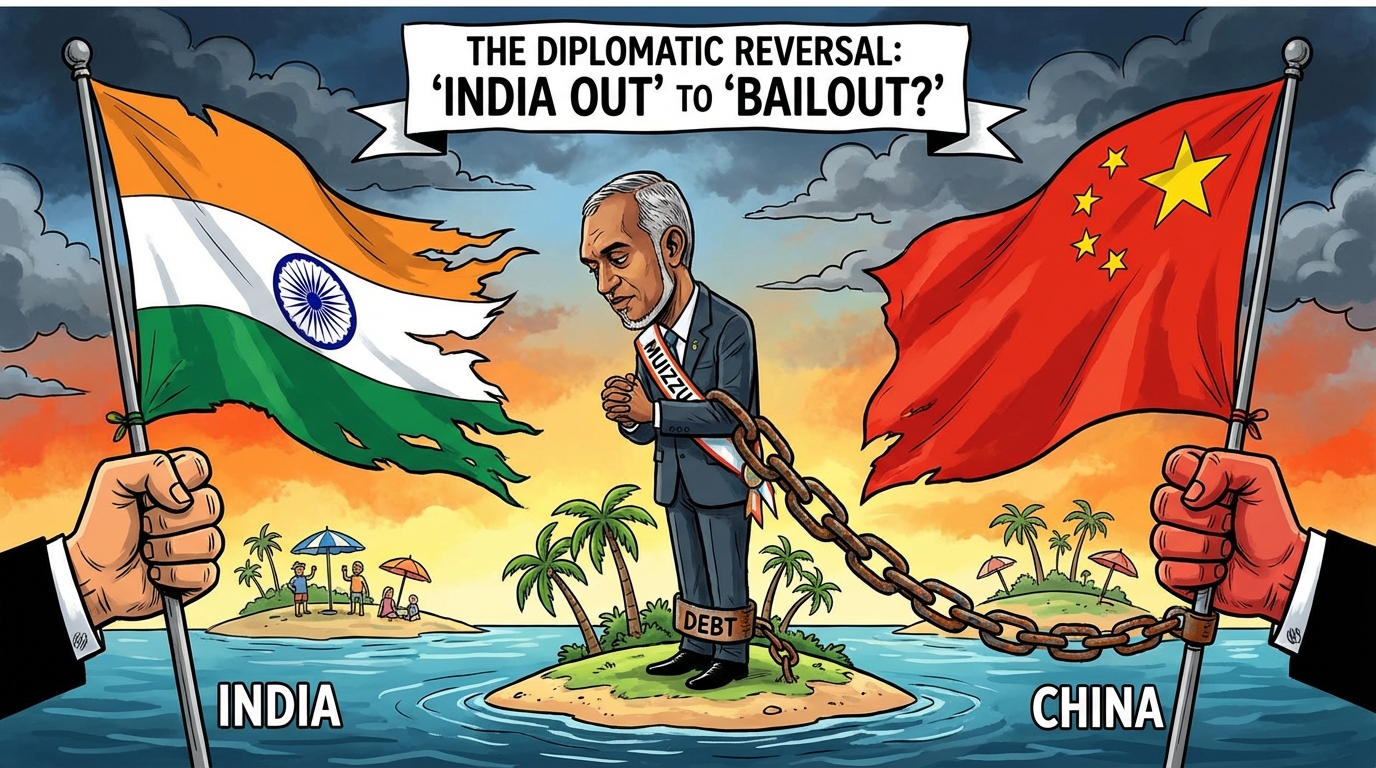
November 2023: Mohamed Muizzu wins Maldives presidency on "India Out" campaign. First action: demand withdrawal of ~75 Indian military personnel. First foreign visit: Turkey—breaking decades of tradition of visiting India first.
October 2024: Muizzu arrives in New Delhi on first state visit, saying "Maldives has never opposed India." Secures $760 million currency swap bailout from India. Promises "Maldives will not harm India's security interests."
What changed in one year?
- Indian tourism crashed 37.5%
- China became #1 tourist source—but provided zero fiscal support
- Maldives debt hit 110% of GDP ($8.2 billion total)
- IMF warned of "debt distress"
- Muizzu realized: You can't eat geopolitics.
The 'India Out' Gamble
Mohamed Muizzu ran on an explicit anti-India platform. His campaign painted New Delhi as a hegemon eroding Maldivian autonomy. His promise: kick out Indian military personnel and pivot to China.
November 17, 2023: Muizzu takes office, immediately demands Indian troops leave.
Late November 2023: Breaks tradition by visiting Turkey first, not India. Signal sent: Maldives is done with India-first policy.
December 2023: India agrees to withdraw. All 75 Indian military personnel repatriated by May 10, 2024.
Muizzu got what he wanted. India was out. Now what?
The Tourism Collapse
The Trigger
January 2024: Maldivian government officials mock PM Modi's visit to India's Lakshadweep islands (India's own tropical paradise). Social media firestorm erupts in India. #BoycottMaldives trends. Indians cancel bookings en masse.
The Numbers
Indian tourist arrivals fell from 209,000 (2023) to 130,805 (2024)—a 37.5% collapse.
India's ranking: #1 tourist source (2023) → #6 (2024).
Monthly carnage:
- February 2024: -40.9%
- March 2024: -54%
- April 2024: -55.6%
Translation: Hotels empty. Revenue gone. Foreign exchange evaporating.
Why It Hurt
India was not just the largest tourist source—Indian travelers were consistent, year-round visitors. Western tourists come seasonally. Chinese tourists come in groups. Indian tourists come throughout the year, fill mid-range resorts, and spend predictably.
Lose them, and you lose the financial backbone of your tourism sector.
The China Illusion
The Numbers Look Good
Chinese tourists surged 40.7%: 263,340 arrivals in 2024, making China the #1 source (12.9% market share).
Muizzu celebrated. Problem solved, right? Replace Indian tourists with Chinese tourists. Pivot complete.
The Reality: China Brought Tourists, Not Money
Here's what China didn't provide:
- Fiscal Support During Crisis
Maldives debt-to-GDP ratio: 110%. Total debt: $8.2 billion.
Of that, $1.3 billion is owed to China. Over 60% of sovereign-guaranteed debt is to Chinese financial institutions (China Development Bank, Export-Import Bank of China).
But when Maldives faced:
- $600-700 million debt obligations in 2025
- $1 billion+ in 2026
- IMF warning of "debt distress" in February 2024
China did: Nothing.
No currency swap. No rollover. No emergency loan. No fiscal bailout.
- The Debt Trap Reality
China's Belt and Road Initiative (BRI) gave Maldives infrastructure loans. Those loans built bridges, airports, and ports. But they came with:
- High interest rates
- Short repayment windows
- Limited grace periods
When the bills came due, China expected payment—or collateral.
The fear: Another Sri Lanka scenario, where inability to repay Chinese loans led to handing over Hambantota Port on a 99-year lease.
- Tourist Revenue Didn't Cover Debt
Chinese tourists came in large numbers. But tourism revenue alone doesn't solve a fiscal crisis. You need:
- Foreign exchange reserves (Maldives: depleted)
- Budget support (China: provided none)
- Debt restructuring (China: offered none)
Chinese tourists spent money on resorts. But that revenue wasn't enough to cover debt repayments to China, much less other obligations.
The Crawl Back to India
The Reversal
By mid-2024, Muizzu realized: The 'India Out' policy was bankrupting the Maldives.
October 2024: Muizzu visits India on his first state visit—nearly a year after taking office.
His message: "Maldives has never opposed India. We value India as a close neighbor and friend."
Translation: "Please bail us out."
What India Provided
India, despite being snubbed, insulted, and strategically undermined, stepped in:
- October 2024: $760 million currency swap agreement (bilateral bailout)
- May 2024: $50 million Treasury Bill rollover (budgetary support)
- September 2024: Additional $50 million Treasury Bill extension
Total India support in 2024: ~$860 million.
China support in 2024: $0 in emergency fiscal assistance.
The New Promise
Muizzu, in New Delhi, October 2024: "Maldives will not do anything that would harm India's security interests."
Compare to:
November 2023: "India Out. Remove your troops."
One year later: "India, we need you."
Why the Pivot Failed
1. Maldives Misread Geopolitics
Muizzu assumed: If you distance yourself from India, China will replace it as a patron.
Reality: China lends. India rescues.
China builds infrastructure and sends tourists. But when you face a fiscal crisis, China doesn't bail you out—it collects.
India, despite having far less strategic interest in Maldives than China, provided emergency financial support because India's approach to neighbors is different. India has historically bailed out neighbors (Sri Lanka, Nepal, Bhutan) during crises—not to extract assets, but to maintain regional stability.
2. Tourism Is Not Fiscal Policy
Replacing Indian tourists with Chinese tourists looked good on paper. But tourism revenue is:
- Seasonal
- Vulnerable to external shocks
- Not liquid enough to pay sovereign debt
You can't pay China Development Bank with hotel receipts.
3. Small Nations Can't Play Big Power Games
Maldives has a population of 500,000. GDP: $6 billion. Land area: 298 square kilometers (115 square miles).
This is not a country that can afford to:
- Alienate its largest neighbor
- Replace a reliable partner with a transactional one
- Bet its fiscal survival on geopolitical posturing
When you're small, strategic autonomy is a luxury you can't afford during a debt crisis.
What Maldives Lost (Beyond Money)
1. Tourism Reputation
Indian tourists won't return overnight. The damage is done. Even if Maldives aggressively courts India again (which it is—targeting 300,000 Indian tourists in 2025), trust is gone.
Indians now know: Maldives will throw you under the bus when politically convenient. Why risk your holiday on that?
2. Regional Credibility
Neighboring countries watched the Maldives pivot—and then reverse. Lesson learned: Maldives' foreign policy is transactional and unreliable.
Sri Lanka, which faces similar debt issues, watched this play out and chose a different path: maintain ties with both India and China without alienating either.
3. Strategic Leverage
By begging India for a bailout after expelling Indian troops and courting China, Maldives lost negotiating power. India now knows: Maldives has no alternative.
When you crawl back after burning bridges, you accept the terms offered—not the terms you wanted.
The Price of Big Power Posturing
Muizzu's "India Out" wasn't about sovereignty. It was about domestic politics. He won an election by scapegoating India.
But governing isn't campaigning. Reality check:
- Indian tourists: Gone. -37.5%.
- Chinese fiscal support: Zero.
- IMF debt warning: Issued.
- Currency reserves: Depleted.
- Bailout source: India—the country you just expelled.
Translation: You played yourself.
What This Teaches Other Small Nations
1. Sovereignty Costs Money
You can't be strategically independent if you're fiscally dependent. Maldives wanted to distance from India but lacked the economic foundation to survive alone.
Sovereignty requires:
- Diverse revenue sources
- Foreign exchange reserves
- Debt sustainability
- Economic resilience
Maldives had none of these. "India Out" was a slogan, not a strategy.
2. Choose Patrons Wisely
China offers infrastructure. India offers stability.
When you're in crisis:
- China collects
- India rescues
If you're a small nation in South Asia, which would you rather have on your side?
3. Don't Burn Bridges You Might Need to Cross Again
Muizzu expelled Indian troops in November 2023. By October 2024, he was in New Delhi asking for money.
Humiliating.
If you're going to distance yourself from a neighbor, make sure you have a viable alternative. Muizzu didn't.
India's Strategic Win
India played this perfectly:
- Withdrew troops gracefully (no confrontation, no escalation)
- Allowed Maldives to implode economically (patience)
- Stepped in with bailout when asked (magnanimity)
- Secured strategic promise from Muizzu ("Maldives will not harm India's security interests")
Result: India regained influence without lifting a finger. Maldives learned the hard way: You need India more than India needs you.
The Brutal Lesson
When you're a nation of 500,000 people with $8.2 billion in debt and 110% debt-to-GDP, you don't get to play superpower games.
You can campaign on "India Out." But when the bills come due, you'll be back—hat in hand—asking India for a bailout.
Muizzu's mistake: Assuming China's tourists and loans could replace India's strategic partnership and fiscal backstop.
Reality: China sent tourists. India sent money. Guess which one kept Maldives afloat?
The next time a South Asian leader runs on an "anti-India" platform, they should study the Maldives case: How 'India Out' became 'India, please help' in 12 months.
The Future: Can Maldives Recover?
What Needs to Happen
- Rebuild Indian tourism → Aggressive marketing, apologies, discounts, cricket diplomacy
- Restructure Chinese debt → Negotiate longer repayment terms (good luck)
- Diversify revenue → Reduce dependence on tourism (easier said than done)
- Stabilize currency reserves → India's $760M bailout buys time, not solutions
What Will Probably Happen
- Indian tourism will slowly recover (already rising in late 2024)
- Maldives will continue paying off Chinese debt (no restructuring)
- Next debt crisis will arrive in 2026 when $1B+ comes due
- Muizzu will go back to India (again) for another bailout
The cycle: Play geopolitics → Crash economy → Beg India → Repeat.
The Verdict
Mohamed Muizzu won an election by promising to distance Maldives from India. Within one year, he was in New Delhi asking for nearly $1 billion in financial support.
What did 'India Out' achieve?
- Indian tourism crashed
- China tourists surged but provided no fiscal support
- Debt crisis worsened
- Muizzu had to reverse course entirely
What did India achieve?
- Withdrew troops without confrontation
- Let Maldives learn the hard way
- Secured $860M in leverage over Maldives
- Got strategic promise: "Maldives will not harm India's security"
The lesson for small nations: You can't eat geopolitics. When you're broke, slogans won't pay the bills. Only real partners will.
And Maldives just learned: When you're drowning, the lifeguard doesn't care if you insulted them last year. They'll still pull you out—because they're not like the creditor standing on the shore, waiting to collect.
India bailed out Maldives. China did not.
That's the difference.
Sources:
- Al Jazeera: Maldives President vows to expel foreign military personnel
- US News: India agrees to withdraw soldiers from Maldives
- Xinhua: India completes troop withdrawal from Maldives
- Corporate Maldives: Can Cricket Heal the Maldives' India Tourism Crisis?
- Business Today: Indian tourists to Maldives drop by 33%
- ORF: Understanding the Maldives' economic crisis
- Asia Times: Debt forces Maldives to pivot back to India from China
- France24: IMF warns of Maldives foreign debt crisis
- Lowy Institute: Maldives ditches "India-Out" for an economic lifeline
- VOA: Maldives, India reset ties troubled by Maldivian leader's pro-China stance
- East Asia Forum: The Maldives presses reset on ties with India
Ramachandran Rajeev Kumar is the founder of BarathVector. Agree? Disagree? The debate continues in the comments.