By Ramachandran Rajeev Kumar — 2026-02-10
The Malacca Signal: India's Quiet Air Power Play Near the World's Busiest Chokepoint
By Ramachandran Rajeev Kumar
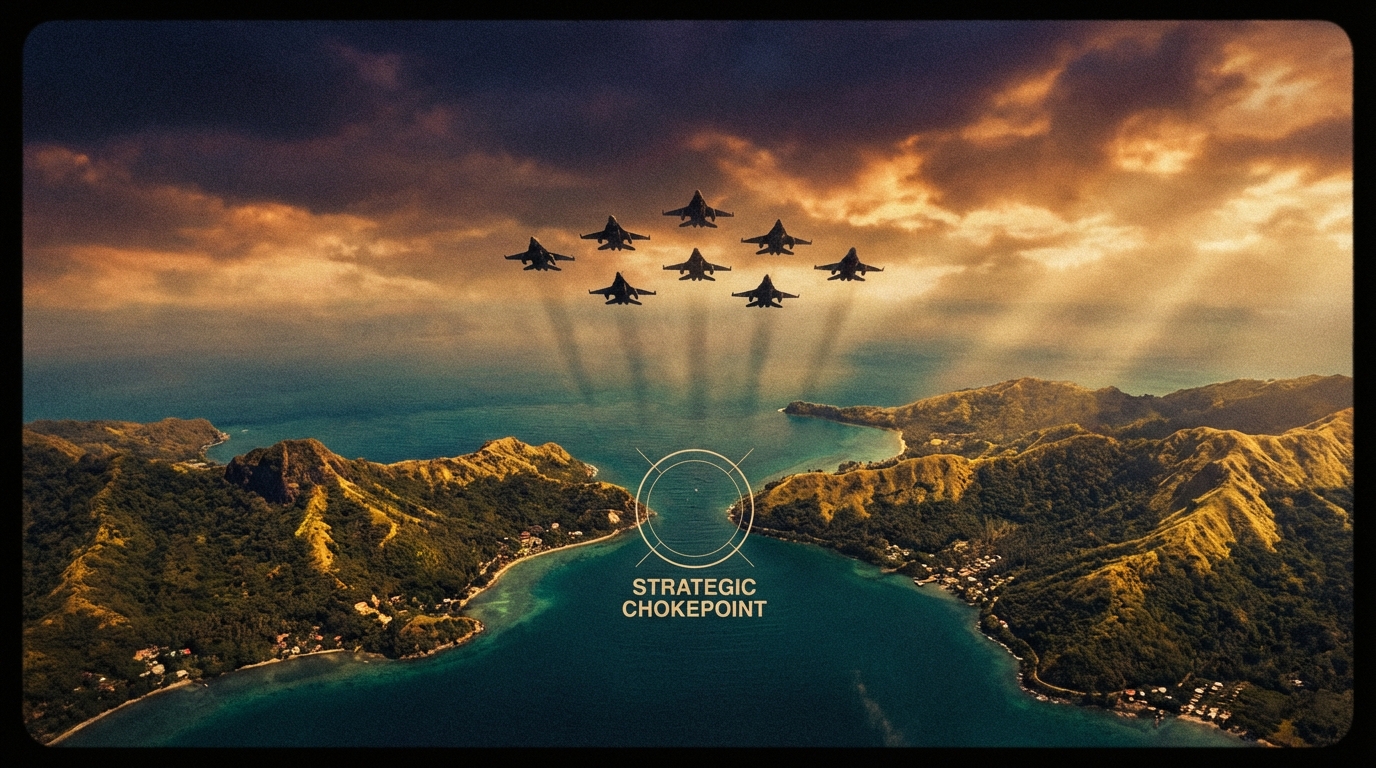
On February 9, 2026, Indian Su-30MKI fighters and Royal Thai Air Force Gripen jets conducted Exercise SIAM BHARAT in the airspace above the northern Malacca Strait, near India's Andaman and Nicobar Islands. The official description -- enhancing interoperability between two friendly air forces -- was accurate, unremarkable, and entirely beside the point.
The Malacca Strait carries roughly a quarter of all global trade. Approximately 80% of China's oil imports transit this narrow waterway between Malaysia and Indonesia. The country that can project credible air power over the Strait does not merely conduct exercises. It holds a strategic position that no amount of naval expansion can entirely neutralise.
India just demonstrated that it can.
The Exercise Architecture
SIAM BHARAT 2026 was compact by design but layered in capability. Four to six aircraft from each side participated -- India's Su-30MKIs operating from an air base in the Andaman Islands, Thailand's Gripens flying from a base on the Thai mainland. The numbers were modest. The support architecture was not.
India deployed mid-air refuelling tankers, extending the operational radius of its fighters well beyond the Andamans. An Airborne Warning and Control System aircraft provided the surveillance and command-and-control overlay that transforms individual fighters into a networked combat force. Indian Navy warships were positioned in the exercise area for search-and-rescue operations -- a standard safety measure that also demonstrated the ability to coordinate air and naval assets in the same operational theatre.
This was not a display of raw firepower. It was a demonstration of operational reach -- the ability to sustain air combat operations at extended range, over water, with integrated support systems. This is precisely the capability required to influence events in the Malacca Strait during a crisis.
The Andaman Advantage
India's Andaman and Nicobar Islands are among the most strategically significant pieces of territory in the Indo-Pacific, and among the most under-discussed. The island chain stretches over 800 kilometres from north to south, with the northernmost point sitting just 150 kilometres from the Myanmar coast and the southernmost barely 150 kilometres from the northern entrance to the Malacca Strait.
The Andaman and Nicobar Command -- India's only tri-service theatre command -- is headquartered at Port Blair. The islands host air bases, naval facilities, and surveillance infrastructure that give India a natural forward operating position overlooking the eastern approaches to the Indian Ocean.
For years, India underinvested in the Andamans. The islands' potential as a strategic asset was discussed in academic papers and think-tank reports but not matched by infrastructure development, force deployment, or operational activity. That is changing. The conduct of SIAM BHARAT from Andaman-based air facilities signals that India is now willing to use the islands not just as a surveillance outpost but as a power projection platform.
The Thailand Dimension
Thailand is not India's most prominent defence partner. It does not feature in the headlines the way Japan, Australia, or the United States do. But Thailand occupies a unique geographic and diplomatic position that makes it a quietly valuable partner for India's Indo-Pacific strategy.
Thailand borders the Malacca Strait. Its air force operates Gripen fighters -- Swedish-built, NATO-interoperable platforms that represent a different technological tradition from India's Russian-origin Su-30MKIs. The ability to operate jointly with Gripens expands the range of coalition partners India can work with in a contingency scenario.
Equally important, Thailand maintains working relationships with both the Western alliance structure and China. It is not a treaty ally of the United States in the way Japan or South Korea are, but neither is it aligned with Beijing. This ambiguity makes Thailand a useful partner for exercises that need to demonstrate capability without escalating diplomatic tensions.
An exercise near the Malacca Strait between India and a treaty ally of the United States would generate headlines in Beijing. The same exercise with Thailand generates professional interest -- a lower temperature that allows both sides to explore operational concepts without triggering the kind of response that defeats the purpose.
What Beijing Reads
China's strategic planners are well aware of the Malacca Dilemma -- the vulnerability created by their dependence on energy imports transiting a chokepoint that China cannot control. This awareness has driven Beijing's investment in overland energy corridors (the China-Myanmar pipeline, the China-Pakistan Economic Corridor), its development of alternative maritime routes, and its naval expansion into the Indian Ocean.
India's ability to project air power over the northern Malacca Strait directly engages this vulnerability. In a crisis scenario, the combination of air superiority over the Strait, naval assets in the Andaman Sea, and submarine operations along likely transit routes would give India significant influence over the flow of maritime traffic -- including energy supplies -- to East Asia.
SIAM BHARAT does not create this capability by itself. A four-day exercise with a dozen aircraft does not constitute operational readiness. But it demonstrates the concept, tests the logistics, and establishes the institutional relationships that would be needed to operationalise the capability under pressure.
The message to Beijing is not confrontational. It is geometric: India sits astride the western approach to the Malacca Strait, it can operate there with regional partners, and it is practising the skills required to make that position meaningful.
The Larger Pattern
SIAM BHARAT fits within a broader pattern of Indian military exercises that, taken individually, appear routine but collectively map an expanding operational footprint across the Indo-Pacific. Exercises with Japan in the Philippine Sea, with Australia in the eastern Indian Ocean, with France in the western Indian Ocean, and with Thailand near the Malacca Strait create a network of demonstrated interoperability that covers the major maritime corridors of Asia.
No single exercise is decisive. The cumulative effect is strategic. India is building a portfolio of operational relationships that can be activated at different points across a vast geographic space. This is coalition building without the rigidity of formal alliances -- flexible, scalable, and deniable when necessary.
The Malacca Signal is one node in that network. It is not the loudest signal India has sent this month -- the International Fleet Review at Visakhapatnam will claim that distinction. But it may be the most precisely targeted.
After all, geography does not care about decibels. It cares about position.
The author is Founder & Editor-in-Chief of BarathVector.