By Ramachandran Rajeev Kumar — 2026-01-10
In January 2026, something unprecedented happened in New Delhi's diplomatic quarter. Noor Ahmed Noor, a Taliban official who previously served as Director General of Afghanistan's First Political Department, arrived to take charge as Charge d'Affaires at the Afghan Embassy.
The Islamic Emirate's flag now flies in the Indian capital. No formal recognition has been extended. Yet a Taliban representative sits in the heart of Delhi, processing passports and visas for thousands of Afghan refugees.
Welcome to India's new Afghanistan policy: engagement without recognition.
The October Turning Point
The groundwork for this moment was laid in October 2025, when Afghan Foreign Minister Amir Khan Muttaqi made his first visit to India since the Taliban takeover of August 2021.
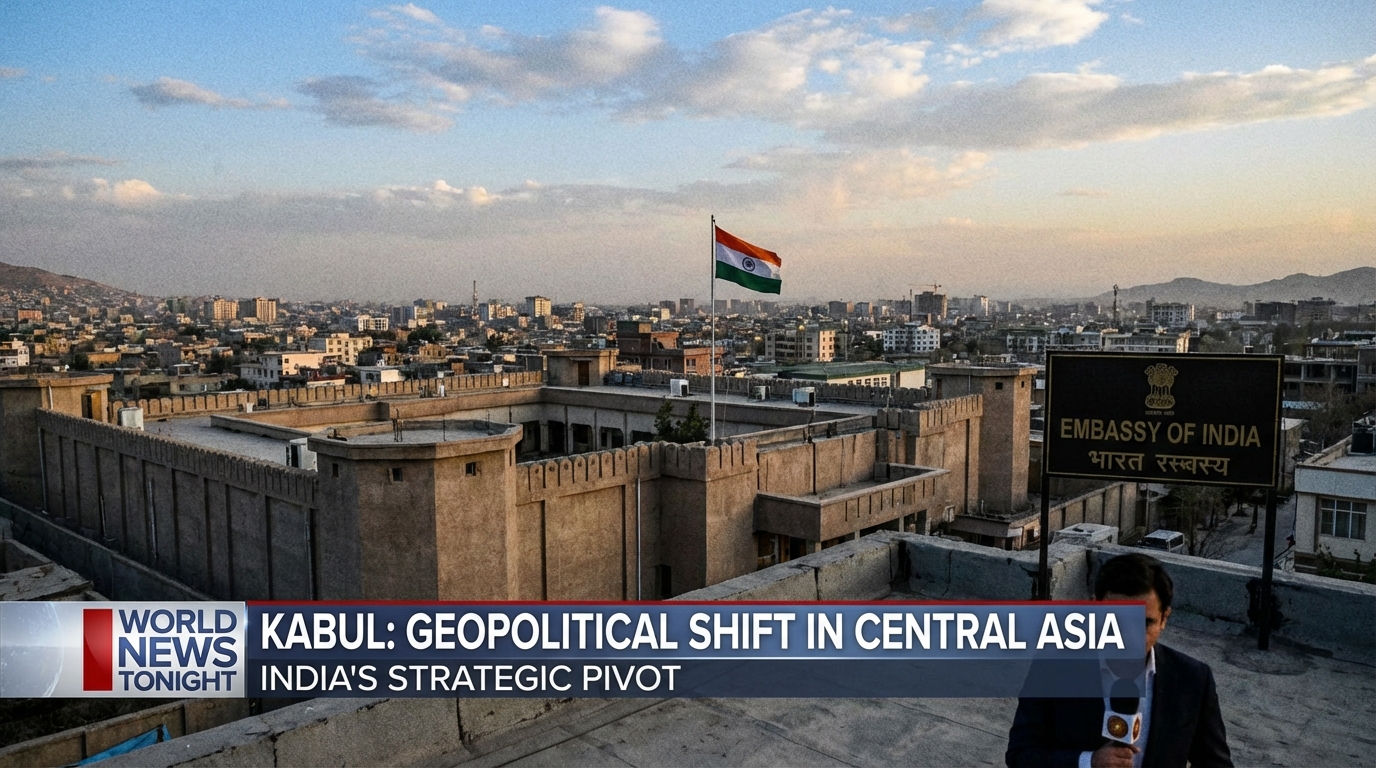
The optics were extraordinary. Muttaqi, who remains on the UN sanctions list, stood on the same stage as External Affairs Minister S. Jaishankar. India subsequently upgraded its Kabul technical mission to a full embassy. The Islamic Emirate's flag was hoisted with New Delhi's quiet acquiescence.
By November, Afghanistan's Commerce Minister Nooruddin Azizi announced that visa hurdles between the two countries had been resolved. Direct flights resumed. Business visas began flowing.
India wasn't recognizing the Taliban. It was doing something more interesting: it was normalizing relations without the formality of recognition.
Why India Changed Course
For three years after the 2021 Taliban takeover, India maintained studied distance. The regime's treatment of women, its shelter of terrorist groups, its ideological extremism - all made engagement politically toxic.
What changed?
First, Pakistan imploded. The relationship between Islamabad and Kabul has deteriorated to what analysts call a "breaking point." Pakistan accuses the Taliban of harboring the Tehrik-i-Taliban Pakistan (TTP), which has dramatically escalated attacks inside Pakistani territory. Border closures have disrupted trade. Military tensions simmer.
The Taliban, in turn, needs friends beyond the China-Pakistan axis. And India, after centuries of civilizational ties to Afghanistan, presents an alternative.
Second, the Taliban demonstrated pragmatism. When terrorists struck Pahalgam in May 2025, the Taliban publicly condemned the attack - a significant gesture that distinguished them from Pakistan-based terror networks in Indian eyes.
Third, Trump's tariffs changed calculations. With India's traditional trade relationships under pressure, diversification has become imperative. Afghanistan sits on trillions in untapped mineral wealth. The Taliban need investors. India needs new markets.
As one analyst noted: "Economically besieged China needed access to a growing Indian market. India realized that its economic rise necessitates technology, trade, critical minerals, components, and investment from the world's second-largest economy - and neighbors matter too."
The Recognition Question
Let's be clear about what India is not doing. It is not recognizing the Taliban as Afghanistan's legitimate government. Only Russia has formally done so.
India's approach mirrors China's "engagement without endorsement" - deepening practical ties while maintaining formal distance. The thousands of Afghan refugees in India need passport services, bank access, UN refugee clearances. The Taliban representative in Delhi provides these consular services.
This is transactional, not ideological. India remains among the world's largest suppliers of humanitarian aid to Afghanistan. It continues to call for inclusive governance and women's rights. But it has decided that isolation serves no strategic purpose.
Pakistan's Nightmare Scenario
For Islamabad, India's Taliban outreach represents a strategic catastrophe.
Pakistan's entire Afghan policy for four decades rested on "strategic depth" - the idea that Afghanistan provided a buffer and sanctuary that could be leveraged against India. The Taliban were supposed to be Pakistan's proxies.
That assumption is collapsing.
"India stands out as one country that has much to gain from continued escalation in hostilities between the Afghan Taliban and Pakistan," one analysis noted. "As Pakistan concentrates on managing its Afghan frontier, its capacity to address issues related to India diminishes."
The geometry has flipped. Pakistan now faces potential conflict on two fronts - with India to the east and an increasingly hostile Taliban to the west. Meanwhile, India cultivates the very force Pakistan thought it controlled.
Husain Haqqani, Pakistan's former ambassador to Washington, captured the dynamic simply: "He now likes Pakistan because Pakistan likes him." Trump embraces whoever flatters him. The Taliban, apparently, are learning to play the same game with India.
The Limits of Engagement
None of this means India and the Taliban are allies.
The regime in Kabul remains one of the most repressive on earth. Women are barred from secondary education and most employment. The justice system operates on medieval principles. International sanctions persist.
India's engagement is explicitly conditional. It's premised on Afghanistan not becoming a launchpad for terrorism against India - a promise the Taliban have so far kept. It's premised on practical access for Indian businesses and citizens. It's premised on the Taliban demonstrating minimum diplomatic reciprocity.
The relationship could reverse quickly if any of these conditions fail.
What has emerged, as The Diplomat put it, is "not reconciliation, but management under pressure."
Regional Realignment
The India-Taliban thaw is part of a larger reconfiguration in South and Central Asia.
Two competing axes are emerging:
- An Iran-India-Russia alignment focused on connectivity, energy, and regional stability
- A Pakistan-Saudi-China alignment centered on CPEC and Gulf security
Afghanistan sits at the intersection, courted by both. The Taliban's willingness to engage India represents a bet that diversifying relationships is smarter than exclusive dependence on Pakistan and China.
India, for its part, is executing what strategists call a "hedging" approach - maintaining options across all regional relationships without committing fully to any bloc.
2026 Outlook
The Council on Foreign Relations lists the Afghan-Pakistan frontier as one of the world's most volatile flashpoints for 2026. India-Pakistan tensions remain elevated after last year's military standoff. The risk of a terrorist attack traced to Pakistan triggering another crisis remains real.
Against this backdrop, India's Taliban engagement serves multiple purposes:
- It constrains Pakistan's freedom of maneuver
- It provides intelligence access to developments in Afghanistan
- It positions India for economic opportunities if Afghanistan stabilizes
- It demonstrates that New Delhi can be pragmatic with adversaries
Whether this calculated embrace produces lasting strategic benefits or explodes in diplomatic blowback depends on variables no one fully controls - including whether the Taliban can maintain internal coherence and external restraint.
For now, India has made a bet. A Taliban diplomat sits in Delhi. The Islamic Emirate's flag flies. And South Asia's oldest rivalry finds new battlegrounds.
India's quiet acceptance of a Taliban representative signals pragmatic engagement, not recognition. The question is whether pragmatism can survive the region's next crisis.