By Ramachandran Rajeev Kumar — 2026-02-17
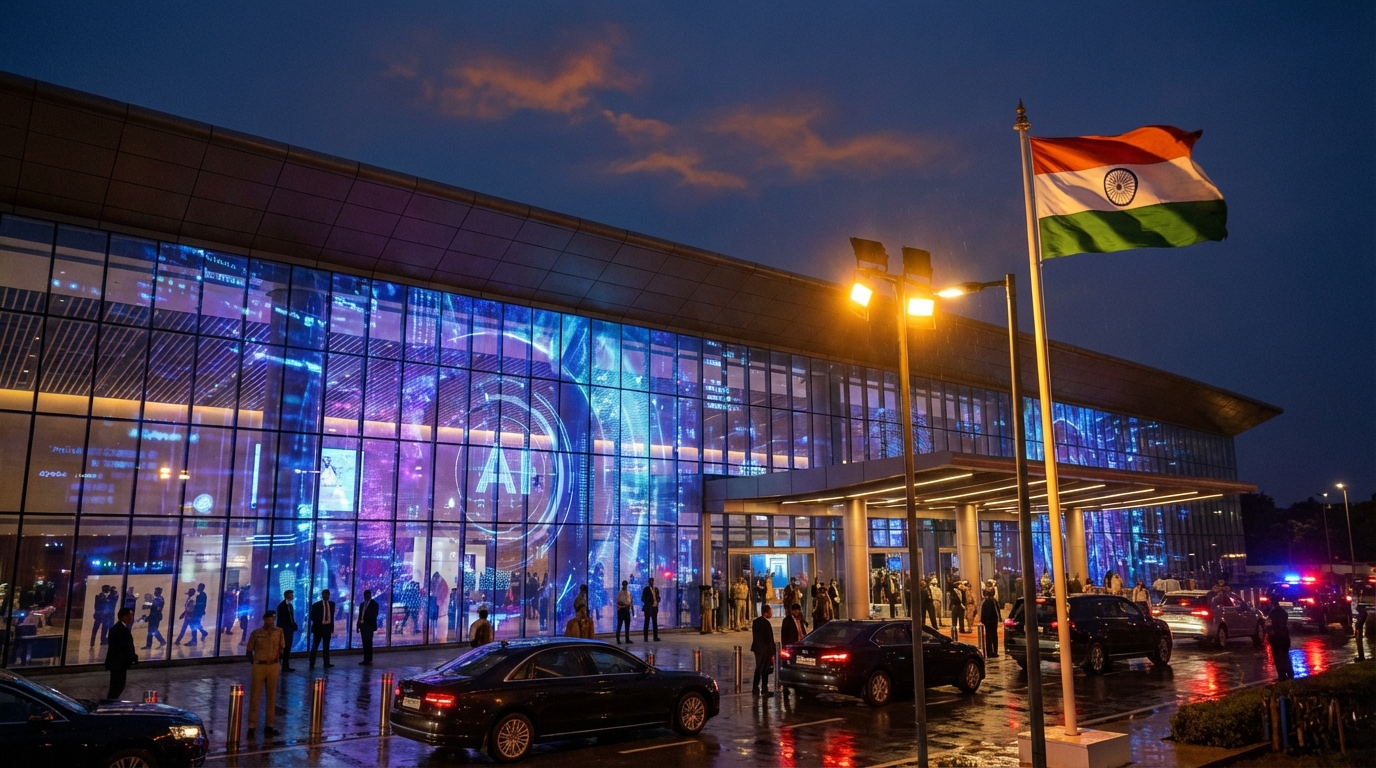
On Sunday morning, as Prime Minister Narendra Modi walked through 70,000 square metres of AI exhibits at Bharat Mandapam, the assembled audience included Sam Altman, Sundar Pichai, Dario Amodei, Demis Hassabis, Bill Gates, Yann LeCun, and Yoshua Bengio. Emmanuel Macron flew in from Paris. Lula da Silva from Brasilia. UN Secretary-General Antonio Guterres cleared his calendar. Over forty CEOs and twenty heads of state gathered in New Delhi for what Bloomberg called the largest assembly of AI luminaries to date.
The question worth asking is not what India offered them. It is what brought them here in the first place.
One in Eight
The answer, in its most compressed form, is a number: one hundred million. That is how many Indians use ChatGPT every week, according to Sam Altman himself, who disclosed the figure in the Times of India on Saturday. India is now OpenAI's second-largest market after the United States. Out of roughly 800 million weekly active ChatGPT users worldwide, every eighth one is Indian.
This is not an audience that any technology company can treat as optional. India has more student ChatGPT users than any other country on the planet. When OpenAI launched a sub-five-dollar ChatGPT Go tier tailored for India's price-sensitive market and then made it free for a year, it was not generosity -- it was market-making. The company opened a New Delhi office in August 2025 for the same reason: you do not plant a flag in irrelevant territory.
But usage is only half the equation. India holds between thirteen and sixteen percent of the global AI workforce, depending on which study you trust. The country's developer community on GitHub -- 17 million and growing at 28 percent annually -- is on course to surpass the United States by 2028. Over 1,700 Global Capability Centres employ 1.6 million professionals, with 80 percent actively investing in AI and machine learning. Two thousand AI startups make India the world's second-largest AI startup ecosystem, behind only the Americans.
AI needs India twice over: once for the size of its market, and again for the depth of its talent. No other country in the world offers both at this scale simultaneously.
The Decoupling Trap
And yet, there is a scenario that keeps circulating in Washington think tanks and Silicon Valley boardrooms: what if American AI decouples from India? What if trade tensions, data sovereignty disputes, or plain protectionist impulse leads the dominant AI ecosystem to treat India as a secondary market rather than a partner?
The immediate impact would fall on India. No question. American AI companies control the frontier models, the compute infrastructure, the research pipelines. A sudden withdrawal of access would disrupt Indian enterprises that have built workflows around GPT, Gemini, and Claude. Startups relying on API access to build products would find themselves scrambling.
But here is what the decoupling enthusiasts miss: the long-term damage falls squarely on the decoupler.
India is not a country that sits quietly when a door closes. It builds another door. The twelve indigenous foundation models unveiled at this summit -- built under the IndiaAI Mission, trained on vast Indian datasets across 22 official languages -- are the early architecture of that alternative. Sarvam AI is building multilingual reasoning and speech systems. Soket AI Labs is producing open-source models for defence, healthcare, and education. IIT Bombay's BharatGen project is creating multimodal models rooted in Indian socio-cultural realities. Tech Mahindra's Maker's Lab is developing agentic AI frameworks for governance.
These are not vanity projects. They are insurance policies. And the premium is being paid now, while the American door is still open.
The Alternate Route
If American AI walks away from India, the vacuum does not remain empty. It gets filled -- either by China, or by India itself. Both outcomes are bad for the decoupler.
China already has the infrastructure, the models, and the political will to court the Indian market. Beijing has been building AI partnerships across the Global South, and India -- with its 800 million internet users and an AI market projected to exceed 17 billion dollars by 2027 -- would be the crown jewel. A Sino-Indian AI alignment, even a pragmatic commercial one, would reshape the global technology order in ways that Washington has not adequately gamed out.
The self-development route is slower but arguably more threatening to incumbents. India's AI skill penetration factor of 3.09 is the highest among G20 and OECD nations. The talent exists. The institutional capacity is being built. The 12 foundation models are the beginning, not the end. Give India a decade of focused sovereign AI development -- backed by a domestic market of a billion users and a government willing to fund it -- and the result is a third pole in global AI that owes nothing to either Silicon Valley or Shenzhen.
Whoever captures the Indian market in the meantime becomes the darling of global investors. Not because India is a charity case, but because one hundred million weekly users is not a market you can re-create elsewhere. There is no substitute for a billion people coming online simultaneously, demanding AI in twenty-two languages, and building applications that nobody in Palo Alto thought to imagine.
The Real Summit
The exhibits and speeches at Bharat Mandapam matter less than the negotiating posture they represent. India is no longer arriving at the AI table as a supplicant. It is arriving as a country that knows exactly what it has -- market, talent, democratic scale -- and is prepared to offer it on its own terms.
Altman warned in his Times of India piece that without democratised access, the economic benefits of AI could remain concentrated in too few hands. He was speaking about India's internal challenge. But the same logic applies to the global order: if AI remains concentrated in too few ecosystems, the systems that get locked out will not disappear. They will build alternatives. And some of those alternatives will be better adapted to the realities of the Global South than anything built in Mountain View.
The AI Impact Summit was designed around three themes: People, Planet, and Progress. A more honest framing might be: Market, Talent, and Leverage. India has all three. The hundred million handshake is not a greeting. It is a negotiation. And for the first time, both sides know it.