By Ramachandran Rajeev Kumar — 2026-02-06
The Drone Gap India Cannot Afford
There is a moment in every military modernization story when pragmatism defeats pride. For India, that moment arrived in January 2026 when the Indian Army formally selected Shield AI's V-BAT autonomous drone system, complete with the company's proprietary Hivemind AI autonomy software, for intelligence, surveillance, and reconnaissance missions along some of the most contested borders on earth.
The decision has predictably drawn murmurs from the usual quarters. Why buy American when India should be building its own? Why give a Silicon Valley firm the keys to autonomous military operations when DRDO's Ghatak programme promises indigenous capability? The criticism is understandable. It is also dangerously wrong.
What India Just Bought
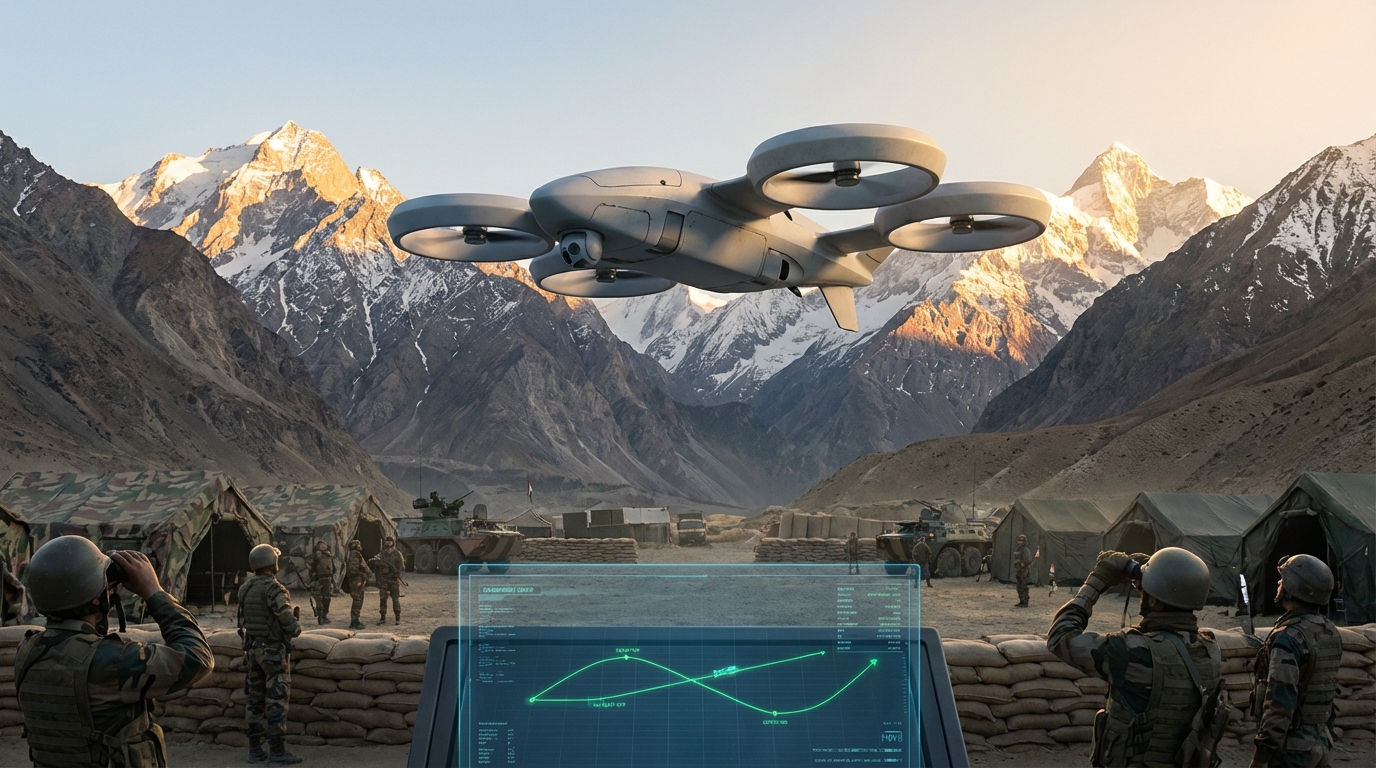
The V-BAT is not a toy quadcopter or a surveillance balloon with delusions of grandeur. It is a Group 3 vertical takeoff and landing unmanned aerial system built around a ducted-fan configuration that can launch and recover from a 4.6-metre-square landing zone. Rooftops, ship decks, forward operating bases tucked into Himalayan valleys--the V-BAT does not need a runway or a catapult.
The numbers tell a compelling story. Over thirteen hours of endurance on a heavy-fuel engine. Up to 18 kilograms of payload capacity. Communications range of 130 kilometres on standard link, 180 kilometres on C-band radio, with satellite communications extending operations beyond line of sight. The platform supports multi-payload integration including wide-area motion imagery, synthetic aperture radar, and electronic warfare packages.
But the hardware is only half the equation. The real prize is Hivemind.
Hivemind: The Software That Changes Everything
Shield AI's Hivemind autonomy software is what separates the V-BAT from every other drone in India's inventory. Hivemind enables autonomous platforms to sense, decide, and act in dynamic environments--including GPS-denied and communications-denied zones, precisely the kind of electronic warfare environment India would face in any serious border confrontation.
The software uses visual odometry navigation, meaning the drone can orient itself using onboard cameras rather than satellite signals. In October 2023, Shield AI demonstrated drone-swarming capabilities using Hivemind, enabling multiple V-BATs to coordinate distributed autonomous operations without a human operator micromanaging each platform.
This is the capability gap India needed to close yesterday. Along the Line of Actual Control, where electronic warfare, jamming, and signal denial are standard operating procedure, a drone that goes blind the moment GPS is disrupted is a liability. A drone that navigates autonomously, coordinates with its peers, and completes its mission regardless of the electromagnetic environment is a strategic asset.
The BrahMos Precedent
Critics who reflexively oppose foreign defence procurement should study their own history. The playbook India is deploying with Shield AI is not new. It is the same formula that produced the BrahMos supersonic cruise missile--arguably India's most successful defence programme of the past three decades.
BrahMos Aerospace began as a 50.5-49.5 joint venture between DRDO and Russia's NPO Mashinostroyenia. In the early years, Russia supplied roughly 65 percent of the components, including the ramjet engine and radar seeker. India assembled, integrated, and learned. By 2018, the ratio had flipped: 65 percent of BrahMos was manufactured in India. Indian seekers were tested. Indian propulsion systems followed. Today, India exports BrahMos to the Philippines and has signed contracts with multiple nations, with integration facilities in Hyderabad and production centres across the country.
The lesson is clear. Buy the best available technology. Manufacture it domestically under licence. Train your engineers on the factory floor, not in PowerPoint seminars. Then iterate, improve, and eventually indigenize. BrahMos proved the model works. The V-BAT deal follows the same logic.
JSW Defence: The Factory Floor Matters
The selection of JSW Defence as the manufacturing partner is not a footnote. It is the spine of the entire strategy. In December 2025, JSW broke ground on a dedicated next-generation unmanned aerial systems facility at EMC Maheshwaram, Hyderabad, backed by an investment of approximately ninety million dollars.
This is not a screwdriver assembly operation. The programme is structured as an integrated ecosystem covering manufacturing, assembly, testing, operator training, maintenance, repair and overhaul, and long-term innovation. JSW has committed sixty-five million dollars in the first twelve months alone to establish manufacturing infrastructure, a global compliance programme, proper technology licensing, and workforce training.
Critically, the agreement includes access to Shield AI's Hivemind software development kit, allowing Indian engineers to develop and test mission autonomy software inside India. When production reaches full capacity by late 2026, the Hyderabad facility is designed not only to supply the Indian Armed Forces but to serve as a global production hub for V-BAT exports.
The geography is deliberate. Hyderabad is already India's defence and aerospace corridor, home to DRDO laboratories, HAL facilities, and a growing cluster of private defence manufacturers. JSW's investment reinforces this ecosystem rather than creating an isolated outpost.
Why Waiting Is Not an Option
The criticism that India should develop everything indigenously sounds principled until one examines what indigenous development actually looks like in the autonomous drone space.
DRDO's most ambitious unmanned combat programme, Ghatak, remains developmental. India's private drone sector, while vibrant in the commercial space, faces persistent challenges: bureaucratic procurement inefficiencies, unclear military requirement specifications, and a component supply chain that still depends heavily on imports. The Ministry of Defence recently blacklisted several Indian drone manufacturers for sourcing components from China, highlighting the fragility of the domestic ecosystem.
Meanwhile, the threat environment is not waiting for indigenous solutions. China operates thousands of military drones, including autonomous swarm-capable platforms, along the northern border. Pakistan's Turkish-origin armed drone fleet has been battle-tested. Every year India spends perfecting a homegrown solution on paper is a year its soldiers face adversaries who have already fielded autonomous systems.
The V-BAT deal is not a concession of defeat on indigenous capability. It is an acceleration strategy. Indian soldiers get world-class autonomous ISR capability now. Indian engineers get hands-on access to frontier autonomy software. Indian factories produce the platforms. Indian defence export ambitions get a globally competitive product to offer.
The HAL Tejas Lesson
Consider the trajectory of HAL's Tejas light combat aircraft. The programme began in 1983 with ambitious plans for a fully indigenous fourth-generation fighter. Forty years and numerous redesigns later, the Tejas Mark 1 finally achieved Initial Operational Clearance. The delays were not from lack of talent but from attempting to develop every subsystem simultaneously without the benefit of manufacturing experience with existing platforms.
Now compare the Tejas timeline with India's Sukhoi Su-30MKI programme. India licensed the Su-30 from Russia, manufactured it at HAL Nashik, progressively increased indigenous content, and in the process built the institutional knowledge, workforce skills, and supply chain infrastructure that now underpins broader aerospace manufacturing ambitions.
The V-BAT deal follows the Sukhoi model, not the Tejas model. Acquire a proven platform. Build it domestically. Learn the technology. Then use that knowledge to develop the next generation. The only difference is that this time, the technology transfer includes artificial intelligence software--arguably more valuable than any airframe.
Strategic Implications
The Shield AI selection sends several signals beyond the immediate military utility.
First, it deepens the India-US defence technology relationship at a moment when Washington is eager to counterbalance Chinese influence in the Indo-Pacific. The iCET (Initiative on Critical and Emerging Technology) framework between New Delhi and Washington has been searching for tangible deliverables. Autonomous military AI software is about as tangible as it gets.
Second, it positions India as a potential re-export hub for Shield AI's platforms across South Asia, Southeast Asia, and the Middle East--markets where India has strategic relationships and where demand for affordable autonomous ISR is growing rapidly.
Third, it forces a healthy competitive pressure on India's indigenous drone ecosystem. When the Army has a working, world-class autonomous platform in inventory, it raises the bar for domestic developers. The next indigenous drone will not just need to fly; it will need to match Hivemind-level autonomy to earn procurement orders.
The Pragmatism Dividend
India's defence procurement history is littered with projects that drowned in ideology. The insistence on doing everything from scratch, while noble in theory, has produced decades-long delays, cost overruns, and capability gaps that adversaries exploit. The nations that modernize fastest are those that combine strategic purchasing with aggressive technology absorption.
South Korea did it with American fighter technology and now builds the KF-21. Japan did it with licensed production of the F-15 and F-2. Israel built its defence industrial base by first purchasing the best available platforms, then systematically learning to improve upon them.
India is finally learning the same lesson. Not where the technology originates, but what you do with it after it arrives on your factory floor. The V-BAT with Hivemind gives India autonomous drone capability now, manufacturing jobs in Hyderabad now, and a technology transfer pathway that--if managed as well as BrahMos--will produce an indigenous successor within a decade.
The soldiers patrolling the Line of Actual Control cannot wait for perfection. They need the best available tools today. The Hivemind Gambit delivers exactly that.