By Ramachandran Rajeev Kumar — 2026-01-16
By Ramachandran Rajeev Kumar
The Numbers That Define India's Existence
Over 9.25 million Indians are employed across six Middle Eastern countries, making this "the biggest migration corridor, even more than the Mexico-US one."
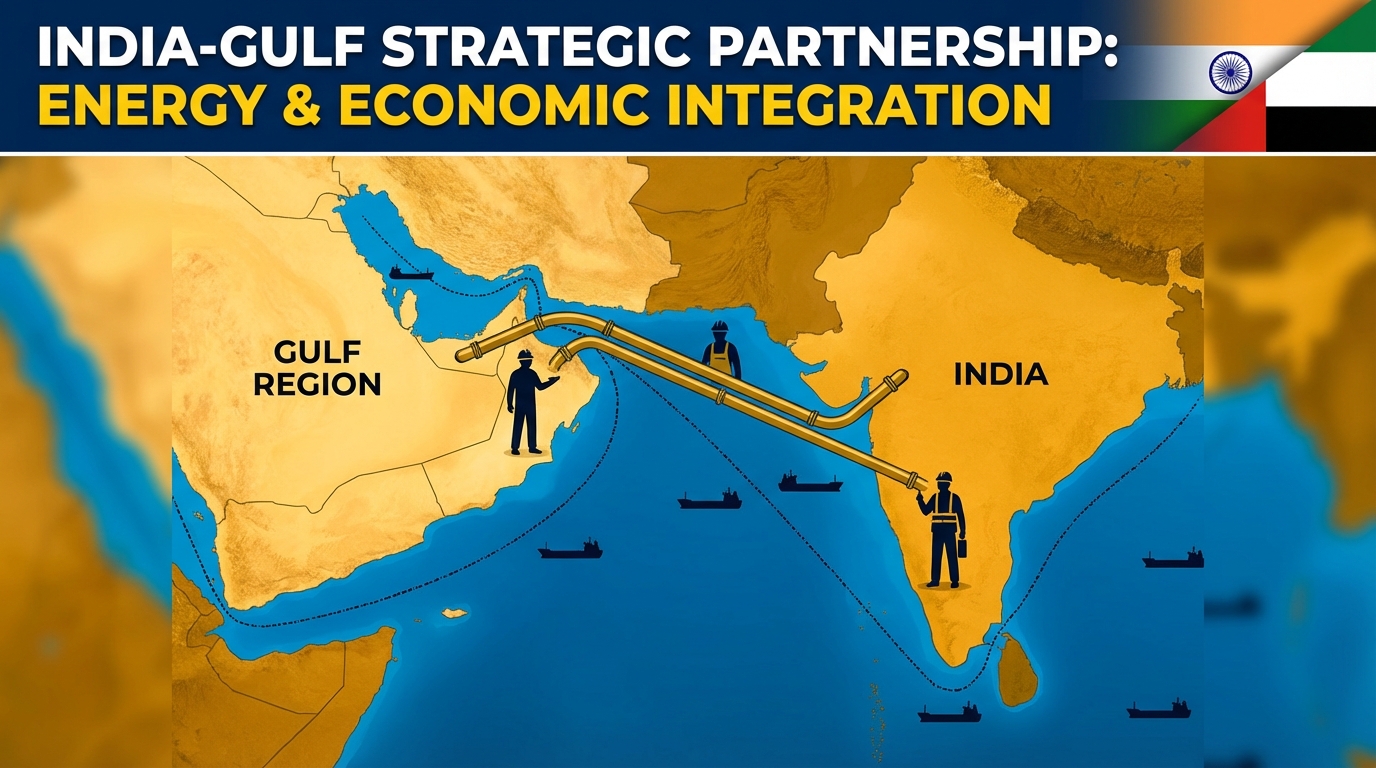
The Middle East accounts for 44.6% of India's crude oil imports. Nearly half of India's liquefied natural gas comes from Qatar. More than two-thirds of India's oil imports and nearly 50% of LNG pass through the Strait of Hormuz.
The UAE is India's third-largest trading partner after China and the US, with $50 billion bilateral trade. During the Qatari Emir's February 2025 visit, both countries elevated their relationship to a Strategic Partnership and agreed to double bilateral trade by 2030.
This isn't foreign policy. This is survival infrastructure.
If the Strait of Hormuz closes for a week, India's economy stops. If Gulf states deport Indian workers, remittances collapse and unemployment explodes. If Saudi-Iran tensions escalate, India's energy security evaporates.
India's Gulf pivot isn't optional. It's existential.
What India Gets From the Gulf
1. Energy Security (The Jugular Vein)
India imports 85% of its oil. The Middle East supplies nearly half of it.
Why this matters:
- Every price spike in Gulf oil = inflation in India
- Every tanker disruption = fuel shortages
- Every Iran-Saudi escalation = rupee depreciation
India has strategically repositioned from "Look West policy" to "Link West policy", emphasizing deepened collaboration through economic, security, and cultural ties.
The chokepoint vulnerability: Two-thirds of India's oil imports pass through the Strait of Hormuz—the 21-mile-wide channel between Iran and Oman that Iran has repeatedly threatened to close.
If Hormuz closes: India's Strategic Petroleum Reserve holds 40 days of supply. Then what?
Diversification efforts:
- Russia now supplies ~40% (up from 2% pre-Ukraine war)
- But Russian oil reaches India via longer, costier routes
- Gulf oil remains irreplaceable for price and proximity
2. Remittances (The Financial Lifeline)
9.25 million Indians in the Gulf send home $50-60 billion annually—one of the world's largest remittance flows.
What this funds:
- Rural Kerala's middle class (almost entirely Gulf-remittance-dependent)
- Healthcare and education for millions of families
- Real estate booms in Tamil Nadu, Punjab, and UP
- India's current account balance (remittances offset part of the trade deficit)
The risk: Gulf states are Saudizing/Emiratization their workforces. Preference for nationals over expats. India's worker share has been slowly declining.
India's response: Shift focus from manual labor to skilled professionals—doctors, engineers, IT specialists who are harder to replace.
3. Trade and Investment
UAE-India bilateral trade: $50 billion. Saudi-India trade: $43 billion. Qatar-India trade: $15 billion.
Beyond hydrocarbons:
- UAE investing $75 billion in Indian infrastructure, renewable energy, ports
- Saudi Arabia's $100 billion commitment (Aramco refinery in Maharashtra, renewable energy projects)
- Qatar's LNG long-term contracts ensuring energy stability
The new pivot: India's critical minerals partnerships with Gulf countries—from oil to green energy transition. UAE and Saudi positioning as clean energy hubs. India needs lithium, cobalt, rare earths—Gulf states are gateway to African and Latin American suppliers.
The Geopolitical Tightrope: Balancing Everyone
Here's the impossible challenge: The Gulf isn't unified. It's fractured—and India needs all sides.
The Saudi-Iran Divide
Saudi Arabia + UAE (Sunni bloc): India's primary energy and investment partners.
Iran (Shia power): Shares border with Pakistan, critical for Chabahar Port (India's Afghanistan gateway), gas pipeline potential.
India's position: Friends with both. Diplomatically neutral. Practically pragmatic.
The tightrope:
- Can't alienate Saudi (45% of oil, $100B investment)
- Can't abandon Iran (Chabahar, Afghanistan access, Central Asia route)
- US pressures India to choose Saudi over Iran (sanctions, CAATSA threats)
- India's answer: "We'll take both, thanks."
The Israel-Palestine Quagmire
In the past two years, India's stance has become more "interest-driven" and less neutral.
India's Israel relationship:
- $3 billion annual defense trade (drones, missiles, cyber tech)
- Intelligence cooperation against Pakistan-based terror
- Agricultural and water tech partnerships
India's Arab relationship:
- Dependent on Gulf oil and workers
- Historical solidarity with Palestine
- Large Muslim population (200 million) sensitive to Palestine issue
The balancing act:
- India abstains on UN votes (satisfies neither side, offends neither)
- Maintains defense ties with Israel quietly
- Issues pro-Palestine statements publicly
- Outcome: Nobody's thrilled, nobody's angry
The US-China Shadow
As US-China tensions rise, Gulf states become India's strategic hedge.
US wants: India to align with Quad, counter China, reduce dependence on Russian/Iranian oil.
China offers: Belt and Road infrastructure, cheap manufacturing, no strategic demands.
India's Gulf pivot advantage: The Gulf doesn't force choices. UAE trades with China ($100B), invests in India ($75B), buys US weapons, and hosts both militaries. India can do the same.
Translation: India uses Gulf relationships to maintain strategic autonomy—not fully aligned with US, not dependent on China, hedging through Middle East partnerships.
The Risks India Faces
1. Workforce Replacement
Saudization, Emiratization, nationalization drives across the Gulf mean fewer jobs for Indians.
The numbers:
- Indian share of UAE workforce: declining from 30% to 27%
- Saudi replacement: 2 million jobs nationalized by 2030 target
India's buffer: Skilled professionals harder to replace. Blue-collar workers vulnerable.
2. Regional Instability
Yemen war. Syria conflict. Iran-Israel tensions. Houthi attacks on shipping.
One miscalculation = Hormuz closure = India's energy crisis.
India has no military power to protect shipping lanes (unlike US, China). Dependent on others for Gulf security.
3. Renewable Energy Transition
Gulf states diversifying away from oil. India needs to lock in long-term energy contracts before global demand drops and Gulf states pivot entirely to renewables/hydrogen.
The window: 10-15 years to secure advantageous oil/gas deals before energy transitions render them irrelevant.
What India Must Do Now
1. Deepen Defense and Security Ties
Current: Minimal defense cooperation with Gulf states.
Needed:
- Joint naval patrols in Arabian Sea
- Intelligence sharing on terrorism
- Defense manufacturing partnerships (make in India for Gulf markets)
Why: Security partnerships create stickiness beyond economic ties. US-Saudi relationship survives oil price crashes because of defense interdependence.
2. Diversify Within the Gulf
Over-dependence on UAE-Saudi axis leaves India vulnerable if their priorities shift.
Expand:
- Qatar LNG contracts (lock in 20-year supply)
- Oman logistics partnerships (alternative to Hormuz via pipelines)
- Kuwait and Bahrain economic zones for Indian businesses
3. Build the Chabahar-INSTC Corridor
Chabahar Port (Iran) + International North-South Transport Corridor (INSTC) = India's direct access to Afghanistan, Central Asia, Russia.
Status: Underutilized due to US sanctions on Iran.
Fix: Negotiate US exemptions (arguing strategic counter to China's Belt and Road). Make Chabahar economically viable even under sanctions.
4. Skill Upgradation for Workers
Current Gulf workers: Construction, domestic help, low-skilled.
Future demand: Healthcare, IT, hospitality, logistics, green energy tech.
India's move: Government-funded skill training targeting Gulf labor market needs. Send engineers, not laborers.
5. Energy Transition Partnerships
Gulf states investing $2 trillion in renewables and hydrogen by 2030.
India's play:
- Joint solar projects (Abu Dhabi's Masdar already investing in India)
- Green hydrogen imports (Saudi/UAE will be major exporters)
- Critical minerals sourcing through Gulf investment vehicles
Result: As Gulf pivots from oil sellers to clean energy hubs, India pivots from oil buyer to clean energy partner.
The Brutal Reality
India doesn't have the luxury of picking sides in the Middle East. We need:
- Saudi oil and investment
- Iranian Chabahar and gas
- Israeli defense tech
- Emirati capital
- Qatari LNG
- Omani logistics
The West says: Choose us or China. China says: Join Belt and Road or lose out. India says: We'll take Gulf relationships and keep our options open.
This isn't fence-sitting. It's strategic depth.
The Gulf pivot allows India to hedge against US unreliability, Chinese aggression, and Russian unpredictability—without committing fully to any bloc.
The 9.25 million Indian workers aren't just labor. They're strategic assets. The $100 billion trade isn't just commerce. It's leverage. The 45% oil imports aren't just energy. They're the lubricant that keeps India's engine running.
Lose the Gulf, and India loses strategic autonomy. Simple as that.
Sources:
- Al Jazeera Centre for Studies: India-Gulf Relations
- Middle East Institute: India's Balancing Act in the Gulf
- Middle East Monitor: India's Changing Middle East Policy
- New Security Beat: India Navigates Middle East Volatility
- Rasanah IIIS: South Asia-Gulf Cooperation
- CSEP: India's Critical Minerals Partnerships with Gulf
- Springer: India's Gulf Policy in China-US Strategic Competition
Ramachandran Rajeev Kumar is the founder of BarathVector. Agree? Disagree? The debate continues in the comments.