By Ramachandran Rajeev Kumar — 2026-02-11
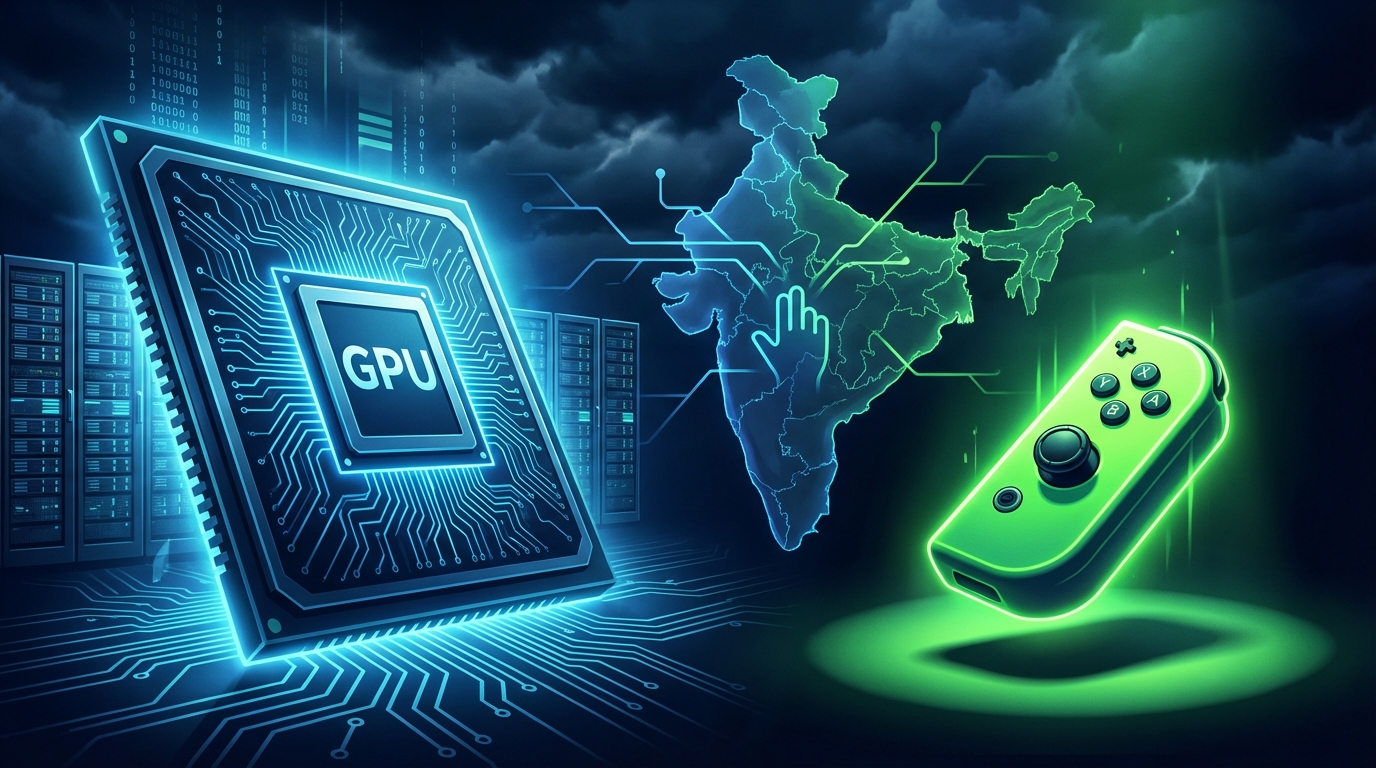
The GPU Imperative: India Needs AI Factories, Not Gaming Lounges
By Ramachandran Rajeev Kumar
When NVIDIA launched its GeForce NOW cloud gaming service in India last week, Jensen Huang's marketing team celebrated with the usual fanfare: partnership announcements, influencer campaigns, and projections of how Indian gamers would embrace premium cloud-streamed titles at subscription prices.
Missing from the celebration was an honest question: Is this really what India needs from the world's most valuable semiconductor company?
Gaming Lounges vs. AI Factories
Consider what other countries have received from NVIDIA in recent months.
Japan secured a $200 million partnership to build sovereign AI compute infrastructure, including dedicated GPU clusters for Japanese-language model training. Thailand received commitments for a sovereign AI cloud, enabling Thai institutions to train and deploy models without sending data to American servers. Indonesia landed an AI development centre focused on local language processing and government digital services.
India got a gaming subscription service.
The disparity is not incidental. It reflects a broader failure -- not by NVIDIA, which is a corporation following profit signals, but by Indian policymakers who have not made sovereign AI compute a non-negotiable demand in every technology partnership negotiation.
The 178x Gap
India has approximately 30,000 enterprise-grade GPUs available for AI training. South Korea, with one-twenty-fifth of India's population, has over 120,000. The gap in GPUs per capita for AI workloads is staggering -- roughly 178 to 1.
This matters because AI capability in 2026 is not a luxury. It is infrastructure, as fundamental as electricity grids were in the twentieth century. The nation that cannot train its own large language models is dependent on nations that can. The nation that cannot run AI inference at scale for its 1.4 billion citizens is renting intelligence from abroad.
India's AI startups -- Krutrim, Sarvam AI, Bhashini, and dozens of others working on Indian-language models -- currently rent GPU time from AWS Singapore, Google Cloud Mumbai, and Azure Hyderabad at premium rates. A single training run for a foundational model costs $2-5 million in compute alone. This is not democratised access. This is a tax on Indian innovation imposed by foreign cloud providers.
Making cheap access to AI computing power available to India's masses is not a policy wish -- it is an urgent national imperative.
The Sovereignty Imperative
The solution is not to ban foreign providers but to build domestic alternatives at scale. India needs sovereign AI compute -- GPU clusters on Indian soil, governed by Indian data policy, accessible to Indian researchers and startups at subsidised rates.
Who builds this? Ideally, Indian companies. Practically, India needs partners -- and it should be pragmatic about where they come from.
NVIDIA is the obvious candidate but not the only one. AMD, Intel, and their respective datacenter GPU lines offer competitive alternatives. And here is where pragmatism must override ideology: if Chinese semiconductor companies can deliver capable AI accelerators at lower cost, and if they agree to operate under Indian data policy with rigorous monitoring and compliance frameworks, they should be welcomed at the table.
The geopolitical discomfort is real. But compute poverty is more dangerous than compute diplomacy. India cannot afford to exclude providers on political grounds when its citizens and startups lack basic AI infrastructure. Preferably sovereign, certainly -- but accessible above all.
The Manufacturing Road
India's semiconductor manufacturing ambitions are genuine but nascent. The Tata-PSMC fab in Gujarat and the Renesas partnership in Karnataka are encouraging first steps, not solutions. Reaching the fabrication capabilities of Taiwan, South Korea, or even China will require a decade of sustained investment running into hundreds of billions of dollars.
In that interim decade, India must build cooperative frameworks. Japan's semiconductor ecosystem -- materials, equipment, process technology -- is the world's deepest outside TSMC. South Korea's Samsung and SK Hynix are exploring diversification away from China-concentrated supply chains. Taiwan's TSMC is politically motivated to build partnerships beyond the Strait.
India should be at the centre of these conversations -- not as a supplicant asking for technology transfer, but as a partner offering what these companies need: a massive domestic market of 1.4 billion potential consumers, a growing engineering workforce of 1.5 million new graduates annually, and a stable democratic governance framework.
Google's Open Window
Among the hyperscale cloud providers, Google has the most untapped potential in India. Its search dominance gives it distribution. Its TPU architecture gives it an AI compute stack independent of NVIDIA. Its Gemini model family gives it a product line to build services around.
If Google committed to building a sovereign AI compute facility in India -- not a standard cloud region, but a dedicated AI training centre with subsidised access for Indian startups and researchers -- it would cement its position in the Indian AI ecosystem before competitors can consolidate theirs.
The window is open. But windows close. Amazon and Microsoft are not standing still. Whoever moves first on dedicated Indian AI infrastructure will define the market for a generation.
Google, if it is serious about India, has a great opportunity to expand before others occupy the space. But it must act decisively -- and soon.
The Golden Rule for MNCs
The lesson from NVIDIA's gaming launch, the semiconductor negotiations, and the AI infrastructure deficit converges on a single principle: multinational technology companies operating in India must design their operations so that geopolitics does not derail business and progress.
This means building with local sovereignty in mind from day one. Data residency compliance by default, not as an afterthought. Technology transfer frameworks embedded in partnership agreements, not vague promises. Pricing structures that enable mass access, not just premium-tier profits.
India does not need gaming lounges. It needs AI factories. It needs GPU clusters that its researchers can access at rates comparable to what their counterparts in Seoul, Tokyo, and Taipei enjoy. It needs semiconductor partnerships that build domestic capability, not just consumption.
The AI Impact Summit in Delhi next week (February 16-20) is the right venue to make this demand explicit. Jensen Huang will be there. So will representatives from every major semiconductor and cloud company in the world.
India's message should be simple and non-negotiable: we welcome your investment, we offer the world's largest market, but the price of entry is real infrastructure -- not entertainment subscriptions. Build AI factories, not gaming lounges. That is the partnership India will remember.