By BarathVector Editorial — 2026-03-06
The Gold Alarm: When Metal Screams What Markets Whisper
By BarathVector Editorial
There is a particular kind of silence that precedes economic trouble. It is the silence of headline GDP numbers that look robust, of central bank communiques that project calm, of equity markets that recover just enough after each crash to suggest resilience. In that silence, gold speaks.
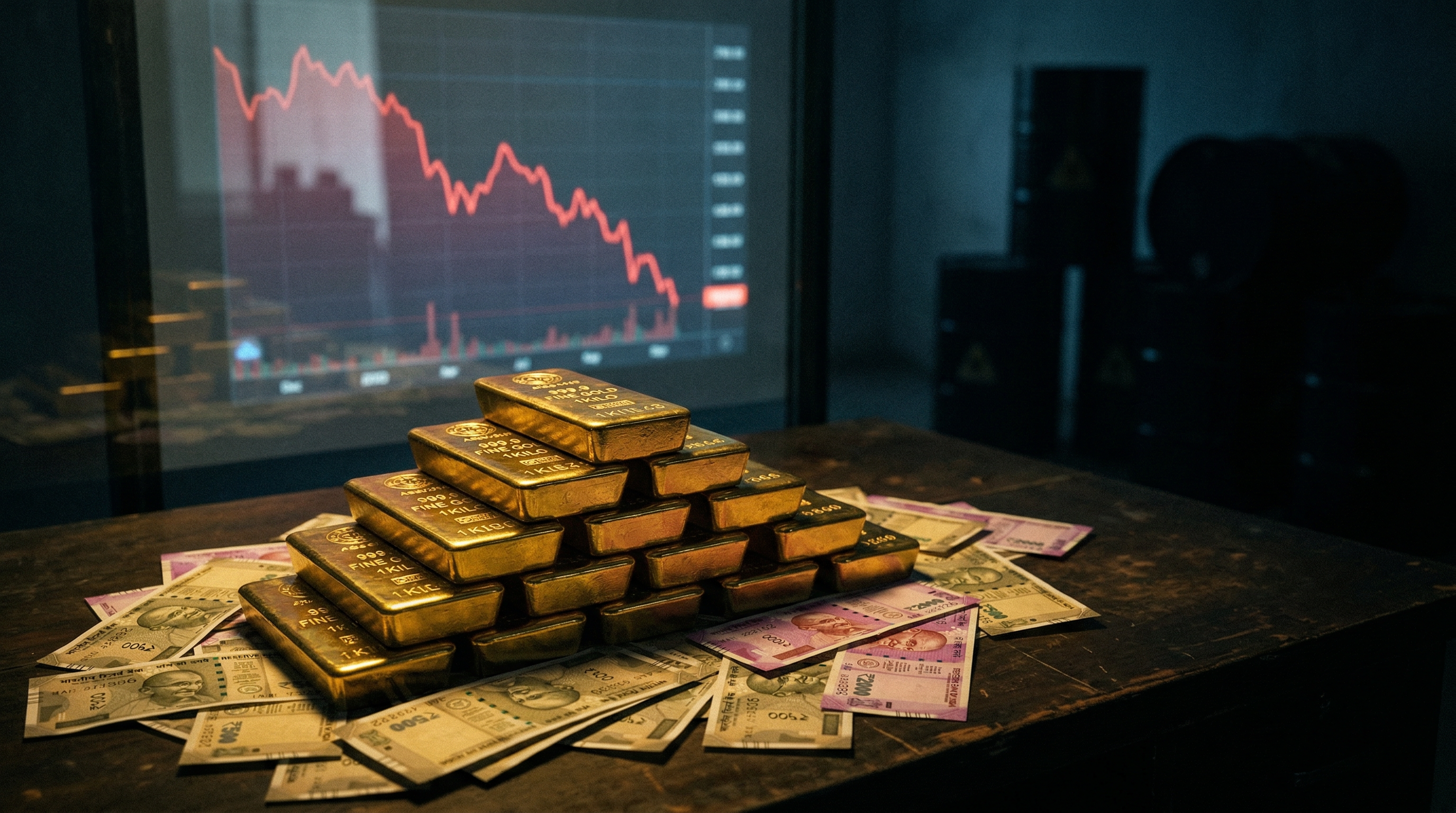
On March 5, 2026, MCX gold futures surged past Rs 1,63,700 per 10 grams -- a gain of 1.6 per cent in a single session. Internationally, gold touched $5,417 per ounce, an all-time record. Silver, not to be outdone, broke out of a four-day consolidation to leap Rs 10,000 per kilogram in a single session, settling near Rs 2,95,000. By March 3, silver had climbed further still to Rs 3,15,100 per kilogram.
Year-to-date, gold has gained 19 per cent globally. In 2025, it gained 64 per cent. Central bank purchases jumped 64 per cent in 2025. These are not the numbers of an asset class having a good year. These are the numbers of an asset class that has become a geopolitical seismograph.
Gold is not celebrating. Gold is screaming.
The Metal That Remembers
Gold has no earnings calls. It pays no dividends. It sits in vaults and does nothing -- which is precisely why it matters. When investors, central banks, and sovereign wealth funds collectively decide that doing nothing with metal is preferable to doing something with paper, that is a statement about paper. About fiat currencies. About the institutions that print them. About the geopolitical order that underwrites them.
The current gold surge is not a speculative mania. It is a convergence of three forces that, individually, would be concerning. Together, they constitute a signal that India's economic policymakers cannot afford to misread.
The first force is Hormuz. The second is tariffs. The third is the rupee. Each is a wound. Together, they are a haemorrhage.
Force One: The Strait That Strangles
On March 1, 2026, crude tanker transits through the Strait of Hormuz dropped to four vessels. The daily average since January had been twenty-four. Following Operation Epic Fury -- the coordinated US-Israeli campaign targeting Iranian leadership and nuclear infrastructure -- the strait has become, in the words of Euronews, a "no-go zone."
Brent crude surged 13 per cent to $82.76 a barrel. Goldman Sachs analysts warned that a four-week disruption could push prices toward $100. President Trump's offer to insure tankers transiting the Persian Gulf calmed markets briefly, but a presidential tweet is not the same as a reopened shipping lane.
For India, this is existential arithmetic. The country imports 88.2 per cent of its crude oil. Roughly half of those imports transit through Hormuz. Aviation turbine fuel prices for March 2026 rose to Rs 96,638 per kilolitre -- a 6 per cent increase over February. ATF accounts for 30 to 40 per cent of airline operating costs and up to 45 per cent of the airfare structure. Indian carriers are staring at a 10-15 per cent fare hike, according to the Free Press Journal, though intense domestic competition may prevent them from passing through the full cost.
Which means the airlines absorb the loss. Which means margins compress. Which means the next quarterly results will tell a story that today's gold price is already narrating.
Force Two: The Tariff Fog
The United States-India trade deal remains, in the diplomatic euphemism of the season, "in progress." What this means in practice is that Indian exporters -- particularly MSMEs and labour-intensive sectors like seafood, textiles, apparel, and auto components -- are operating under a cloud of uncertainty that no amount of bilateral bonhomie can disperse.
The UN's World Economic Situation and Prospects report projects India's GDP growth at 6.6 per cent for 2026, down from an estimated 7.4 per cent in 2025. The report is careful to note that "resilient household consumption, strong public investment, and lower interest rates" will underpin growth. What it is diplomatically quieter about is the export side of the ledger, where US tariff hikes on select Indian goods have already begun to bite.
Gold, unlike diplomats, does not do euphemism. When trade routes are uncertain, when tariff regimes are unpredictable, when the world's largest consumer market treats its second-most-populous trade partner as a negotiation rather than a partnership -- gold rises. Not because gold traders are pessimists. Because they are accountants.
Force Three: The Rupee's Slow Bleed
On March 5, 2026, the US dollar traded at 91.64 Indian rupees. Over the past month, the rupee has weakened 1.40 per cent. Over the past twelve months, it has lost 5.36 per cent. It is Asia's worst-performing currency in 2026.
The Reserve Bank of India has been intervening -- selling dollars through state-run banks, propping up the currency with the institutional equivalent of sandbags against a rising tide. The rupee briefly recovered to 91.5 after the RBI's intervention on March 5. But central bank intervention is a tourniquet, not a cure. It slows the bleeding. It does not heal the wound.
A weak rupee in the context of rising oil prices is a particularly vicious compound. India pays for crude in dollars. When the rupee weakens, the rupee cost of oil rises even when the dollar price holds steady. When the dollar price is also rising -- as it is now, driven by Hormuz -- the effect is multiplicative, not additive.
This is how cost-of-living crises are born. Not with a bang, but with a basis point.
The RBI's February Gambit
In February 2026, the RBI's Monetary Policy Committee held the repo rate at 5.25 per cent. The decision was unanimous. The stance remained neutral. The inflation estimate was nudged up to 2.1 per cent for FY26, with projections of 3.2 per cent for Q4 FY26, 4.0 per cent for Q1 FY27, and 4.2 per cent for Q2 FY27.
On its face, this looks prudent. Inflation at 2.1 per cent is well within the RBI's 2-4 per cent tolerance band. GDP growth at 7.4 per cent is the envy of the G20. The RBI described India as being in a "Goldilocks zone" -- strong growth, contained inflation.
The problem with Goldilocks is that she never accounted for bears.
The February decision was made before Hormuz became a no-go zone. Before Brent crossed $82. Before ATF prices jumped 6 per cent. Before the rupee slid to 91.64. Before gold breached $5,400. The RBI's inflation projection of 4.2 per cent for Q2 FY27 assumed a world that, as of March 6, no longer exists.
The interplay is worth spelling out. Oil prices feed into transportation costs. Transportation costs feed into food prices. Food prices feed into CPI. The January 2026 CPI reading was 2.75 per cent -- already above market expectations of 2.4 per cent. Food inflation, which had been negative in December 2025 at minus 2.71 per cent, reversed to positive 2.13 per cent in January. That reversal happened before the Hormuz crisis. Before the ATF spike. Before the latest leg of the rupee's decline.
The RBI is not wrong to hold rates. But the assumptions underpinning that decision are being stress-tested in real time, and the results are not looking favourable.
The Cost-of-Living Blindspot
Here is what GDP numbers will not tell you. A family in Bengaluru paying Rs 180,000 a month to maintain a middle-class lifestyle does not experience 2.75 per cent inflation. They experience the price of cooking gas, which rose in March. They experience airfares that are climbing 10-15 per cent. They experience the price of imported electronics, priced in a dollar that now costs Rs 91.64 instead of Rs 87 twelve months ago. They experience school fees, medical costs, and grocery bills that bear no resemblance to the consumer price index.
The CPI is a statistical average. Nobody lives at the average.
Gold, in this context, is the rebellion of capital against optimistic statistics. When a middle-class Indian family buys gold -- and they buy more gold than almost any other population on earth -- they are not speculating. They are hedging. Against a rupee that leaks value. Against an inflation rate that understates their lived experience. Against an economic future that looks strong on PowerPoint but feels precarious at the provision store.
The World Gold Council noted in February 2026 that Indian gold demand remains robust despite -- or perhaps because of -- price strength. This is not irrational. It is deeply rational. It is the collective intelligence of 1.4 billion people who have learned, across generations, that gold remembers what governments prefer to forget.
The Trifecta
Strip away the financial jargon and the situation is this: three external forces are compounding against the Indian consumer simultaneously.
Hormuz raises the cost of energy. India cannot drill its way out of 88 per cent import dependency in the short term. The Andaman Basin discovery is promising but years away from production-scale extraction.
Tariff uncertainty suppresses export growth and chills investment in export-oriented manufacturing. The Make in India thesis depends on access to global markets. When the largest of those markets becomes unpredictable, the thesis develops cracks.
The weak rupee amplifies both of the above. It makes imported energy more expensive. It makes imported raw materials costlier. It makes the dollar-denominated debt of Indian corporations heavier. And it makes gold, priced in rupees, look like the only asset that reliably goes up.
Each of these forces, individually, is manageable. India's macroeconomic fundamentals -- strong domestic consumption, a young demographic profile, robust public infrastructure spending -- provide genuine resilience. The UN is not wrong to project 6.6 per cent growth. The RBI is not wrong to maintain a neutral stance. The government is not wrong to emphasise long-term structural reform.
But external shocks do not wait for structural reforms to mature. They compound. And they compound fastest precisely when multiple shocks arrive simultaneously -- which is what is happening now.
What Gold Is Telling Us
Gold at $5,417 is a composite signal. It says: paper currencies are under stress (the dollar is strong but that strength is itself a symptom of global flight to safety). It says: geopolitical stability is deteriorating (Hormuz, Ukraine, Taiwan, tariffs). It says: central banks worldwide are buying metal rather than trusting each other's sovereign debt.
For India specifically, gold at Rs 1,63,700 per 10 grams says something more pointed. It says: the cost-of-living squeeze is real and accelerating, regardless of what the CPI reports. It says: the rupee's trajectory is not reassuring. It says: the Hormuz crisis has exposed a dependency that decades of policy have failed to address.
None of this means India's economy is in crisis. It is not. Growth is real. Infrastructure is being built. Digital infrastructure is world-class. The demographic dividend is arriving on schedule.
But there is a difference between an economy that is growing and an economy whose growth is being felt. When gold screams, it is telling us that the gap between headline numbers and household reality is widening. When silver surges Rs 10,000 in a single session, it is not because silver suddenly became more useful. It is because confidence in the alternative -- holding rupees, holding equities, holding faith in stable prices -- has diminished.
The alarm is sounding. The question is whether anyone in North Block is listening, or whether they are too busy admiring the GDP chart to hear the metal scream.
Gold prices and exchange rates cited as of March 5, 2026. Oil prices and ATF data as of the latest available March 2026 figures.
Sources: MCX, World Gold Council, RBI, CNBC, Euronews, UN WESP 2026, Goldman Sachs, Free Press Journal, Trading Economics.