By Ramachandran Rajeev Kumar — 2026-01-30
The Four Battlefronts
India's 2026 Foreign Policy Challenge
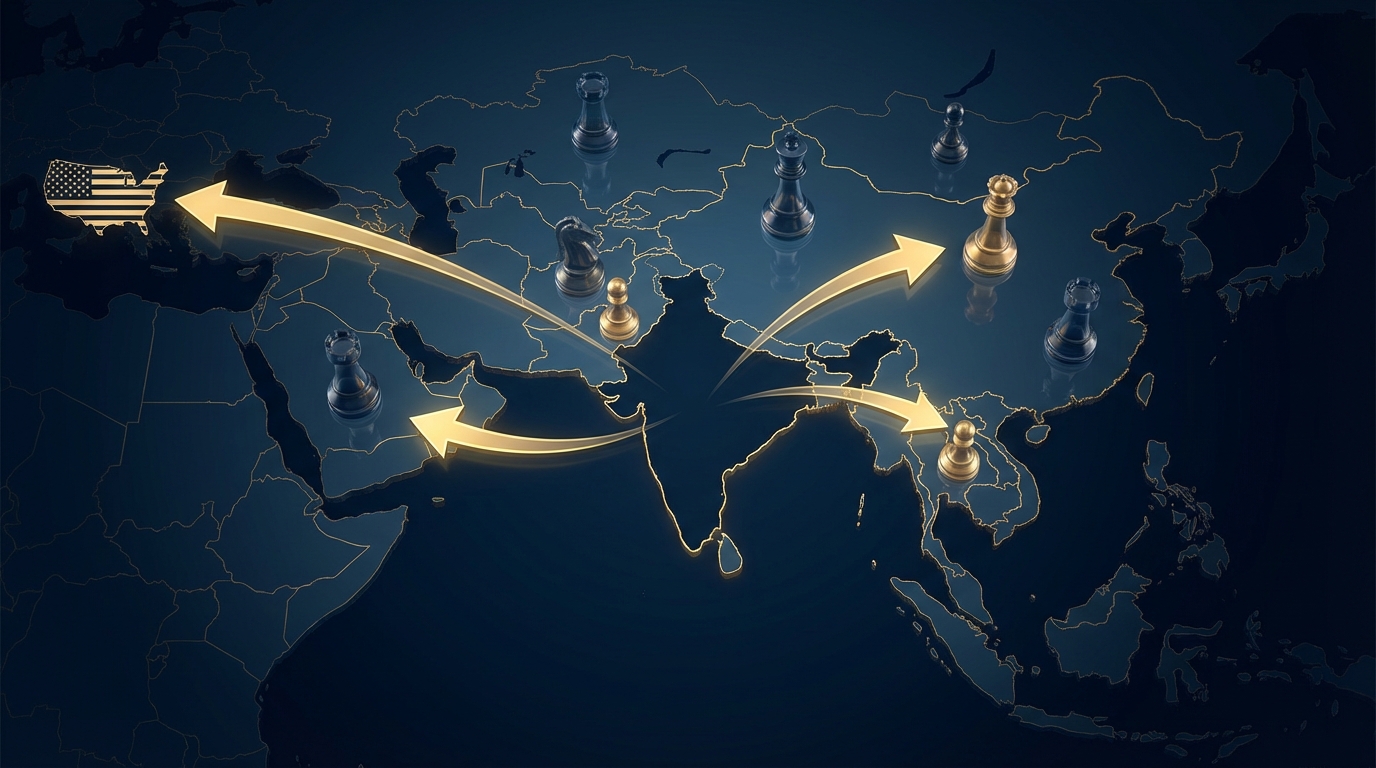
Indian foreign policy in 2026 can be reduced to a single uncomfortable reality: four simultaneous pressure points, each demanding resources, attention, and strategic clarity that would challenge any nation addressing them individually.
China. Pakistan. The United States. The Middle East.
Each front carries existential stakes. Each operates on different timelines. And increasingly, each is interconnected in ways that limit India's room for maneuver.
Front One: The Frozen Conflict
The India-China relationship remains frozen at a temperature just above open conflict.
The October 2024 agreement on patrolling rights in Depsang and Demchok—the last two major friction points along the Line of Actual Control—was supposed to mark a turning point. It didn't. De-escalation has stalled. Both sides maintain heavy troop presence and continue racing to build infrastructure.
In January 2026, China reasserted its claim over the Shaksgam Valley—territory India considers sovereign but China controls under a 1963 agreement with Pakistan. The message was clear: the underlying dispute hasn't changed, only the volume.
Yet something unusual also happened. A Communist Party of China delegation engaged with Indian leaders including RSS General Secretary and BJP representatives—the first such party-to-party contact in over six years. Cautious communication beyond formal diplomatic channels.
The pattern is familiar: stable tension. No resolution. No escalation. Both sides building capabilities for a conflict neither wants but both must prepare for.
The dominant Chinese narrative still views India as a country that needs to be "subdued" to realize Beijing's global ambitions. Until that calculation changes, expect more of the same.
Front Two: The Weaponized Crisis
India-Pakistan relations haven't been this bad since 1971.
The April 2025 Pahalgam attack—26 tourists killed by unidentified gunmen—triggered India's most extensive military operation in half a century. Operation Sindoor struck nine alleged terrorist locations across the Line of Control and into Pakistan proper. U.S. President Trump brokered a ceasefire on May 10.
But the real escalation wasn't kinetic. It was hydraulic.
India withdrew from the six-decade-old Indus Waters Treaty, suspending participation until Pakistan "credibly and irrevocably abjures its support for cross-border terrorism." In a region already facing water stress, where rivers cross borders and populations depend on flows controlled by upstream neighbors, this introduces a dangerous new variable.
The December 2025 handshake between officials in Dhaka sparked speculation about possible dialogue. But India's position has hardened: no trade, no water sharing, no talks until terrorism ends.
Two nuclear-armed adversaries with no functioning dialogue channels. A weaponized resource both populations need to survive. This is not a sustainable equilibrium.
Front Three: The Transactional Partnership
The India-U.S. relationship has never been more strategically aligned or economically contested.
President Trump and Prime Minister Modi committed to negotiating a Bilateral Trade Agreement targeting $500 billion in trade by 2030. Eighteen months later, the deal remains unfinished.
The friction points are familiar: the U.S. wants India to open agriculture and dairy markets—sectors employing hundreds of millions. The U.S. wants India to reduce purchases of discounted Russian oil. India wants tariff relief on textiles, apparel, and manufacturing.
The Trump administration's approach—what Commerce Secretary Lutnick described as "deals like a staircase" where hesitation means worse terms—produced a dramatic ultimatum: three Fridays to close, or the U.S. would move on to Indonesia, Philippines, and Vietnam.
India's response was equally dramatic: a historic free trade agreement with the European Union announced January 27, 2026. Zero duties on textiles, apparel, marine products, leather, footwear. Access to a $27 trillion market comprising 25% of global GDP.
The message to Washington: India has options.
The U.S. countered with an invitation to Pax Silica, its initiative to build secure semiconductor and critical mineral supply chains. Strategic partnership continues. Trade friction persists. The relationship is simultaneously indispensable and irritating.
Combined U.S. tariffs on India now stand at 50%—among the highest on any country. Yet officials on both sides describe negotiations as "very advanced" and potentially concluding "any day."
This is the new normal: allies who argue, partners who compete, friends who tariff each other.
Front Four: The Energy Balancing Act
Forty to fifty percent of India's energy imports pass through the Strait of Hormuz. In 2023, India imported just under $103 billion from the GCC, Iran, and Iraq.
The Middle East isn't optional for India. It's existential.
Yet the region in 2026 offers only difficult choices. Iran and Israel remain on the edge of military conflict, with the diplomatic window for a renewed nuclear agreement effectively closed. Any disruption to Hormuz shipping would devastate Indian energy security.
Saudi Arabia and Iran have transformed their rivalry into pragmatic coexistence, but the underlying tensions haven't resolved. Gulf states are actively engaged in diplomacy to prevent U.S.-Iran escalation—diplomacy in which India plays little role.
The pressure to choose sides intensifies. Arab-Israeli conflict. Syrian reconstruction. Qatari-Gulf reconciliation. Iran-Israel and Iran-Gulf rivalries. Each demands positions India would prefer not to take.
India's approach has been transactional relationships without articulated strategy—bilateral deals that protect energy interests while avoiding commitments that would alienate anyone. It has worked so far. Whether it can survive a regional war is another question.
The Interconnected Challenge
These four fronts don't exist in isolation.
The China-Pakistan nexus connects the first two battlefronts. The Shaksgam Valley dispute involves territory Pakistan ceded to China in 1963. Military modernization on one front affects the other. Intelligence sharing, infrastructure projects, nuclear cooperation—the relationship is deeper than formal alliance.
U.S. pressure on Russian oil purchases and Iranian trade connects the third and fourth fronts. Washington demands India distance itself from both countries. India depends on both for energy security and strategic flexibility.
The Middle East connects to Pakistan through Islamic finance, expatriate populations, and counterterrorism cooperation. It connects to China through Belt and Road investments and energy competition.
Every move on one front affects the others. Strategic autonomy—India's preferred posture—becomes harder to maintain when adversaries coordinate and partners demand exclusivity.
The 2026 Question
India's foreign policy establishment faces a fundamental question: can the country continue managing these four fronts simultaneously, or must it prioritize?
The case for prioritization: resources are finite, attention is limited, and trying to address everything means addressing nothing well.
The case against: adversaries don't wait. Deprioritizing Pakistan doesn't stop terrorism. Deprioritizing China doesn't slow infrastructure building along the LAC. Deprioritizing the Middle East doesn't protect oil flows.
The likely answer: continued muddling through. Tactical adjustments on each front. Strategic ambiguity preserved. Relationships managed rather than resolved.
It's not elegant. It's not satisfying. But for a rising power facing simultaneous pressure on multiple fronts, it may be the only realistic approach.
Four battlefronts. One country. And 2026 has only just begun.
India faces simultaneous foreign policy challenges across four critical regions in 2026, with limited strategic bandwidth to address any comprehensively.