By Ramachandran Rajeev Kumar — 2026-02-10
The Fleet Statement: India's Blue-Water Moment at Visakhapatnam
By Ramachandran Rajeev Kumar
When a nation lines up its warships for the world to see, it is not conducting a parade. It is delivering a message. Between February 15 and 25, 2026, Visakhapatnam will host three simultaneous maritime events that together constitute the loudest such message India has ever sent: the International Fleet Review, Exercise MILAN 2026, and the Indian Ocean Naval Symposium Conclave of Chiefs.
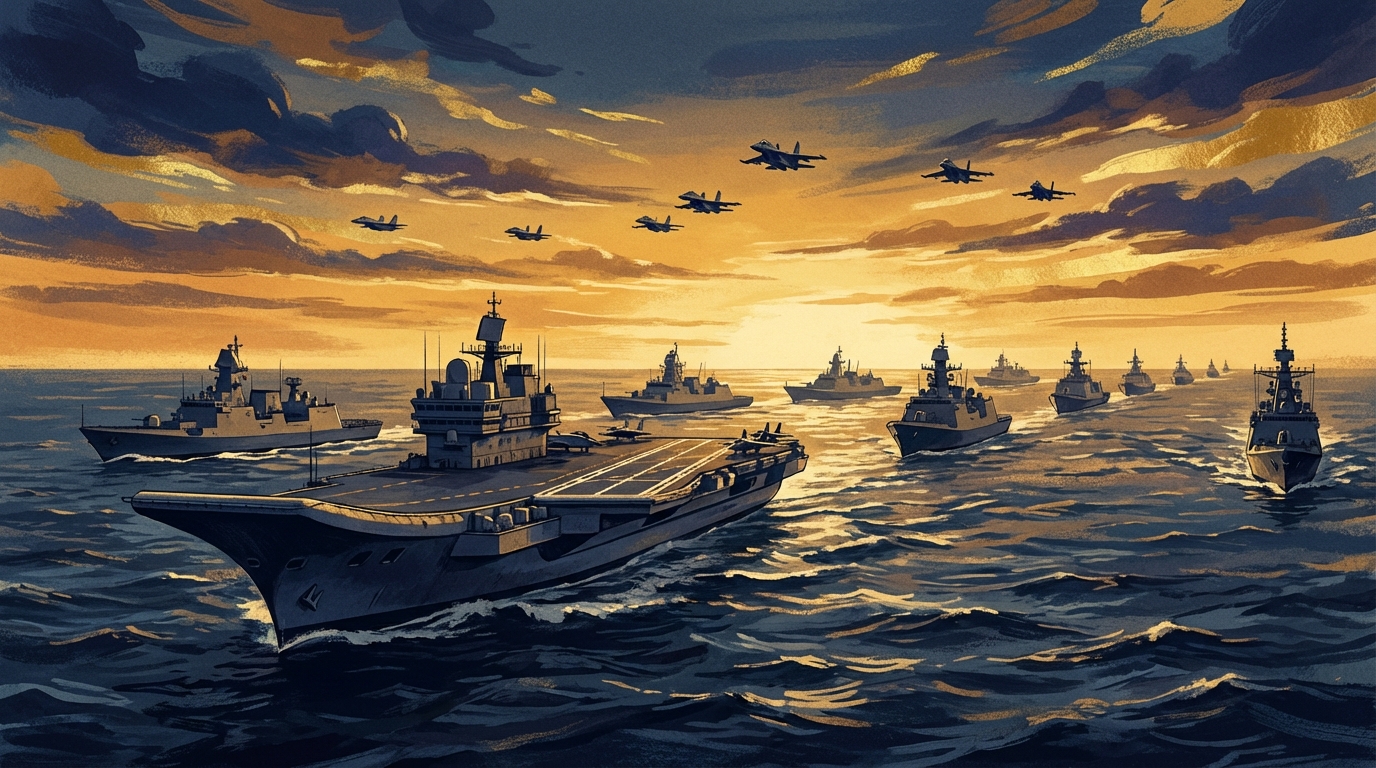
More than 50 nations are expected to participate. INS Vikrant -- India's first domestically built aircraft carrier -- will take centre stage. And President Droupadi Murmu will lead the Presidential Fleet Review at sea, the first such review with an indigenous carrier as the flagship.
This is not diplomacy. This is geometry. India is drawing a circle around the Indian Ocean and inviting the world to note who stands at the centre.
Three Events, One Message
The decision to co-locate the International Fleet Review, MILAN, and the IONS Conclave in a single city during a single window is deliberate and unprecedented. Each event serves a different purpose, but together they project a unified narrative.
The International Fleet Review is the showcase -- a Presidential review of warships from dozens of navies, with India's indigenous platforms front and centre. The Visakhapatnam-class destroyers, Nilgiri-class stealth frigates, and Arnala-class anti-submarine warfare corvettes will line up alongside foreign vessels, demonstrating that India's Navy is no longer a customer of global shipyards but a builder in its own right.
Exercise MILAN is the operational layer. Originally a bilateral exercise, MILAN has evolved into a multilateral naval exercise that tests interoperability, communication protocols, and joint operational procedures. For navies that participate, MILAN is a practical demonstration of whether they can work together when it matters.
The IONS Conclave of Chiefs is the strategic layer. The Indian Ocean Naval Symposium brings together navy chiefs from littoral and island nations of the Indian Ocean Region. This is where doctrine is discussed, maritime security frameworks are shaped, and the political architecture of ocean governance takes form. India, as the convener, sets the agenda.
INS Vikrant Returns to the Spotlight
Sixty years ago, the original INS Vikrant -- a British-built light carrier -- was the centrepiece of India's fleet reviews. The current Vikrant, commissioned in 2022, is an entirely different proposition: a 45,000-tonne aircraft carrier designed and built in Indian shipyards, carrying MiG-29K fighters and Kamov helicopters, and serving as the operational flagship of India's carrier battle group.
Vikrant's presence at IFR 2026 is loaded with symbolism. India is one of only six nations that operate full-deck aircraft carriers. The ability to build one domestically places India in an even more exclusive club. When Vikrant sails past the reviewing stand, it carries with it the accumulated engineering effort of thousands of Indian workers at Cochin Shipyard -- and the strategic argument that India can sustain blue-water naval power without depending on foreign platforms.
The Builder's Navy
The phrase "Builder's Navy" has become a recurring motif in Indian naval discourse, and IFR 2026 is designed to make the argument in steel. The platforms on display represent a deliberate shift from procurement-dependent force building to indigenous design and construction.
The Visakhapatnam-class (Project 15B) destroyers incorporate stealth features, advanced sensor suites, and BrahMos supersonic missiles. The Nilgiri-class (Project 17A) stealth frigates represent the next generation of surface combatants, with reduced radar cross-sections and enhanced electronic warfare capabilities. The Arnala-class (Project 17 Alpha) anti-submarine warfare corvettes address the growing submarine threat in the Indian Ocean, where Chinese submarine deployments have increased significantly.
Each of these platforms was designed by the Indian Navy's Warship Design Bureau and built in Indian shipyards. The capability gap between these ships and their global counterparts has narrowed to the point where the distinction is not quality but quantity -- India builds good warships, it simply needs to build more of them.
The City Parade
In an unusual move, IFR 2026 will include an International City Parade along Visakhapatnam's RK Beach, with contingents from participating navies marching alongside Indian Army and Air Force units. This is public diplomacy at its most visible -- bringing maritime power out of the harbour and onto the beachfront where citizens can see, photograph, and share the spectacle.
The decision to include a city parade reflects a broader shift in how India communicates its military capabilities. For decades, military events were conducted away from public view, accessible only through official media releases. The increasing visibility of events like IFR, Republic Day parades, and military exercises on social media has created a new constituency for defence awareness -- one that the government is actively cultivating.
The Indian Ocean Calculus
The subtext of IFR 2026 is competition. The Indian Ocean, once considered India's strategic backyard by default, is increasingly contested. China's naval presence has expanded through port access agreements in Djibouti, Gwadar, and Hambantota. The People's Liberation Army Navy conducts regular anti-piracy patrols and submarine deployments in waters that India considers its primary area of responsibility.
By hosting 50-plus navies at Visakhapatnam, India is not just showcasing hardware. It is mapping its relationship network. The nations that send warships are making a statement about their willingness to engage with India as a maritime partner. The size and composition of their contributions -- a destroyer versus a patrol vessel, a fleet commander versus a junior officer -- communicates the depth of that engagement.
For smaller Indian Ocean nations -- the Maldives, Seychelles, Mauritius, Sri Lanka -- the presence of global navies at an India-hosted event reinforces the message that India remains the primary security provider in the region. Whether those nations find this reassuring or constraining depends on their own strategic calculations, but the message is sent regardless.
Beyond the Review
The real test of IFR 2026's impact will come after the warships depart. Fleet reviews are spectacular but transient. The lasting value lies in the operational relationships forged during MILAN, the doctrinal consensus shaped at IONS, and the procurement conversations that happen in the margins between defence officials.
India's Navy has articulated a vision of itself as a net security provider in the Indian Ocean. IFR 2026 is the theatrical expression of that vision. Whether the follow-through matches the spectacle -- in basing agreements, joint patrol frameworks, and sustained diplomatic engagement -- will determine whether Visakhapatnam 2026 is remembered as a turning point in Indian maritime strategy or merely a very expensive weekend at the beach.
The ships, at least, make the argument well.
The author is Founder & Editor-in-Chief of BarathVector.