By BarathVector Editorial — 2026-03-07
The Factory Floor Mirage: Make in India's Missing Eleven Percentage Points
Part 2 of "The Delivery Deficit" series
By BarathVector Editorial | March 7, 2026
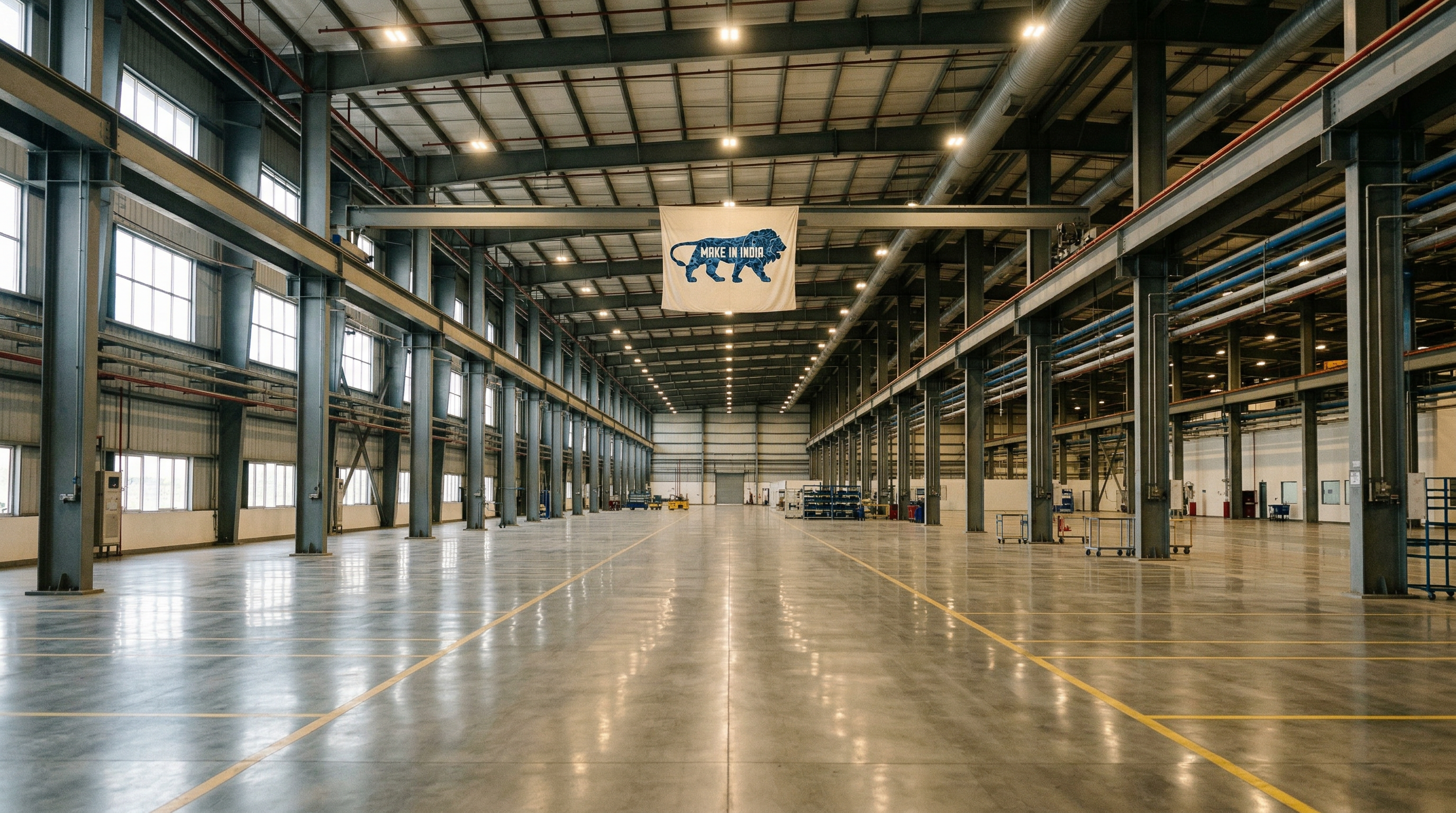
In September 2014, Prime Minister Narendra Modi launched Make in India with a lion logo and a promise: manufacturing would rise to 25 per cent of GDP by 2025. The number was not aspirational rhetoric. It was a stated policy target, repeated in government documents, cited in investor roadshows, and embedded in planning assumptions across ministries.
The year 2025 has come and gone. Manufacturing's share of GDP stands at 13 per cent. Not 25. Not 20. Not even the 17 per cent it was when Make in India was launched. It has declined.
This is not a rounding error. It is an 11-percentage-point miss on the most prominent economic target of the decade.
The Numbers That Matter
Let the data speak plainly.
Manufacturing value added as a percentage of GDP was 17 per cent in 2010. By 2024, according to the World Bank, it had fallen to 12.53 per cent. The government's own Economic Survey projects a recovery to 14 per cent for FY26. The 25 per cent target has been quietly retired from official discourse.
The Production Linked Incentive (PLI) scheme, launched in 2020 across 14 sectors with an outlay of Rs 1.97 lakh crore, was designed to catalyse manufacturing investment. It has produced results -- electronics manufacturing has surged, mobile phone exports have grown significantly, and specific sectors like pharmaceuticals and medical devices have responded. Apple's supply chain shift towards India is real and consequential.
But sectoral success has not translated into structural transformation. The aggregate share of manufacturing in GDP has not moved because the services sector has grown faster. India's IT and digital services, financial services, and professional services have expanded so rapidly that manufacturing, even while growing in absolute terms, has shrunk as a proportion of the whole.
Why the Target Was Always Difficult
The 25 per cent target was borrowed, loosely, from the trajectory of East Asian economies -- South Korea, Taiwan, China -- that achieved sustained manufacturing growth during their high-growth decades. But those economies had structural advantages that India does not:
Land acquisition. In China, the state controls land. In South Korea during its high-growth phase, eminent domain was exercised with minimal judicial interference. In India, land acquisition for industrial use remains among the most politically contested and legally complex processes in any democracy. The Land Acquisition Act of 2013, while protecting farmer rights, added years and costs to every major industrial project.
Labour law flexibility. East Asian manufacturing growth was built on labour-intensive industries -- textiles, toys, electronics assembly -- that employed millions of low-skilled workers under flexible labour regimes. India's labour laws, until the 2020 reforms, made it effectively illegal for firms with more than 100 workers to lay off employees without government permission. The reforms are on paper. Implementation varies by state. The result: India's manufacturing sector is capital-intensive when it should be labour-intensive, employing fewer people per unit of output than its Asian peers.
Infrastructure reliability. A factory that experiences power cuts, road delays, and port congestion cannot compete with a factory in Shenzhen that has 24/7 electricity, eight-lane highways, and a port that turns around containers in hours. India's infrastructure has improved dramatically -- highway construction has tripled, port turnaround times have fallen -- but "improved dramatically" and "globally competitive" are not synonyms.
Bureaucratic friction. The World Bank's Ease of Doing Business rankings (before they were discontinued) showed India improving from 142nd to 63rd between 2014 and 2020. This is genuine progress. It is also a reminder that India was 142nd when Make in India launched. The starting point was so low that dramatic improvement still left India behind its competitors.
The China Comparison India Avoids
China's manufacturing share of GDP peaked at 32 per cent in 2006 and has since declined to about 27 per cent as its economy has matured and services have grown. But even China's declining manufacturing share is double India's aspirational target.
More importantly, China did not achieve manufacturing dominance through announcements. It built the infrastructure of manufacturing -- not just roads and ports, but the ecosystem:
- Special Economic Zones with genuine regulatory exemptions, not watered-down versions
- Exhibition infrastructure that made it easy for global buyers to find Chinese suppliers
- Visa regimes that welcomed buyers, not interrogated them
- Subsidised logistics that reduced the cost of getting goods from factory to port
- Vocational training at scale, producing workers who could operate machinery on day one
India has attempted versions of all of these. SEZs were launched and then undermined by tax policy changes. Exhibition infrastructure remains fragmented and expensive. Visa processes for business visitors from Africa and Southeast Asia -- India's natural buyer base -- remain cumbersome. Vocational training under Skill India has reached scale in enrollment but not in quality or employment outcomes.
The PLI Bright Spots
It would be dishonest to ignore what has worked. The PLI scheme has produced genuine manufacturing momentum in specific sectors:
Electronics. India's electronics manufacturing crossed USD 115 billion in FY25. Mobile phone production has grown from negligible in 2014 to making India the world's second-largest manufacturer. Apple now assembles a significant share of iPhones in India.
Pharmaceuticals. India remains the pharmacy of the world, producing 60 per cent of global vaccines and 20 per cent of generic medicines. The PLI scheme has expanded capacity in APIs (active pharmaceutical ingredients), reducing dependence on Chinese imports.
Defence. Production crossed Rs 1.5 lakh crore. Exports grew thirtyfold. The Tejas fighter, Pinaka rocket systems, and BrahMos missiles represent genuine indigenous capability.
These are real achievements. They are also islands. The sea around them is still services.
What Would 25 Per Cent Actually Require?
For manufacturing to reach 25 per cent of GDP, India would need to approximately double its manufacturing output relative to services growth. At current GDP levels, this would mean adding roughly Rs 30-40 lakh crore in manufacturing value addition -- the equivalent of creating another entire manufacturing sector on top of the existing one.
This is not impossible. But it requires a scale of investment, policy consistency, and infrastructure development that India has not demonstrated in any single sector, let alone across manufacturing as a whole.
It also requires something India has been reluctant to provide: affordable, accessible sales infrastructure for its manufacturers. A textile unit in Tirupur, a furniture workshop in Jodhpur, a brass foundry in Moradabad -- these MSMEs are the backbone of Indian manufacturing. They do not need PLI incentives. They need buyers. And they need it to be easy for those buyers to come to India, see their products, and place orders.
China understood this. India has not.
The Honest Assessment
Make in India has not failed in the sense of producing nothing. It has shifted India's manufacturing trajectory upward in absolute terms. Electronics, defence, and pharmaceuticals are stronger than they were a decade ago. The policy intention is correct. The PLI mechanism has proven effective in targeted sectors.
But Make in India has failed in its own stated terms. The 25 per cent target was not met. Manufacturing's share of GDP has fallen, not risen. The structural transformation from services to manufacturing has not occurred. And the systemic barriers -- land, labour, infrastructure, bureaucracy -- remain sufficiently intact that no amount of PLI allocation will overcome them without deeper reform.
The factory floor is not a mirage in the sense of being entirely imaginary. It is a mirage in the sense that it appears closer than it is. India sees 25 per cent on the horizon. The ground beneath its feet says 13.
This is Part 2 of "The Delivery Deficit" series examining India's announcement-execution gap.
Sources: World Bank, Trading Economics, IBEF, PIB India, Economic Survey 2025-26