By BarathVector Editorial — 2026-03-07
The Exhibition Gap: Where Are India's Buyers?
Part 8 of "The Delivery Deficit" series
By BarathVector Editorial | March 7, 2026
This is the article that policy conferences will not discuss, because it is not about grand strategy or diplomatic architecture. It is about the most mundane, most consequential infrastructure a trading nation can build: the sales floor.
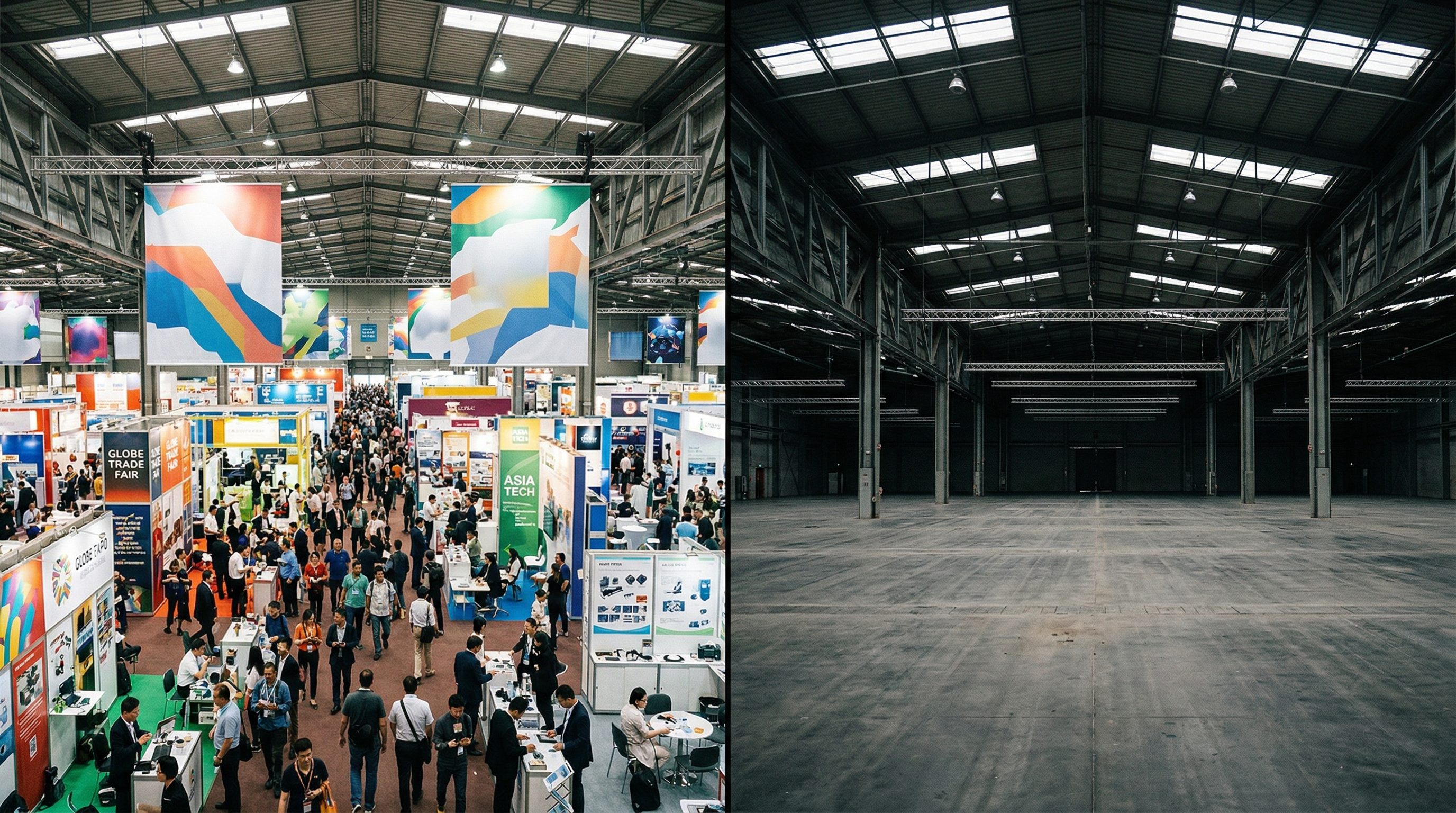
China did not become the world's manufacturing superpower by announcing it. It became one by making it extraordinarily easy for the world to buy from China. The infrastructure of that ease is not abstract. It is physical, logistical, and bureaucratic. And India does not have it.
The Canton Fair: A Masterclass in Selling
The China Import and Export Fair -- known universally as the Canton Fair -- has been running in Guangzhou since 1957. Twice a year, every year, for nearly seven decades. Without interruption. Without reinvention. Without rebranding.
The autumn 2025 edition:
- 28,000+ exhibitors across three phases
- 1.5 million square metres of exhibition space
- Buyers from 210 countries attended
- Products from the smallest township manufacturer to the largest industrial conglomerate, displayed side by side
- On-site translation, logistics, banking, and customs services
The Canton Fair is not a diplomatic event. There are no ministerial speeches. No vision statements. No policy papers. It is a sales floor. Its sole purpose is to connect Chinese manufacturers with international buyers and to make the transaction as frictionless as possible.
A small manufacturer in Dongguan -- making LED bulbs, or bathroom fittings, or plastic toys -- can rent a booth for a few hundred dollars. A buyer from Lagos or Lima can walk in, inspect the product, negotiate a price, place an order, and arrange shipping -- all within the same complex. The infrastructure exists to make buying Chinese as easy as buying local.
Yiwu: The Permanent Canton Fair
If the Canton Fair is China's biannual marketplace, the Yiwu International Trade Market is its permanent one. Located in Zhejiang province, Yiwu hosts 75,000 suppliers in a facility that covers over 5.5 million square metres. It is the world's largest small commodities market.
Foreign buyers receive simplified visa procedures. Many qualify for visa-on-arrival. The market operates year-round. Translation services, freight forwarding, quality inspection, and financial services are integrated into the complex. Hotels, restaurants, and transportation are calibrated around the buyer's needs.
Yiwu is not glamorous. It is not the subject of thought leadership pieces at Davos. It is the reason a shopkeeper in Nairobi stocks Chinese goods rather than Indian ones. Not because Chinese goods are better -- often they are comparable or inferior. But because buying Chinese is easier. The sales infrastructure exists. The visa exists. The logistics exist. The price transparency exists.
India's Exhibition Landscape: Fragmented and Expensive
India has trade fairs. It does not have a Canton Fair.
India International Trade Fair (IITF), Delhi: An annual event, not a permanent institution. Pragati Maidan's redevelopment under the International Exhibition-cum-Convention Centre (IECC) project has modernised the facility -- 123,000 square metres of indoor exhibition space, world-class amenities. It is a significant improvement. It is also less than one-tenth of Canton Fair's footprint.
State-level fairs: Vibrant Gujarat, Tamil Nadu Global Investors Meet, UP Investors Summit. These are investment summits, not trade fairs. They attract corporate executives and government officials. They do not attract the Nigerian buyer looking for a container of textiles or the Brazilian importer searching for auto components.
Industry-specific exhibitions: Auto Expo, IETF, India Wood, Plastindia. These serve specific sectors effectively. They do not provide the broad-spectrum, all-products-under-one-roof experience that Canton Fair offers.
Cost: Booth costs at Indian exhibitions are, relative to manufacturer income, significantly higher than equivalent Chinese venues. A small MSME in Tirupur or Moradabad typically cannot afford a booth at a major Indian trade fair, let alone the travel, accommodation, and logistics costs of participating. China subsidises booth costs for small exporters. India does not, at comparable scale.
The Visa Wall
This is where India's trade infrastructure failure is most acute and most easily fixable.
A furniture manufacturer in Jodhpur wants to sell to a buyer from Kenya. The Kenyan buyer needs an Indian visa. The process:
- Online application with extensive documentation
- Processing time: 7-15 business days (often longer)
- Supporting documents: invitation letter, bank statements, company registration, travel insurance
- Interview may be required
- Fee: varies by nationality, typically USD 50-100
A buyer from the same country visiting China:
- Visa-on-arrival or simplified e-visa for many nationalities
- Processing time: 24-72 hours for those requiring pre-approval
- Yiwu and Canton Fair offer dedicated "buyer visa" facilitation with minimal documentation
- The entire system is designed around the assumption that buyers are welcome
India's visa regime for business visitors from Africa, Southeast Asia, Latin America, and the Middle East -- the markets where Indian manufacturers have the greatest competitive potential -- is bureaucratic, slow, and unwelcoming. It communicates, implicitly, that India views these visitors as potential immigration risks rather than potential customers.
The solution is not open borders. It is not naive. It is pragmatic:
- Visa-on-arrival for all buyers from countries without significant security concerns -- and that covers the vast majority of India's potential buyer base
- Online visa in 72 hours for buyers from sensitive-origin countries, with a dedicated "trade visa" category that requires minimal documentation beyond a valid invitation from an Indian exhibitor
- Dedicated buyer visa desks at major Indian airports, staffed during major trade fair seasons, with expedited processing
These are not radical proposals. They are what China, Turkey, and the UAE already do. India's refusal to do the same is not a security policy. It is a trade barrier wearing a security costume.
The MSME Problem
India has approximately 63 million MSMEs. They employ over 110 million people. They produce textiles, leather goods, brassware, furniture, auto components, pharmaceuticals, handicrafts, and thousands of other products that are globally competitive on quality and price.
Most of these MSMEs have never exhibited at an international trade fair. They cannot afford it. They do not know how. They do not have the English-language marketing materials, the product certification, or the logistics partnerships required to handle international orders.
China solved this through state-supported ecosystem development:
- Subsidised exhibition space for MSMEs at Canton Fair and regional trade fairs
- Export training programmes that teach small manufacturers how to price for international markets, create catalogues, and handle cross-border logistics
- Aggregation platforms like Alibaba and 1688.com that give the smallest manufacturer a digital shopfront accessible to global buyers
- Government-backed quality certification programmes that simplify the process of meeting international standards
India has versions of all these. The District Export Hubs initiative, the MSME Udyam portal, the GeM marketplace. But none operates at Canton Fair scale. None is designed primarily around the buyer experience. The Indian system is built for compliance and documentation. The Chinese system is built for sales.
Five Canton Fairs
What India needs is not another policy announcement about MSMEs or export promotion. It needs physical infrastructure:
Five permanent trade exhibition centres -- in Delhi, Mumbai, Chennai, Ahmedabad, and Kolkata -- each with at minimum 500,000 square metres of exhibition space, operating year-round with rotating sector-specific exhibitions.
Booth costs subsidised for MSMEs -- a small manufacturer should be able to exhibit for the cost of a train ticket, not the cost of a month's revenue.
Integrated buyer services -- translation, logistics, banking, customs, quality inspection, and accommodation, all within or adjacent to the exhibition complex.
Visa reform -- visa-on-arrival for buyers from all non-security-risk countries. Online visa in 72 hours for everyone else. No interview. No bank statement. An invitation letter from a registered exhibitor should suffice.
Digital integration -- every physical booth linked to a permanent online catalogue, accessible to buyers who cannot travel. B2B e-commerce integrated with exhibition logistics. Follow-up order processing handled through a national export facilitation platform.
This is not visionary. This is plumbing. China built this plumbing decades ago. India's manufacturers are still carrying water by hand.
The Honest Assessment
India's trade infrastructure gap is, in some ways, the most fixable problem in this entire series. Semiconductor fabs require decades of institutional development. AI compute requires billions in hardware. Defence indigenisation requires deep engineering capability.
But building exhibition halls, reforming visa processes, and subsidising MSME booth costs? These are administrative decisions. They require money, yes. But the money is modest relative to the defence budget, the PLI scheme, or the cost of a single semiconductor fab. The obstacle is not capability or funding. It is orientation.
India's economic infrastructure is built around the assumption that the government's job is to create the conditions for manufacturing. It is not built around the assumption that the government's job is to help manufacturers sell. China understood that the two are inseparable. India has not.
Build the sales floor. Open the visa counter. Let the buyer in. The factory floor cannot fill itself.
This is Part 8 of "The Delivery Deficit" series examining India's announcement-execution gap.
Sources: Canton Fair official records, IBEF, India International Trade Fair, Yiwu International Trade Market, MSME Ministry