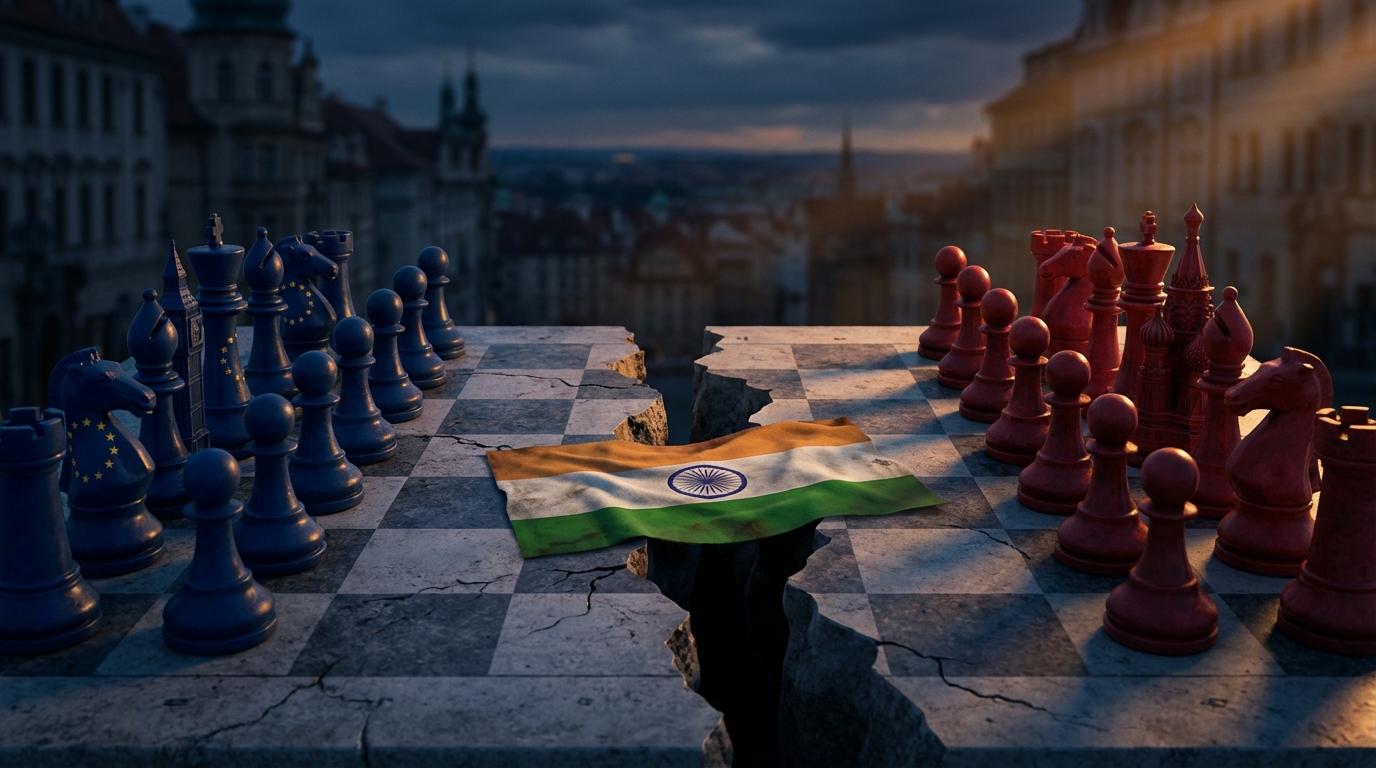
By Ramachandran Rajeev Kumar — 2026-01-18
An Opinion Article
The Ukraine war has now crossed 1,400 days. It has lasted longer than the Great Patriotic War on the Eastern Front. Russia occupies 116,250 square kilometers of Ukrainian territory - roughly the size of Ohio - and despite over one million combined casualties, neither side shows signs of decisive victory.
And yet, Europe finds itself scrambling for a seat at the negotiating table it helped create the need for.
This is not an argument for Russian aggression. It is an observation about strategic failure. Europe's policy toward Russia has been driven by fear rather than calculation, by reaction rather than foresight. The result is a continent that has weakened itself economically, expanded a military alliance that accelerated the very conflict it sought to prevent, and now watches as Washington and Moscow negotiate Europe's security future without meaningful European input.
The NATO Expansion Paradox
The uncomfortable truth about NATO expansion is that it achieved the opposite of its stated purpose.
In 2004, when seven Eastern European nations joined NATO - including the three Baltic states, the first former Soviet republics to do so - Putin's public response was notably restrained. He stated: "As to NATO enlargement, we have no concerns regarding the security of the Russian Federation."
This was not naivety. It was strategic patience. Russia was weak in 2004. Putin understood that open confrontation would fail. But the seeds of grievance were planted.
By 2007, the tone had shifted. Putin accused Western powers of violating pledges by expanding NATO. The alliance's eastward march continued regardless - Montenegro in 2017, North Macedonia in 2020.
Then came the war in Ukraine. And in a twist of profound irony, Russia's invasion to prevent NATO expansion on its borders resulted in Finland and Sweden - two historically neutral nations - joining the alliance. NATO's border with Russia more than doubled.
Was NATO expansion "unnecessary and provocative" as critics argue? The evidence suggests it was at least counterproductive. An alliance designed to contain Soviet expansion ended up provoking Russian expansion. The security it promised to Eastern Europe came at the cost of a war that has devastated Ukraine and destabilized the entire continent.
What the War Revealed About Russian Capabilities
Here is what 1,400 days of war have taught us about Russia's military:
Russia has lost over 3,000 tanks - more than its entire prewar active-duty inventory. It has suffered an estimated 400,000 killed and 750,000 wounded. Its equipment reserves are depleting; by 2026, most easily restorable vehicles will be exhausted, requiring deeper refurbishment that Russia's industrial base struggles to provide.
Russian forces have advanced an average of 50 meters per day in areas like Kharkiv - slower than the infamous Somme offensive of World War I.
This is not the military of a nation capable of sweeping across Europe. This is an army that has struggled for four years to overcome a country with a fraction of NATO's combined military power.
The fear that Russian tanks would roll through Warsaw and Berlin if not stopped in Kyiv was always more hysteria than analysis. Russia has demonstrated the capacity for prolonged attrition warfare, but not for the kind of decisive breakthrough operations that would threaten NATO territory.
Yet this fear - not strategic calculation - has driven European policy.
The Donbas Reality
Putin is not going to relent on Donbas or the captured territories. This is the hardest truth for European policymakers to accept, but accepting it is the first step toward pragmatism.
Russia now controls 78% of Donetsk Oblast and nearly all of Luhansk. It has transformed occupied Donbas into what analysts describe as "a huge military base." Russian military objectives for 2026 include full control of Donetsk and Zaporizhzhia.
The 20-point peace framework currently being negotiated - with 90-95% reportedly agreed upon - will almost certainly involve some recognition of territorial realities on the ground. Security guarantees are reportedly 100% agreed. The sticking point remains the territorial question.
Europe can continue to insist on the restoration of 2014 borders. It is a morally defensible position. But after 1,400 days, it is not a strategically achievable one - not without a level of military commitment that European publics have shown no appetite for.
The Pragmatic Path Forward
German Chancellor Friedrich Merz stated this month that "Russia is a European country and the EU will need to restore balance in relations with it." Italian PM Giorgia Meloni said "the time has come" for the EU to resume high-level dialogue with Russia. French President Macron has called for Europe to create a "framework" to directly engage with the Kremlin.
These are not capitulations. They are recognitions of reality.
The pragmatic European action should be to draw the line where it now stands and begin the long process of normalizing relations with Russia - not because Russia deserves it, but because Europe needs it.
Europe's energy crisis, its inflation, its industrial competitiveness challenges - all of these have been exacerbated by the rupture with Russia. The continent that once imported 40% of its gas from Russia has found alternatives, but at enormous economic cost. German industry, built on cheap Russian energy, has lost competitive advantage it may never recover.
Drawing the line does not mean forgetting. It means choosing a future over an endless present of attrition.
India's Potential Role
This is where India enters the picture.
India has maintained what Prime Minister Modi calls "pragmatic neutrality" - a position that has frustrated Western capitals but positioned New Delhi as one of the few actors trusted by both sides.
Consider the numbers: India-Russia bilateral trade has increased nearly six-fold since the invasion, from $10 billion to $69 billion. Putin visited New Delhi in December 2025, signing 28 agreements including co-production of fifth-generation fighter jets. Russia supplied 36% of India's weapons imports between 2020 and 2024.
Yet European leaders - including European Commission President Ursula von der Leyen and European Council President António Costa - are attending India's Republic Day celebrations on January 26, 2026. An EU-India Summit is scheduled for the same day.
India is playing what analysts call a "triple game" - balancing relationships with the US, EU, and Russia simultaneously. This is not fence-sitting. It is strategic positioning that has preserved India's options while others have foreclosed theirs.
If Europe and Russia genuinely wish to find a path toward normalized relations - and recent statements suggest some appetite for this on both sides - India could serve as an honest broker. It has credibility with Moscow that European capitals have lost. It has economic interests in both markets. It has no territorial ambitions in the European theatre.
The question is whether both parties sincerely wish it.
Beyond Fear
The great failure of European Russia policy was not that it sought to defend Ukraine or contain Russian aggression. Those were legitimate goals.
The failure was in confusing fear with strategy. In expanding an alliance without considering how expansion would be perceived. In imposing sanctions without a theory of how sanctions would lead to desired outcomes. In cutting energy ties without a plan for industrial competitiveness. In isolating Russia without considering where isolation would push it.
Russia has responded to isolation by deepening partnerships with China, India, and the Global South. It has found buyers for its oil, suppliers for its military, and diplomatic cover for its actions. The isolation meant to weaken Russia has, in some ways, diversified its dependencies.
After 1,400 days, Europe faces a choice. It can continue a policy driven by fear - hoping that Russia will eventually collapse, that Putin will be replaced by someone more amenable, that the territorial status quo will somehow reverse itself.
Or it can begin the harder work of strategic engagement. Accepting losses. Defining achievable objectives. Building relationships that serve European interests rather than merely expressing European values.
India has shown that neutrality and engagement are not moral failures. They are strategic choices that preserve options.
Europe might consider what options it has left, and which ones pragmatism might restore.
The views expressed are the author's own.