By Ramachandran Rajeev Kumar — 2026-02-28
The Heart of the Matter
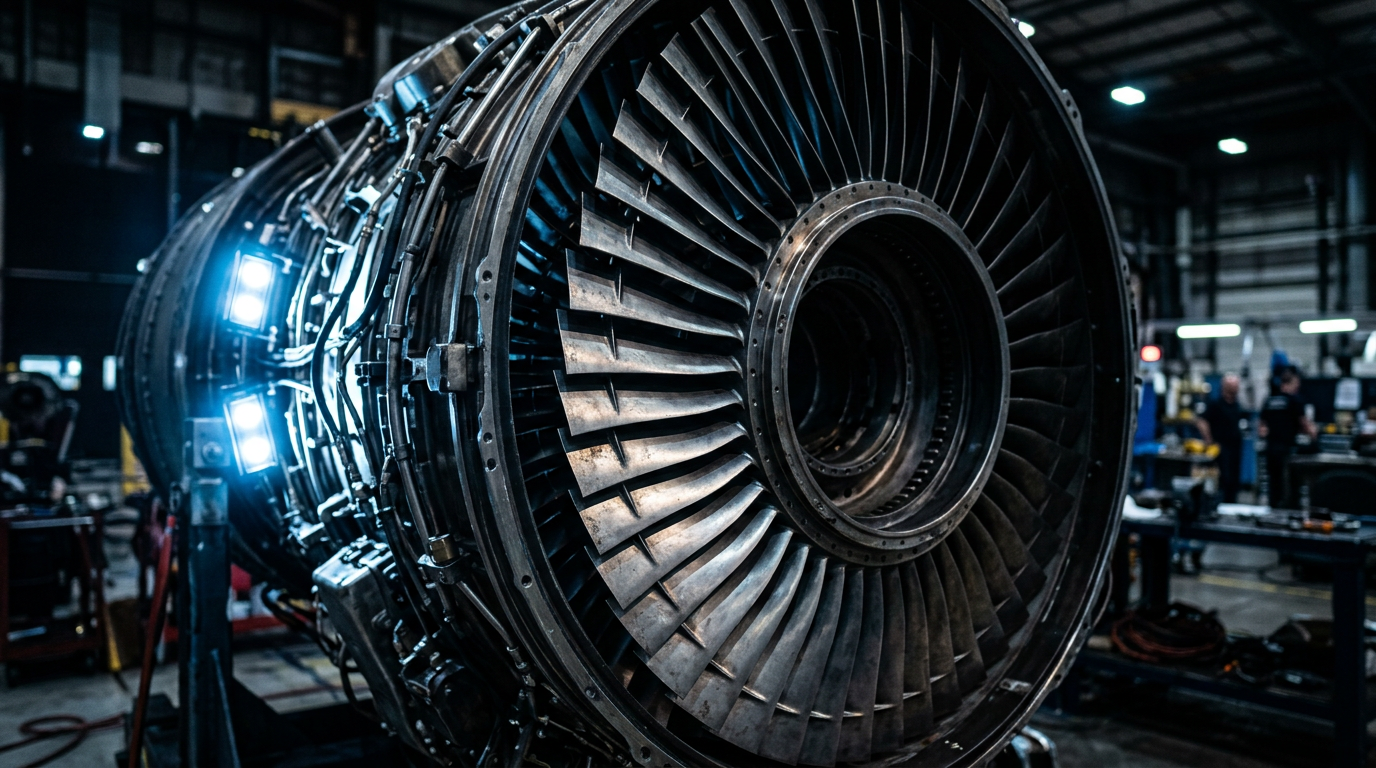
There is a reason the jet engine is called the heart of a fighter aircraft. Without it, the airframe is sculpture. The avionics are decoration. The stealth geometry is a museum exhibit. Every nation that has attempted to build a serious combat aircraft has learned this lesson the hard way -- and India, four decades into the effort, is still learning.
On February 25, the contours of a deal worth approximately 6.7 billion euros were finalised between India's Defence Research and Development Organisation and Safran, the French aerospace propulsion giant, to co-develop a 120-kilonewton class engine for the Advanced Medium Combat Aircraft -- India's first indigenous fifth-generation stealth fighter. The deal edged out Britain's Rolls-Royce, and it represents the single largest technology transfer agreement in Indian defence history.
The collaboration is welcome. It is, in fact, necessary. But let us not confuse a purchase order with a graduation certificate. India is enrolling in a seven-billion-dollar classroom. The question is whether it will emerge as a student who has mastered the subject -- or one who will need to keep paying tuition forever.
What the Deal Contains
The specifics matter, because in defence partnerships the devil lives not in the headline but in the technology transfer annexures.
Safran and GTRE -- the Gas Turbine Research Establishment under DRDO -- will jointly develop a clean-sheet turbofan engine blending elements of Safran's M88 core technology and next-generation research from its T-REX programme. The engine is targeted at 120 kilonewtons of thrust, with some reports suggesting headroom for growth to 140 kN. Five prototype engines are expected before the end of the decade, a first AMCA flight with the new powerplant around 2028, certification in the early 2030s, and full-rate production toward 2035.
What distinguished Safran's bid from Rolls-Royce was threefold. First, timeline: Safran offered a ten-year development cycle against Rolls-Royce's thirteen, aligning with the Indian Air Force's production schedule for the AMCA Mark II. Second, depth of transfer: Safran committed to one hundred percent technology transfer, including the hot section -- the brutally difficult core of the engine where temperatures exceed the melting point of the metals that must contain them. This includes single-crystal turbine blade manufacturing, ceramic matrix composites, and high-temperature coatings -- capabilities mastered by fewer than five nations on earth. Third, geopolitical insulation: India assessed that Safran, as a French firm, carried less risk of American sanctions pressure than Rolls-Royce, which has significant US supply chain dependencies.
The deal also carries a commitment to a one hundred percent local supply chain over time, with Safran pledging to build Indian industrial capacity rather than maintain a permanent export relationship.
On paper, this is everything India has asked for. On paper, the Kaveri engine was also supposed to fly by 1996.
The Kaveri Inheritance
No honest analysis of India's fighter engine ambitions can proceed without confronting the Kaveri programme -- the wound that will not close.
In April 1989, the Cabinet Committee on Security sanctioned Project Kaveri with a budget of 382 crore rupees and a 93-month development schedule. GTRE, which had limited experience in full-scale engine development, was tasked with designing and building an afterburning turbofan that would power the Light Combat Aircraft -- what eventually became Tejas. The target: a dry thrust of approximately 52 kN and 81 kN with afterburner, to be delivered by December 1996.
The core module, called Kabini, completed its first run in March 1995. The full engine ran in 1996. Five ground-test prototypes were tested by 1998. Then the trouble began.
The engine could not meet its weight targets. It could not deliver the required thrust. The materials science -- particularly for the high-pressure turbine -- was beyond India's industrial base. The testing infrastructure was inadequate. The programme haemorrhaged time and money. By 2008, the Kaveri was officially delinked from the Tejas programme. In 2010, it flew on a Russian Ilyushin-76 testbed -- a milestone, but one that came fourteen years late and on a foreign aircraft. By 2014, DRDO effectively acknowledged that the Kaveri in its original form would never power a fighter jet.
The lessons from Kaveri are uncomfortable but essential. India did not fail because its engineers lacked talent. It failed because it underestimated the sheer difficulty of the task, under-invested in the materials science and metallurgical infrastructure required, and attempted to leap from near-zero institutional capability to world-class performance in a single bound. The hot section of a jet engine -- where turbine blades must endure temperatures above 1,500 degrees Celsius while spinning at tens of thousands of rotations per minute -- requires not just design knowledge but a manufacturing ecosystem: single-crystal casting foundries, thermal barrier coating facilities, precision machining to tolerances measured in microns, and testing infrastructure that can simulate decades of operational stress in months.
India had none of this in 1989. It has little of it in 2026.
The China Mirror
Across the Himalayas, there is a nation that faced the identical problem -- and solved it.
China's fifth-generation J-20 Mighty Dragon first flew in 2011 with Russian AL-31F engines, the same dependency trap that India knows intimately. For over a decade, the aircraft was powered by interim Chinese engines -- the WS-10C -- that could not deliver the performance the airframe was designed for. Supercruise was impossible. Range was compromised. The J-20 was a fifth-generation airframe with a fourth-generation heart.
But Beijing did something that New Delhi has not: it committed to solving the engine problem at national scale, with national resources, as a national priority. The WS-15 programme consumed enormous investment, suffered failures, and took over thirty years from inception to production. And yet, by late 2025, low-rate initial production of WS-15-powered J-20A variants had commenced. The engine delivers approximately 180 kN of thrust with afterburner. Supercruise is confirmed. China aims for a fleet of over a thousand J-20s by 2030, all powered by indigenous engines.
The comparison is instructive not because China and India have identical industrial ecosystems -- they do not -- but because it demonstrates that engine indigenisation is achievable for a developing nation, provided the commitment is absolute and sustained across decades. China poured resources into single-crystal blade research, turbine disc forging, and thermal coating development with the understanding that there are no shortcuts in metallurgy. You cannot code your way to a turbine blade that survives 2,000-degree gas temperatures. You have to build the foundries, train the metallurgists, iterate through hundreds of failed castings, and accumulate institutional knowledge that cannot be purchased in a technology transfer agreement.
This is the distinction India must internalise. A technology transfer teaches you how to build this engine. It does not teach you how to design the next one.
The Dependency Arithmetic
Consider where India stands today in fighter jet propulsion.
The Tejas Mark 1 flies on the GE F404 -- an American engine. The Tejas Mark 1A will fly on the same. The Tejas Mark 2 will use the GE F414 -- a more powerful American engine, with 99 units to be co-produced under a 2023 agreement between HAL and GE. The Rafale flies on Safran's M88 -- a French engine. The Su-30MKI flies on the AL-31FP -- a Russian engine. The MiG-29 flies on the RD-33 -- another Russian engine.
Not a single fighter jet in the Indian Air Force's current or near-future inventory flies on an Indian engine.
This is not embarrassing. It is dangerous.
Engine dependency means that India's combat aviation readiness is perpetually hostage to the foreign policy calculations of Washington, Paris, and Moscow. It means that in a crisis -- precisely the moment when fighter jets matter most -- India's ability to sustain operations depends on whether its engine supplier's government considers the crisis compatible with its own strategic interests. It means that spare parts, overhaul schedules, and operational availability are determined in boardrooms outside Indian jurisdiction.
The GE relationship illustrates the vulnerability. India's entire Tejas programme -- the flagship of Aatmanirbhar Bharat in combat aviation -- runs on American engines. The same America that has, in living memory, imposed sanctions on India after the 1998 nuclear tests. The same America whose export controls on military technology are subject to Congressional moods, election cycles, and the shifting winds of Indo-Pacific strategy.
France has been a more reliable partner, delivering Rafales during periods of geopolitical strain and maintaining a defence relationship that is less encumbered by third-party vetoes. The Safran deal acknowledges this reality. But reliability of supply and independence of capability are not the same thing.
The Missing Ingredient
The Safran deal promises complete technology transfer. Let us examine what that means -- and what it does not.
Technology transfer, even at one hundred percent, is the transfer of existing knowledge. It teaches GTRE how to build a specific engine designed by Safran's engineers using Safran's philosophy, Safran's materials database, and Safran's decades of iterative development. It will give India the ability to manufacture single-crystal turbine blades -- a significant capability. It will establish production lines for ceramic matrix composites. It will build testing infrastructure that GTRE currently lacks.
What it will not provide is the institutional experience of having conceived the engine from first principles. The design trade-offs, the failed experiments, the dead-end architectures that were explored and abandoned, the intuitive understanding of why certain approaches work and others do not -- this knowledge lives in the engineering culture of the originating organisation, and it does not transfer in a contract.
Consider the analogy of a student who copies a master's painting stroke by stroke. At the end, the student has a painting -- possibly an excellent one. But the student has not become an artist. The ability to conceive the next painting, to respond to a new challenge with original solutions, requires a different kind of learning. It requires having failed, experimented, and discovered on one's own.
India must use the Safran partnership not merely to produce the AMCA engine but to build the institutional depth that enables the next engine -- and the one after that -- to be conceived, designed, and developed primarily by Indian engineers using Indian materials science and Indian testing infrastructure.
What Must Change
The AMCA-Safran deal is a good deal. Let that be stated clearly. India needs this engine, the timeline is aggressive but plausible, and Safran is a credible partner with a track record of genuine technology sharing with India. The criticisms circulating in the defence community -- that Safran has historically under-delivered on transfer commitments, that the M88 core has limitations -- are worth monitoring but should not obscure the fundamental value of the partnership.
But a good deal is not the same as a solved problem.
What India needs, alongside the Safran partnership, is a National Aero Engine Mission with the institutional weight, funding continuity, and political protection that India gave its space programme. ISRO did not become a world-class space agency by licensing rockets from abroad. It built them -- painfully, slowly, with failures that cost careers and sometimes lives -- until the institutional knowledge was so deep that Indian launch vehicles competed on the global market.
The engine mission must include dedicated investment in materials science infrastructure -- single-crystal casting facilities, thermal barrier coating research labs, and superalloy development programmes -- that exist independently of any foreign partnership. It must create a pipeline of metallurgists, thermodynamicists, and turbine aerodynamicists who spend their careers in Indian engine development, not as recipients of foreign training but as originators of Indian solutions. It must accept that the first fully indigenous engine will likely underperform its foreign competitors, just as the early PSLV underperformed the Ariane, and sustain the programme through those difficult years until competence compounds into capability.
The defence minister announced in February that the National Aero Engine Mission has been initiated. The words are correct. Whether the commitment matches the words will determine whether India, in 2045, is still writing deals with foreign engine makers -- or selling its own.
The Twenty-Year Test
The AMCA is scheduled to fly in 2028 and enter service in the mid-2030s. The Safran engine will power the Mark II variant, with the Mark I likely using an interim GE F414 solution. By the time the co-developed engine reaches full-rate production around 2035, nearly fifty years will have passed since GTRE first began work on the Kaveri.
Five decades is a long time to master any technology. India has sent spacecraft to Mars, built nuclear submarines, and developed ballistic missiles that can reach any point on the globe. Each of these achievements required sustained institutional commitment through periods of failure, criticism, and doubt. The jet engine -- thermodynamically the most demanding artefact in conventional military technology -- has so far resisted India's efforts because those efforts have been intermittent, under-resourced, and repeatedly interrupted by the availability of foreign alternatives.
The foreign alternative is, paradoxically, the enemy of indigenous capability. Every time India buys or licenses a foreign engine, it relieves the immediate pressure to develop its own. The operational need is met. The air force gets its aircraft. The political optic of a flying fighter is achieved. And the foundational work of building an engine development ecosystem gets deferred for another decade.
The Safran deal must be the last such deferral. Not because international collaboration is wrong -- it is healthy, it is necessary, it accelerates learning. But because the ultimate measure of defence sovereignty is not the ability to buy the best equipment in the world. It is the ability to build it. And for India, the jet engine remains the one critical military technology where building it has always been tomorrow's problem.
Tomorrow has been arriving for forty years. It is time it actually got here.
India can design stealth airframes, integrate AESA radars, and wire together the most sophisticated avionics. But until it can forge the turbine blade that survives the inferno inside a jet engine's core -- until that blade is conceived, cast, coated, and tested on Indian soil by Indian metallurgists -- the nation's fighter aviation will fly on borrowed fire. The Safran partnership is the classroom. Graduation is building the next engine alone.