By Ramachandran Rajeev Kumar — 2025-12-25
The Elephant and the Dragon: A Fable for Our Times
An Editorial Fable
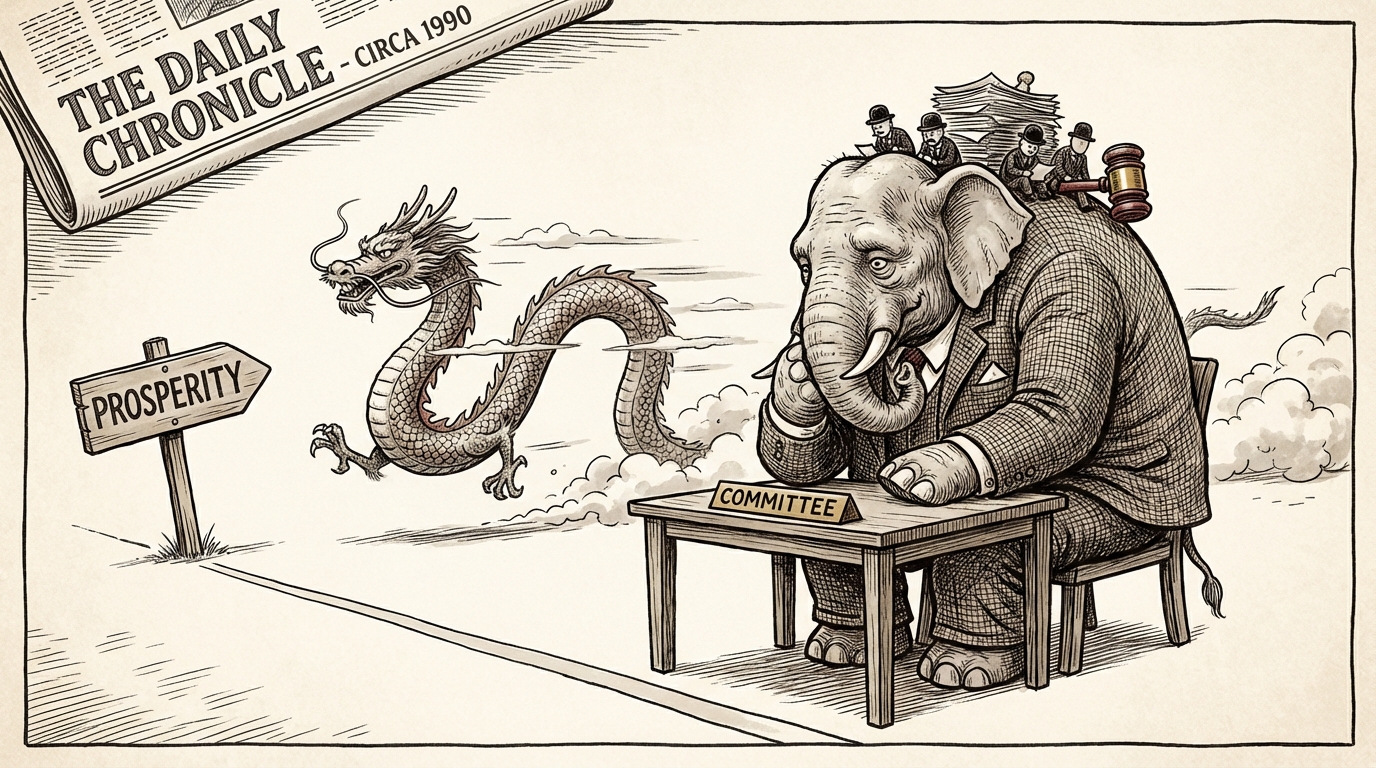
The Daily Chronicle, Circa 1990: One sits in committee. One runs toward prosperity.
Once upon a time, in the year 1990, an Elephant and a Dragon stood at a starting line.
Both were ancient. Both were mighty. Both had fallen on hard times and were now ready to run toward a destination called Prosperity.
A whistle blew. The race began.
The Dragon's Approach
The Dragon did not deliberate. It simply ran.
When villagers in its path complained about being displaced, the Dragon did not form a committee. It relocated them. When rivers blocked its way, it did not conduct environmental impact assessments for seventeen years. It built dams. When its own children questioned the direction, the Dragon did not permit debate. It ran faster.
"This is not fair!" cried observers from distant lands. "You cannot run like this! What about the villagers? What about the rivers? What about freedom?"
The Dragon did not stop to argue. It simply asked: "Are you running this race, or am I?"
And it kept running.
The Elephant's Approach
The Elephant, being a thoughtful creature, first formed a committee to decide which leg should step first.
"The Left Front believes the left leg should lead," announced one faction.
"The Right Wing insists on the right leg," declared another.
"What about the hind legs?" demanded a third group. "They have been historically marginalized!"
After much deliberation, it was decided that all four legs would be given equal opportunity to step first, in rotating order, based on a reservation system that accounted for historical leg-discrimination.
The Elephant took its first step in 1991.
The First Decade
By 2000, the Dragon had built highways connecting every major city. Its factories hummed. Its ports swelled with exports. The world began buying everything the Dragon made.
The Elephant, meanwhile, had successfully debated whether highways were environmentally appropriate. A committee had determined that the existing bullock-cart paths were part of the cultural heritage. A court case was pending.
However, the Elephant had made one clever move: it had taught its children to speak English and solve equations. These children began traveling to distant lands, where they built things for others.
"See?" said the Elephant proudly. "Our children are building the world's future!"
"Yes," noted an observer, "but they're building it for the Dragon's customers."
The Second Decade
By 2010, the Dragon had become the world's factory. It made everything: phones, clothes, toys, steel, ships, trains. It was not always elegant. Sometimes the toys were poisonous and the trains crashed. But the Dragon learned and improved, because it was doing rather than discussing.
The Elephant was now called an "Emerging Market," which is what distant observers call an economy that is perpetually about to become important.
The Elephant had built some software parks, which was good. It had also built some malls, which were air-conditioned. Its children continued to leave for distant lands, promising to return "once things improved."
"When will things improve?" asked the young elephants.
"After the next election," said their elders. "Or the one after that. These things take time."
The Third Decade
By 2020, the Dragon commanded an economy five times larger than the Elephant's. It had built fast trains that traveled 350 kilometers per hour. It had put robots in factories. It was reaching toward the moon.
The Elephant had built a very impressive statue.
"But we have democracy!" trumpeted the Elephant proudly. "Our people can vote!"
"Yes," agreed the observers. "They vote enthusiastically, every five years, for leaders who promise what the Dragon simply delivers."
The Elephant considered this. Then it formed a committee to study the observation.
The Pandemic Pause
In 2020, a great sickness came. The race paused.
The Dragon locked its people in their homes—by force, efficiently, without debate. The sickness was contained. The factories reopened. The running resumed.
The Elephant also locked its people in their homes, but with four hours' notice. Millions of workers began walking home across the vast land, because no one had thought to ask where they would go.
"This is a democracy," explained the Elephant's leaders. "We must act fast, but also consider everyone's feelings, but also not really plan for anything, but also announce it on television. It is complicated."
The Present Day
It is now 2025. Thirty-five years have passed.
The Dragon is the world's largest manufacturer, largest exporter, and largest builder. It has lifted 800 million of its people from poverty. Its high-speed trains cover 45,000 kilometers. Its factories make everything from iPhones to aircraft carriers. It is no longer running. It is flying.
The Elephant has grown too. Its economy has expanded. Its malls are very nice. Its software engineers are still building the world's future—mostly from offices in California, Singapore, and London. Its high-speed train project, announced in 2015, is expected to complete its first 500-kilometer stretch by 2028, assuming no further delays, court cases, or land acquisition disputes.
"We are the fastest-growing large economy!" declares the Elephant.
"Growing from what base?" asks the Dragon, not unkindly. "My economy is five times yours. If I grow at 5% and you grow at 7%, which of us adds more?"
The Elephant considers this. Then it forms a committee.
The Moral
There are those who will say this fable is unfair. That the Dragon's methods are cruel, authoritarian, undemocratic. That the Elephant's deliberation is a feature, not a bug. That freedom and dignity matter more than GDP.
All of this is true.
But it is also true that hungry children do not eat democracy. That the poor cannot live in debates. That a nation's greatness is measured not by the eloquence of its arguments, but by whether its people have toilets, electricity, and hope.
The Elephant has much to be proud of: its diversity, its democracy, its ancient wisdom. But wisdom without action is merely philosophy. And philosophy does not build high-speed trains.
The Dragon asked: "How do we get there?" and then went.
The Elephant asked: "Should we go there? Who should go first? Is going there fair to those who cannot go? What about those who prefer to stay? Have we consulted all stakeholders?"
Both questions have value. But only one of them moves you forward.
The Uncomfortable Question
This fable ends not with a conclusion, but with a question:
If the Elephant knows what it must do—build infrastructure, educate children, create jobs, cut red tape, stop fighting itself—why doesn't it simply do it?
The Dragon did not wait for consensus. It created consensus through results. The Elephant waits for consensus before acting, and so never acts at all.
Thirty-five years ago, they were equals.
Today, they are not.
The race continues. The Elephant still has time—but not infinite time. The question is not whether the Elephant can run.
The question is whether it will.
"A journey of a thousand miles begins with a single step—not a committee meeting about which foot should step first."
— Ancient wisdom, still unheeded
Also in Opinion:
- The Innovation Gap - Why India Consumes But Doesn't Create
- The Caste Calculus - Why India Must Abandon Caste-Based Policy