By Ramachandran Rajeev Kumar — 2026-01-10
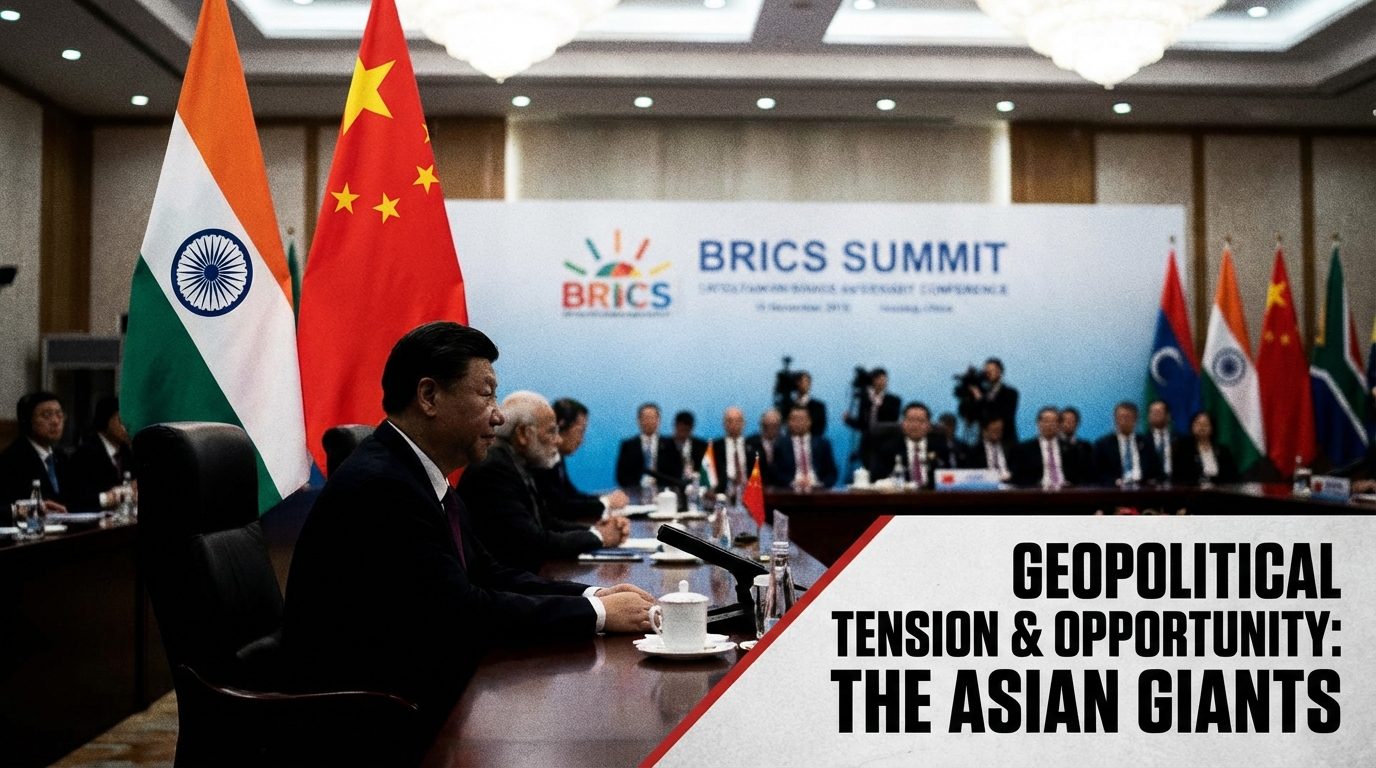
In August 2025, during the SCO Summit in Tianjin, Prime Minister Narendra Modi extended an invitation that would have been unthinkable two years earlier: he asked President Xi Jinping to visit India for the 2026 BRICS Summit.
Xi thanked him. He offered China's support for India's BRICS presidency. He did not explicitly confirm attendance.
But if Xi Jinping does set foot in India later this year, it will mark his first visit since 2015 - and a milestone in the most consequential bilateral relationship of the Asian century.
The Thaw Is Real
Let's be clear about what has changed. The China-India relationship in 2026 looks dramatically different from the frozen hostility of 2020-2024.
In October 2024, both countries announced patrolling arrangements at the Line of Actual Control, ending the military standoff that began with the Galwan clash. Troops have disengaged from Depsang and Demchok. The risk of kinetic conflict has receded.
In August 2025, Modi visited China for the first time in seven years. Both leaders described each other as "development partners, not rivals." They "underlined the importance of peace and tranquility in border areas."
Trade restrictions are easing. India's finance ministry plans to scrap five-year-old curbs on Chinese government contracts - restrictions imposed after Galwan. Direct flights have resumed. Visa processes have accelerated. Hindu pilgrimage to Tibet has restarted.
Chinese companies are back. LONGi Green Energy partnered with Inox Solar for 5GW of photovoltaic manufacturing. CALB Group signed a 20-year partnership with Ashok Leyland for lithium batteries. Indian exports to China jumped 42% year-on-year in October 2025.
This is not friendship. But it is normalization.
India's BRICS Moment
India officially assumed the BRICS chairmanship on January 1, 2026. The 18th BRICS Summit will convene in New Delhi later this year - likely August or September.
The forum has expanded significantly. Beyond the original five (Brazil, Russia, India, China, South Africa), BRICS now includes Egypt, Ethiopia, Iran, UAE, and Indonesia. It represents 49.5% of global population, roughly 40% of global GDP, and 26% of global trade.
India's chairmanship theme is "Building Resilience and Innovation for Cooperation and Sustainability" - bureaucratic language that obscures the real agenda: positioning the Global South as an autonomous force in world affairs.
The four pillars of India's presidency are resilience, innovation, cooperation, and sustainability. The practical focus includes:
- Local-currency trade mechanisms (de-dollarization)
- Reform of global financial institutions
- Ethical AI governance
- Climate-resilient infrastructure
- South-South cooperation frameworks
Xi's presence would lend credibility to these ambitions. China's absence would undermine them.
Why Xi Might Come
Several factors favor a visit:
BRICS legitimacy: China has invested heavily in BRICS as an alternative to Western-led institutions. Xi's attendance validates the platform and signals commitment to multipolarity.
Economic pragmatism: With Trump's tariffs biting, China needs access to large markets. India's 1.4 billion consumers matter. Warming ties opens commercial channels.
Pakistan hedging: The Taliban thaw with India complicates Pakistan's position. China may see value in engaging India directly rather than exclusively through Islamabad.
Global South leadership: Both India and China compete for Global South influence. Sharing a stage at BRICS allows both to claim leadership of the developing world.
Why He Might Not
Counter-pressures also exist:
Border unresolved: Despite disengagement, the territorial dispute remains fundamentally unsettled. Heavy military deployments continue on both sides. Another incident could reverse the thaw overnight.
Trust deficit: An Indian national was detained at a Chinese airport in November 2025 simply for being born in Arunachal Pradesh - which China claims as "South Tibet." Such incidents poison the atmosphere.
Pakistan primacy: Chinese analysts consistently state that Pakistan remains "more important" to Beijing than India relations. Xi may calculate that a high-profile India visit undermines the "all-weather friendship."
Domestic politics: Both leaders face domestic audiences skeptical of rapprochement. Indian public opinion on China remains deeply negative after Galwan. Chinese nationalists view India as an obstacle to regional dominance.
Management, Not Reconciliation
The most accurate framing comes from The Diplomat: "What has emerged is not reconciliation, but management under pressure."
The stability in China-India relations isn't built on trust. It's built on deterrence, sustained deployment, and disciplined engagement. Both sides have calculated that conflict serves neither, but neither is ready for genuine partnership.
The central question, as one analyst put it: "Whether economic pragmatism can still act as stabilizing force amid deepening strategic distrust."
The answer isn't obvious. The border remains militarized. The Brahmaputra dispute festers. Competition in the Indian Ocean intensifies. Tibet remains contested. The Dalai Lama succession looms.
Xi's visit - if it happens - won't resolve any of these. It would simply demonstrate that Asia's giants prefer managed rivalry to unmanaged conflict.
Infrastructure Race Continues
Even as diplomats negotiate, militaries prepare.
India inaugurated 125 projects along the LAC in December 2025 - 93 bridges and 28 roads. The 1,840-km Arunachal Frontier Highway will dramatically improve military mobility in India's northeast.
China continues its own buildup. The infrastructure race shows no signs of slowing.
This is the paradox of the "thaw": normalization at the diplomatic level coexists with intensification at the military level. Both countries are simultaneously talking and fortifying.
2026 Outlook
The International Crisis Group lists China-India tensions as a potential flashpoint for 2026. The Council on Foreign Relations agrees. Analysts warn that a single terrorist attack or border incident could unravel months of careful diplomacy.
India's strategy is to accumulate optionality - deepening EU ties, engaging the Taliban, warming to China - while maintaining the capacity to pivot if any relationship sours.
China's strategy is similar: keep multiple channels open, avoid unnecessary confrontation, but concede nothing substantive on territory or status.
Modi's BRICS invitation to Xi is less about friendship than about framework. Both leaders want a managed relationship. Neither wants a transformed one.
If Xi comes to Delhi, expect handshakes, communiqués, and pledges of cooperation. Expect nothing that changes the fundamental reality: two nuclear powers, sharing a disputed border, permanently watching each other.
The dragon may return to Delhi. But the dragon and the elephant remain what they have always been: neighbors, rivals, and reluctant partners in an Asia neither fully controls.