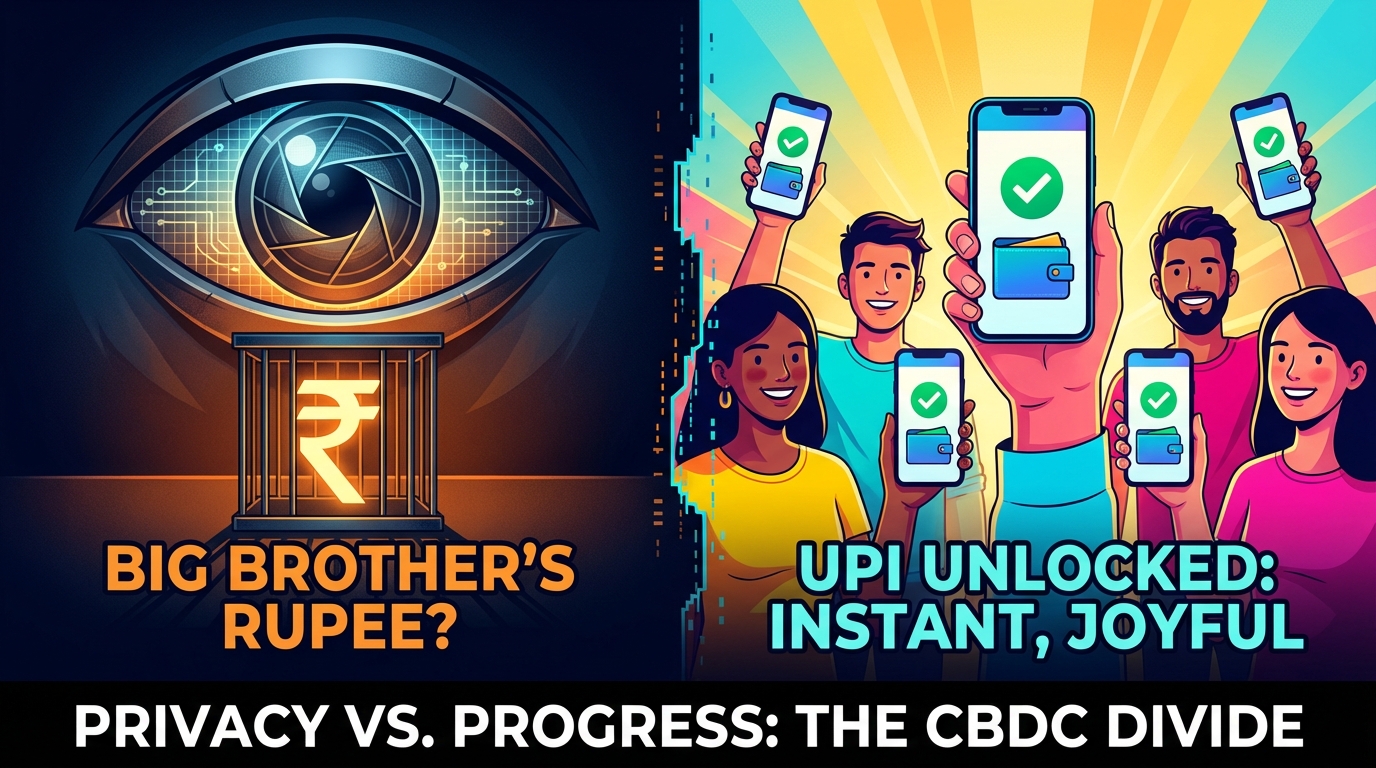
By Ramachandran Rajeev Kumar — 2026-01-16
By Ramachandran Rajeev Kumar
The Paradox That Embarrasses Everyone
India built UPI—the most successful digital payments system on Earth. 49% of all global real-time digital transactions happen in India. UPI processes 13 billion transactions monthly. The world studies India's UPI success as a textbook case of digital infrastructure done right.
And then there's the digital rupee.
India's CBDC pilot, launched in December 2022, set an ambitious target: one million daily transactions by end of 2023. It hit that number—briefly—by forcing government employees and state benefit recipients to use it.
Today? Daily transactions have collapsed to about 100,000. Just 5 million users total. Compare that to UPI's 645 million daily transactions.
The e-Rupee is not just failing. It's an embarrassment. India solved digital payments—and then built a solution nobody wants.
Why?
Two words: Big Brother.
The Numbers That Don't Lie
Let's be brutally honest about where we are:
Digital Rupee (e₹) - January 2026
- Daily transactions: ~100,000 (down from 1 million peak)
- Total users: 5-7 million (~0.4% of India's population)
- Circulation: ₹10.16 billion ($122 million)
- Participating banks: 17
- Growth driver: Forced adoption via government salaries
UPI - January 2026
- Monthly transactions: 13+ billion
- Daily transactions: 645 million
- Market share: 83% of India's payment volume
- Growth driver: Organic user preference
- Global dominance: 49% of world's real-time digital transactions
The gap isn't just wide. It's existential.
Much of the CBDC pilot's retail volume comes from state salaries, government benefits, and reimbursements to RBI employees. This is forced sandboxing—not genuine adoption.
When your "success" depends on mandating usage, you don't have a product. You have a policy experiment that consumers reject.
The Big Brother Problem: Why Privacy Kills Adoption
Here's what RBI doesn't want to admit: Indians don't trust the government with complete visibility into their finances.
The Surveillance State Fear
Since central banks oversee CBDCs, they could track all transactions, raising fears of a surveillance state. Every purchase, every payment, every rupee you earn or spend—visible to the government in real-time.
The RBI claims the Digital Rupee will retain "reasonable anonymity" just like cash.
But what does "reasonable anonymity" mean? Who defines reasonable? The government that already:
- Requires Aadhaar for bank accounts
- Tracks all transactions above ₹50,000
- Has powers to freeze accounts under anti-money laundering and tax laws that critics say are sometimes used against political opponents
- Monitors phone calls, emails, and social media
"Trust us" doesn't work when the track record suggests otherwise.
The Data Dragnet Reality
In a worst case scenario, a CBDC could create a vast new web of financial surveillance and control, as widespread adoption of any centralized digital currency will drastically change how much data is generated by everyday transactions—and therefore how much of the public's identity, income, and transaction information the state has access to.
Every CBDC transaction creates a data point:
- What you bought
- Where you bought it
- When you bought it
- How much you paid
- Your wallet balance
- Your spending patterns
Aggregate this across 1.4 billion people, and you have the most comprehensive financial surveillance system ever built.
The Indian Surveillance Context
This isn't paranoia. It's pattern recognition.
The Indian government has increasingly committed to embedding mass surveillance into its governance framework, with reliance on biometric systems like Aadhaar identification and initiatives such as DigiYatra and the National Digital Health Mission, collecting voluminous and deeply invasive data encompassing biometric markers, geolocation data, health records, and educational history.
Add complete financial surveillance to this mix, and you have a system that knows:
- What you earn (income data)
- What you spend (transaction data)
- Where you go (geolocation data)
- Who you meet (contact data)
- What you believe (purchase patterns reveal ideology)
China already does this with its digital yuan. The Chinese government can:
- See every transaction
- Freeze wallets remotely
- Program "expiring money" (spend by X date or lose it)
- Restrict purchases (no alcohol, no luxury goods)
- Enforce social credit scores through financial control
Is this what India wants?
Why UPI Won (And CBDC Lost)
The comparison is devastating.
What UPI Offers
1. Cashback and Rewards: Every UPI app offers incentives—PhonePe gives scratch cards, Google Pay offers rewards, Paytm provides cashback.
2. Credit Integration: UPI apps offer instant credit lines (Google Pay Later, PhonePe's Credit), turning payments into borrowing tools.
3. Interoperability: Works across 300+ banks and apps. One UPI ID, infinite options.
4. Trust: Built over billions of transactions since 2016. People trust it because it works.
5. Innovation: Apps compete on features—bill splitting, merchant offers, QR codes, voice payments, multilingual support.
What CBDC Offers
1. No Cashback: Zero rewards. No incentives.
2. No Credit: It's just digital cash—no lending capability.
3. Limited Access: Only 17 banks participating. Can't use PhonePe or Google Pay (yet).
4. Forced Adoption: Government employees mandated to use it. Not a vote of confidence.
5. Abstract Benefits: RBI talks about "financial inclusion" and "monetary policy transmission." Users hear: "Why should I care?"
The absence of loyalty points, cashback, credit, or interest-bearing capability further limits CBDC's attractiveness to users already served by mature digital systems.
The Brutal Truth
To consumers, CBDC's benefits seem abstract beside UPI's immediacy, rewards, and trust built over billions of transactions.
Translation: UPI gives me cashback. CBDC gives me surveillance. Which would you choose?
What RBI Must Do: 7 Non-Negotiable Fixes
If RBI is serious about CBDC adoption, here's what must change. Not suggestions. Requirements.
1. Guarantee Privacy—Legally Enforceable
Stop saying "reasonable anonymity." Define it. Legislate it.
Concrete actions:
- Privacy-by-design architecture: Use zero-knowledge proofs or homomorphic encryption so even RBI can't see transaction details without a court order.
- Spending limits without surveillance: Transactions under ₹50,000 should be completely anonymous—no KYC, no tracking.
- Legal firewall: Pass a law that government agencies cannot access CBDC data without judicial warrants, with severe penalties for abuse.
- Transparency reports: Publish quarterly reports on how many times government accessed CBDC data and why.
The standard: If you can't guarantee privacy better than cash, don't call it digital cash.
2. Incentivize Users—Aggressively
Lack of appropriate incentives for attracting intermediaries and users remains a barrier.
What this means in practice:
- Cashback: 1% cashback on all CBDC transactions for the first year.
- Merchant discounts: 2% discount if you pay with e-Rupee instead of UPI.
- Interest-bearing wallets: Let users earn 4% interest on CBDC balances above ₹10,000.
- Tax benefits: Small tax deduction (₹5,000/year) for CBDC usage.
You're competing with UPI apps that give scratch cards, rewards, and credit. Match or beat them.
3. Integrate with PhonePe and Google Pay
Right now, CBDC requires a separate wallet. This is insane.
Fix: Let users hold and spend e-Rupees through their existing UPI apps. Don't force them to download new apps or create new accounts.
If PhonePe's 500 million users can access CBDC through the app they already use, adoption explodes. If they have to download a separate government wallet, adoption dies.
4. Add Programmability and Offline Capability
Programmability means smart money:
- Conditional payments: "Pay contractor ₹50L only after work completion verified"
- Expiring subsidies: "Use this education voucher by Dec 31 or it vanishes"
- Restricted spending: "Corporate per diem can only be spent on meals and lodging"
Offline capability means no internet required:
- Works via NFC or Bluetooth
- Critical for rural areas with poor connectivity
- True digital cash—works even when network fails
5. Cross-Border Settlements
India has bilateral trade worth hundreds of billions with UAE, Singapore, Saudi Arabia, and others.
Enable instant cross-border CBDC settlements:
- Indian business pays Emirati supplier in e-Rupees
- Converts to UAE's CBDC automatically
- Settlement in seconds, not days
- No SWIFT fees, no correspondent banks
This is where CBDC could genuinely outperform UPI (which is domestic-only).
6. Government-Backed Insurance
Promise: "If your CBDC wallet is hacked or fraudulently accessed, RBI will make you whole—100% guarantee."
UPI already has grievance redressal, but CBDC should go further:
- Instant reversal of disputed transactions
- Zero liability for users if wallet compromised
- Government insurance fund backing every rupee
7. Transparent Governance
Create an independent CBDC Privacy Board:
- Citizens' representatives (not just bankers and bureaucrats)
- Public hearings on any feature changes
- Annual audits by external privacy experts
- Power to block RBI proposals that threaten privacy
Trust isn't given. It's earned through accountability.
The Privacy Guarantee RBI Must Provide
Here's what RBI Governor Sanjay Malhotra should announce tomorrow:
"The Digital Rupee Privacy Charter"
No Mass Surveillance: RBI commits that CBDC will never be used for mass financial surveillance of Indian citizens.
Court Orders Only: Government agencies may access individual CBDC transaction data only with a court warrant specifying the account and timeframe.
Anonymous Small Transactions: All transactions under ₹50,000 will have the same anonymity as cash—no identity required.
User Control: Citizens can export, review, and delete their own CBDC transaction history at any time.
Transparency: RBI will publish quarterly reports on:
- How many accounts accessed by government
- Under what legal authority
- With independent audit verification
Legal Penalties: Any RBI or government official who accesses CBDC data without legal authorization faces criminal prosecution and 10-year jail term.
Sunset Clause: If independent audits find privacy violations, the CBDC program will be suspended until compliance is restored.
Sign this. Legislate this. Enforce this.
Without this, CBDC remains a surveillance tool dressed as innovation.
The Choice India Faces
We built UPI because we understood what users wanted: fast, free, rewarding, and trustworthy payments.
We're failing at CBDC because we're building what bureaucrats want: control, visibility, and policy transmission.
The weighing is done. Privacy won. Users have voted with their wallets: they'll use UPI (trusted, rewarding, private) over CBDC (government-controlled, unrewarding, surveilled).
The Two Paths Forward
Path 1: Fix Privacy, Add Incentives, Integrate
- Guarantee legally-enforceable privacy protections
- Offer cashback and rewards that match UPI
- Let users access CBDC through PhonePe/Google Pay
- Add programmability, offline capability, cross-border features
- Build trust through transparency and accountability
Result: CBDC becomes a genuine alternative to UPI, with use cases UPI can't match (programmable money, offline, cross-border). Organic adoption follows.
Path 2: Status Quo
- Keep forcing government employees to use it
- Keep pretending "reasonable anonymity" means something
- Keep adding features nobody asked for
- Keep wondering why adoption stays flat
Result: CBDC remains a policy experiment that Indians tolerate but don't adopt. A decade from now, it'll be a footnote in the story of how India built the world's best payments system—and then tried to control it.
The Brutal Reality
India doesn't need CBDC. UPI already works. It's faster, more trusted, more rewarding, and—crucially—more private than a government-controlled digital currency.
CBDC will only succeed if it offers something UPI cannot: programmable money for government benefits, offline capability for rural areas, cross-border settlements for trade—and ironclad privacy guarantees that UPI, being private-sector-run, might not provide.
But right now? It offers none of that. It's digital cash that's less private than cash, less rewarding than UPI, and less trusted than either.
Fix privacy or forget adoption. There is no third option.
The world is watching India's digital rupee pilot. If it fails, it won't be because the technology didn't work. It'll be because Indians don't trust Big Brother with their wallets.
And they're right not to.
Sources:
- Atlantic Council CBDC Tracker
- FTI Consulting: Central Bank Digital Currencies in India
- Policy Circle: India's CBDC - Policy vision with unproven demand
- Human Rights Foundation: India CBDC Tracker
- Giottus: CBDC India 2025 - RBI e-Rupee Pilot
- MDPI: Does Previous Experience with UPI Affect CBDC Usage?
- TechPolicy.Press: India's Data Protection Act - Shield or Surveillance?
- PWC India: Future of Digital Currency in India
- IMF: Central Bank Digital Currency Adoption - Inclusive Strategies
Ramachandran Rajeev Kumar is the founder of BarathVector. Agree? Disagree? The debate continues in the comments.