By BarathVector Editorial — 2026-03-07
The Delivery Deficit: India's Billion-Dollar Gap Between Announcement and Execution
By BarathVector Editorial | March 7, 2026
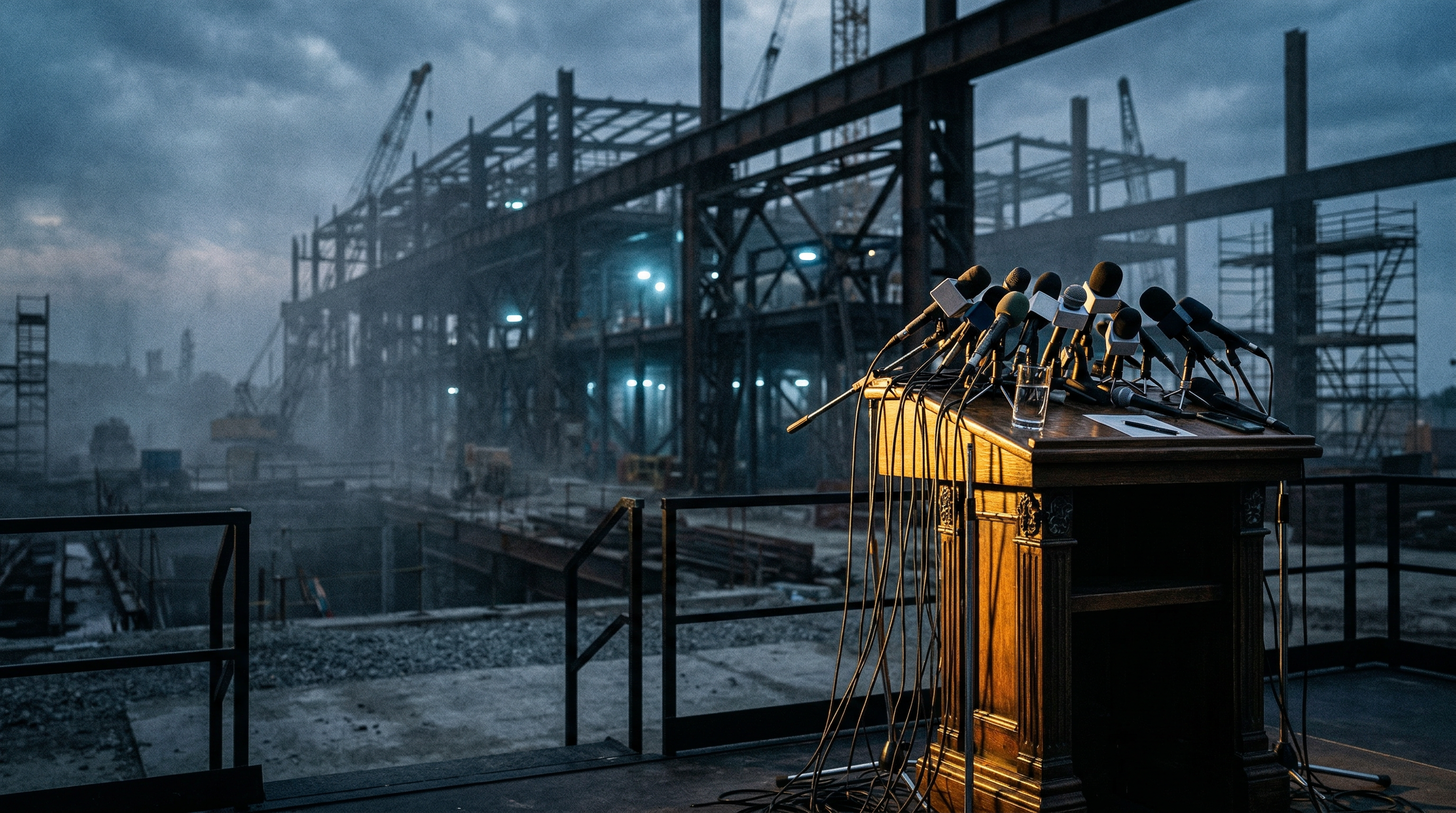
There is a particular art to the Indian policy announcement. It arrives wrapped in aspiration, buttressed by large numbers, garnished with Sanskrit or acronyms, and delivered from a podium that costs more than the first year's budget allocation for the scheme being announced. The cameras flash. The ticker runs. The policy enters the lexicon. And then, quietly, the distance between announcement and delivery begins to stretch -- not in months, but in years, sometimes decades.
This is not a criticism of ambition. Ambition is necessary. Democracies run on aspiration the way engines run on fuel. A government that does not promise is a government that does not lead. Some amount of hype is not merely tolerable -- it is essential. It mobilises capital, attracts talent, signals intent to trading partners, and gives a billion people something to organise their hopes around.
But there is a line between aspiration and delusion. Between signalling and chest-beating. Between telling the world what you intend to build and believing you have already built it.
India, in 2026, is dangerously close to that line.
This is not a partisan criticism. The current government, whatever its other failings, has at least moved the fulcrum. It has built highways, digitised governance, expanded defence exports thirtyfold, and created the most sophisticated digital payments infrastructure on the planet. These are not trivial achievements. They are, by any historical standard, remarkable.
But the system -- the vast, creaking, multi-layered apparatus of Indian governance, bureaucracy, and political economy -- continues to announce faster than it delivers, celebrate milestones before they are reached, and mistake memoranda of understanding for execution. The result is a growing gap between what India says at international forums and what India actually produces on its factory floors, in its laboratories, and through its ports.
Here is the scorecard.
I. The Factory Floor Mirage: Make in India's Missing Percentage Points
In 2014, Make in India set an explicit target: raise manufacturing's share of GDP to 25 per cent by 2025. The number was not arbitrary. It was the threshold at which economists believe a large economy transitions from service-dependent growth to broad-based industrial employment -- the kind that lifts hundreds of millions out of precarity.
The target was missed by 11 percentage points.
Manufacturing's share of GDP, which stood at 17 per cent in 2010, has actually declined to 13 per cent in 2024-25. It is expected to recover to 14 per cent in FY26. Manufacturing growth is healthy -- 8.4 per cent in the first half of FY26 -- but growth in a shrinking share is the statistical equivalent of running faster on a treadmill. You are moving, but the room is not getting larger.
India remains, structurally, a services economy that gives manufacturing speeches.
[Full analysis: "The Factory Floor Mirage"]
II. The Silicon Promise: Forty Years of Announcing Chip Fabs
India's semiconductor ambitions are older than most of its current parliamentarians' careers. The Semiconductor Complex Limited in Mohali was established in 1983. Taiwan founded TSMC in 1987. Four decades later, TSMC fabricates the world's most advanced chips. SCL Mohali is stuck at 180nm -- a node the rest of the world abandoned before the iPhone was invented.
In 2026, Micron's Gujarat facility has begun commercial operations. It is an assembly and testing plant -- necessary, valuable, but not fabrication. The Tata-PSMC fab in Dholera targets 28nm to 110nm wafers -- respectable, but decades behind the frontier. The Rs 1,000 crore allocated to Semiconductor Mission 2.0, in a budget that allocates Rs 7.85 lakh crore for defence, is not a bet on the future. It is a gesture towards one.
TSMC spent USD 30 billion in capital expenditure in 2025 alone. South Korea's semiconductor support package exceeds USD 470 billion. India's Rs 1,000 crore -- roughly USD 115 million -- does not appear on the same chart.
[Full analysis: "The Silicon Promise"]
III. The Corridor That Exists on Paper: IMEC's Implementation Deficit
The India-Middle East-Europe Economic Corridor was announced at the G20 in September 2023 under India's presidency. It was positioned as a counter to China's Belt and Road Initiative -- multimodal connectivity linking India to Europe via the UAE, Saudi Arabia, Jordan, and Israel.
Two and a half years later, IMEC has no dedicated implementing body. No committed funding. The Israeli segment is physically inoperable due to ongoing conflict. UAE-Saudi policy competition complicates coordination. Turkey is actively hostile. TRENDS Research & Advisory's assessment is blunt: "IMEC will not see a return to full-scale development anytime soon."
China's BRI, whatever its debts and controversies, has real railways, real ports, and real power plants in over 140 countries. IMEC has communiques.
[Full analysis: "The Corridor That Exists on Paper"]
IV. The Self-Reported Shield: Defence Indigenisation's Audit Gap
India's defence production has grown from Rs 46,429 crore in 2014-15 to over Rs 1.5 lakh crore by 2025. Defence exports have increased thirtyfold in a decade, crossing Rs 23,622 crore in 2024-25. These are genuine, significant achievements.
India also remains the world's largest arms importer, accounting for 11 per cent of global arms imports.
The uncomfortable truth that the draft Defence Acquisition Procedure 2026 has implicitly acknowledged is this: under the previous framework, indigenous content claims were largely self-reported, with no rigorous audit mechanism. The shift from "Made in India" to "Owned by India" is, in effect, an admission that the previous definition of indigenisation was gameable -- and was gamed.
[Full analysis: "The Self-Reported Shield"]
V. The GPU Arithmetic: India's AI Ambition Meets Hardware Reality
At the India AI Impact Summit in February 2026, the government announced 38,000 GPUs under the IndiaAI Mission, with 20,000 more to be added "in the coming weeks." The aspiration is 200,000 GPUs and USD 200 billion in AI infrastructure investment by 2028. The phrase "Manhattan Project for AI for public good" was used without irony. Ninety-two countries endorsed the declaration.
Microsoft alone committed USD 80 billion to AI data centres in a single fiscal year. Meta's single facility reportedly exceeds 100,000 H100 equivalents. The summit itself was criticised for poor organisation, misrepresentation of Chinese products as Indian, and what Amnesty International called a failure to secure "concrete commitments."
Sovereign AI models running on imported GPUs in data centres powered by imported chips are sovereign only in the narrowest sense.
[Full analysis: "The GPU Arithmetic"]
VI. The Eight-Country Reality: UPI's International Gap
UPI processes 21.7 billion transactions per month domestically. It is, without qualification, the most successful digital payments infrastructure ever built. Nothing else comes close.
Internationally, the story is different. UPI is "live" in eight countries -- UAE, Singapore, Bhutan, Nepal, Sri Lanka, France, Mauritius, and Qatar. MoUs have been signed with 24 countries. Government statements speak of 25 countries "adopting" UPI by FY29.
Field testing by travellers tells a more modest story: reliable functionality in three to four countries. Bhutan at 90 per cent success. Singapore at 85 per cent. Nepal at 70 per cent in cities. Beyond these, merchant enrollment and training lag far behind the infrastructure.
MoUs are not deployments. Press releases are not merchant terminals.
[Full analysis: "The Eight-Country Reality"]
VII. The Exhibition Gap: Where Are India's Buyers?
This is perhaps the least discussed and most consequential gap in India's economic architecture.
China does not merely manufacture. It markets. The Canton Fair in Guangzhou has been running since 1957 -- twice a year, every year, without interruption. The autumn 2025 edition hosted over 28,000 exhibitors across 1.5 million square metres of exhibition space. Buyers from 210 countries attended. The fair is not a political showcase. It is a sales floor. The smallest manufacturer in Dongguan can rent a booth and meet a buyer from Lagos.
The Yiwu International Trade Market -- the world's largest small commodities market -- hosts 75,000 suppliers in a permanent facility. Foreign buyers receive visa-on-arrival. Translation services are built in. Logistics are integrated. The entire infrastructure exists for one purpose: to make it as easy as possible for the world to buy Chinese.
India has nothing comparable. Not in scale, not in accessibility, not in cost.
India's exhibition infrastructure is fragmented, expensive, and bureaucratically tangled. The India International Trade Fair in Delhi is an annual event, not a permanent institution. Pragati Maidan's redevelopment, while impressive, does not approach Canton Fair scale. More critically, India does not offer visa-on-arrival to most potential buyers. A furniture manufacturer in Jodhpur who wants to sell to a buyer from Nigeria cannot simply invite them to a showroom. The buyer needs a visa that may take weeks. The exhibition booth costs more than the manufacturer's monthly revenue. The logistics are the manufacturer's problem.
China understood something that India has not yet internalised: the infrastructure of trade is not roads and ports alone. It is the sales floor. The visa counter. The translation booth. The affordable hotel near the exhibition centre. The simplified customs process for samples. The entire ecosystem that makes buying from your country easy.
India makes buying from India hard. Not impossible -- hard. And in a competitive global marketplace, hard is the same as losing.
What India needs is not another policy announcement. It needs five Canton Fairs -- in Delhi, Mumbai, Chennai, Ahmedabad, and Kolkata -- running year-round, with booth costs subsidised for MSMEs, visa-on-arrival for buyers from all but the most security-sensitive origins, and online visa processing in 72 hours for everyone else. It needs the plumbing of trade, not the poetry of trade.
[Full analysis: "The Exhibition Gap"]
VIII. The Report Card We Won't Take: Education's Silent Crisis
In 2009, India participated in the OECD's Programme for International Student Assessment. It ranked 72nd out of 73 countries. The results were so embarrassing that India withdrew from subsequent rounds. It did not participate in PISA 2022, citing COVID-19 disruption. There are no confirmed plans for the next round.
A nation that aspires to sovereign AI capability, advanced semiconductor manufacturing, and technopolar relevance cannot build these ambitions on an education system it is too embarrassed to measure. The engineering colleges that once produced world-class talent now produce graduates that industry routinely describes as unemployable without extensive retraining. The rote memorisation culture persists despite the National Education Policy's rhetoric about critical thinking.
You cannot announce your way out of an education crisis. You can only teach your way out.
[Full analysis: "The Report Card We Won't Take"]
The China Lesson India Refuses to Learn
The instinct, when China is mentioned in an Indian policy discussion, is defensive. China is authoritarian. China suppresses dissent. China's BRI creates debt traps. All of this is true. None of it is relevant to the lesson India needs to learn.
The lesson is not political. It is operational.
China delivers in kind more than it talks. India talks more than it delivers in kind. That is the gap. Not ideology. Not values. Not system of government. Execution.
China did not become the world's manufacturing floor by announcing it at a conference. It built the factories, the ports, the exhibition halls, the logistics networks, and the visa regimes that made it easy for the world to buy from China. It did this with patient capital, institutional continuity, and a bureaucracy that, whatever its other pathologies, understood that a policy is only as good as its implementation.
India can do this democratically. India can do this transparently. India can do this in a way that is internationally acceptable, environmentally sustainable, and consistent with its values. But it has to actually do it. Not announce it. Not set a target for 2030 and celebrate in 2026. Not sign an MoU and count it as adoption. Not hold a summit and call it a Manhattan Project.
Build the factory. Pave the road. Open the exhibition hall. Issue the visa. Train the engineer. Fabricate the chip. Then -- and only then -- take the podium.
A Note on Fairness
This criticism is systemic, not partisan. Every government since independence has contributed to the announcement-delivery gap. The current government has, to its credit, narrowed it in several domains -- digital infrastructure, highway construction, defence exports, space technology. The fulcrum has moved. But the system's fundamental bias towards announcement over execution remains intact, embedded in electoral incentives, bureaucratic culture, and a media ecosystem that covers launches more enthusiastically than completions.
The question is not whether India is rising. It is. The question is whether the gap between what India announces and what India delivers is itself becoming a strategic vulnerability -- because the world eventually stops listening to nations that announce more than they build.
Some hype is necessary. Delusion is not.
This is the first in a nine-part series examining India's delivery deficit across manufacturing, semiconductors, defence, AI, trade infrastructure, education, digital payments, connectivity, and geopolitical signalling.
Next: "The Factory Floor Mirage: Make in India's Missing Percentage Points"
Sources:
- Carnegie Endowment: India's Semiconductor Mission -- The Story So Far
- TRENDS Research & Advisory: IMEC on Pause
- ORF: Defence Indigenisation -- Progress and Perils
- Amnesty International: AI Summit Assessment
- Trading Economics: India Manufacturing % GDP
- Indian Infrastructure: Mapping Delays
- Atlantic Council: IMEC Connectivity Report
- Zee News: UPI Live in 8 Countries
- Deccan Herald: India's Startup Ecosystem -- From Hype to Reality
- Policy Circle: AI Summit -- Deployment Ahead of Slogans