By BarathVector Editorial — 2026-02-19
Picture two leaders on a factory floor in Miyagi prefecture. Prime Minister Narendra Modi and his Japanese counterpart Shigeru Ishiba, suited and helmeted, walking the production lines of Tokyo Electron — one of the world's most consequential semiconductor equipment makers. The image was deliberate. The symbolism unmistakable. This was not a diplomatic photo opportunity. It was a declaration.
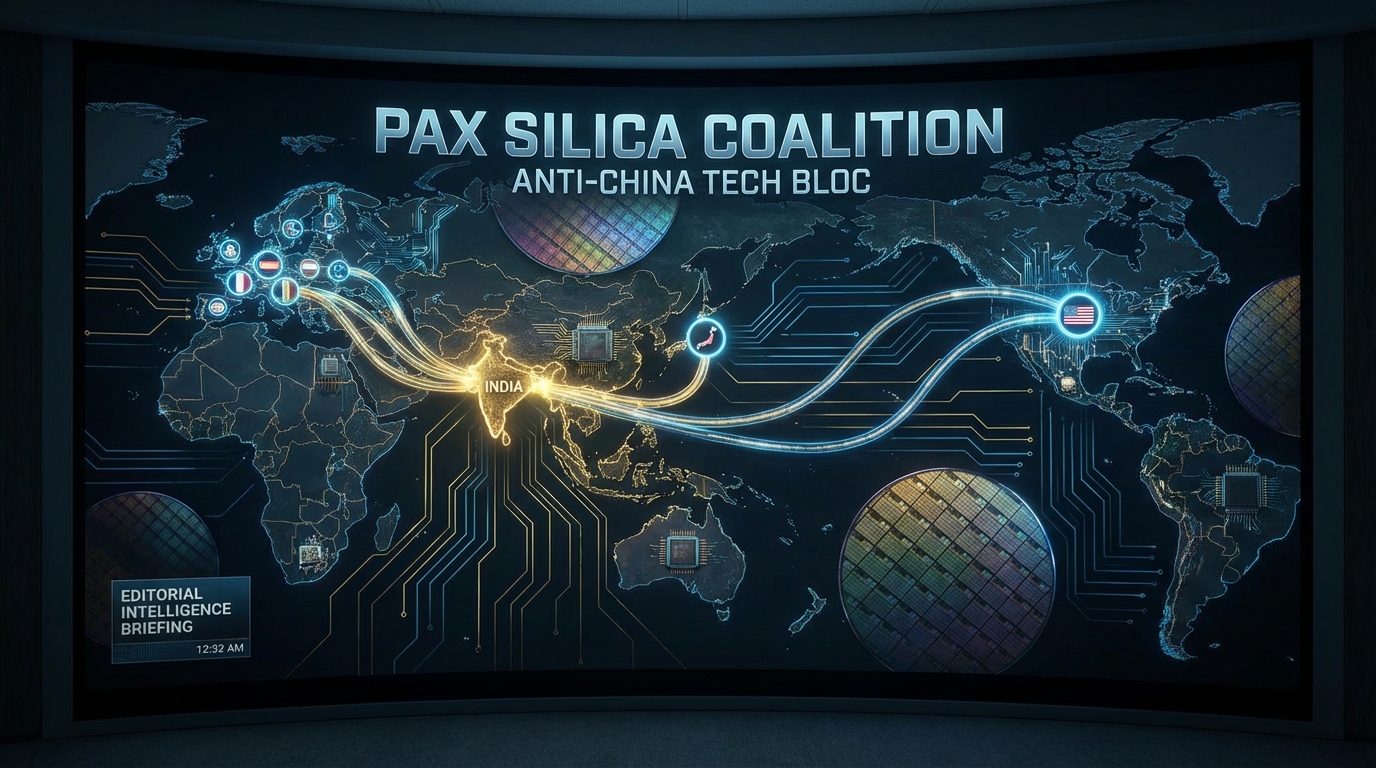
In February 2026, India formally joined Pax Silica — a US-led coalition now spanning more than ten nations, purpose-built to construct a silicon supply chain that owes nothing to Beijing. Japan, South Korea, Singapore, the Netherlands, Israel, the UK, Australia, Qatar, the UAE. And now India. For Washington, this was not simply a new partner. It was the closing of a long-open question about which side of the fracturing global tech order New Delhi would inhabit.
The answer, it turns out, was always more complicated than the question.
The Chip That Launched a Coalition
To understand why India's entry matters, you need to understand what Pax Silica is actually defending against. China currently controls approximately 93 percent of the global polysilicon supply chain — the foundational material for nearly every semiconductor produced on earth. Beijing did not achieve this by accident. It was the product of decades of strategic industrial policy, preferential financing, and patient accumulation of upstream dominance. In his New Year address in January 2026, President Xi Jinping declared that 2025 had been the year China's chips and artificial intelligence "reached new heights." He was not entirely wrong. Lisuan's G100 GPU — a domestically designed 6nm chip — has entered limited production, a milestone that would have seemed improbable five years ago.
China's 15th Five-Year Plan designates AI, quantum computing, and brain-computer interfaces as national strategic priorities. The message from Beijing is consistent: it intends to be self-sufficient, and it intends to set the terms of competition.
Pax Silica is the structured Western response to that posture. According to analysis from the Carnegie Endowment and the Center for European Policy Analysis, the coalition is likely to produce two parallel global technology supply chains — one anchored in Beijing, one in Washington. India's placement in the Western bloc, both institutions assess, represents Washington's biggest geopolitical win in the semiconductor contest.
The TRUST Architecture
India's alignment did not emerge from a single moment. It was assembled in layers. The TRUST Initiative — Transforming the Relationship Utilizing Strategic Technology — was formally launched at the Modi-Trump White House meeting in February 2025, upgrading the earlier iCET framework. Semiconductors and critical minerals were designated core pillars. The architecture was deliberately bilateral before it became multilateral.
By February 2026, the bilateral had become transactional in the most literal sense. Under an interim India-US trade framework, New Delhi committed to purchasing $500 billion in US goods over five years — with GPUs explicitly included in the basket. This is not soft diplomacy. It is supply chain co-dependency written into procurement schedules.
Japan then arrived with scale. Tokyo's $68 billion pledge — approximately 10 trillion yen over a decade — targets semiconductors, artificial intelligence, critical minerals, and clean energy. The Modi-Ishiba fab tour in Miyagi was the ceremonial seal on an arrangement years in the making.
India's Hand
What does India bring to this coalition? The honest answer is: more than most analysts credited two years ago.
India Semiconductor Mission 2.0 has allocated 1,000 crore rupees specifically toward semiconductor equipment manufacturing — an upstream intervention that signals intent to move beyond assembly into the supply chain itself. The Tata Electronics and Tokyo Electron joint investment of $11 billion at Dholera, Gujarat, targets India's first commercial wafer fabrication facility, with an April 2026 launch window. If it delivers on schedule, India will have crossed from design nation to fabrication nation within a single electoral cycle.
The design talent base was never in question. India accounts for an estimated 20 percent of global semiconductor design engineers — a structural advantage that no coalition member can replicate quickly. What was missing was the downstream industrial infrastructure. Dholera is the answer to that gap.
On compute infrastructure, India's national GPU capacity now stands at 38,000 units, with 20,000 more in the pipeline. Google has committed $15 billion toward Indian AI infrastructure alongside an "America-India Connect" fiber-optic initiative. At the India AI Impact Summit held in New Delhi between February 16 and 20, 2026 — the first AI summit of this scale hosted in the Global South — Bharat Mandapam received 20 heads of state and witnessed $200 billion in AI investment commitments. Jensen Huang, Sam Altman, Sundar Pichai, and Dario Amodei were all present. The symbolic weight of convening the global AI conversation in Delhi, rather than San Francisco or Davos, was not lost on anyone in attendance.
The Hedge That Makes the Win
Here is what makes India's Pax Silica entry genuinely significant, rather than simply noteworthy: New Delhi is still a BRICS member. It is still purchasing Russian oil at discounted rates. The strategic autonomy doctrine that has defined Indian foreign policy for decades has not been retired — it has been recalibrated.
Washington did not get a lock-in. It got an alignment. The distinction matters because it tells you something about Indian leverage. India negotiated entry into the anti-China tech bloc while retaining the relationships that give it room to maneuver. That is not diplomatic inconsistency. It is the exercise of genuine agency by a country that spent decades being underestimated as a technology power.
The semiconductor lag that defined India's position in global electronics manufacturing for the better part of the 21st century has been reframed, not erased. India leveraged the lag itself — the urgency that Washington and Tokyo felt about filling the China-shaped gap — to extract commitments, investment, and institutional standing it could not have commanded from a position of strength.
The Shape of What Comes Next
Two parallel supply chains are now actively under construction. The fracture line runs through silicon, through rare earth minerals, through undersea cables and GPU clusters. India has chosen its side of that line — while retaining the studied ambiguity to remind both sides that the choice was deliberate and conditional.
The Dholera fab will be watched closely. Not merely as an industrial project, but as a test of whether India can operationalize its geopolitical repositioning before the next cycle of great-power competition arrives. The coalition is assembled. The capital is committed. The question now is whether the wafers actually get made — and whether the India that emerges from that process is a junior partner in Pax Silica, or something considerably harder to categorize.