By BarathVector Editorial — 2026-03-07
The Corridor That Exists on Paper: IMEC's Implementation Deficit
Part 4 of "The Delivery Deficit" series
By BarathVector Editorial | March 7, 2026
On September 9, 2023, at the G20 Leaders' Summit in New Delhi -- India's proudest diplomatic moment of the decade -- the India-Middle East-Europe Economic Corridor was announced with the kind of fanfare usually reserved for peace treaties. A Memorandum of Understanding was signed by India, the United States, Saudi Arabia, the UAE, the European Union, France, Germany, and Italy. President Biden stood beside Prime Minister Modi. The corridor, it was declared, would reshape global trade, counter China's Belt and Road Initiative, and position India at the centre of a new connectivity architecture linking South Asia to Southern Europe.
Thirty months later, the scorecard is this: no dedicated implementing body. No committed funding. No construction timeline. No operational segment.
IMEC exists on paper, in MoUs, in communique paragraphs, and in the aspirational language of diplomatic press conferences. It does not exist as steel, concrete, rail, or fibre.
What Was Promised
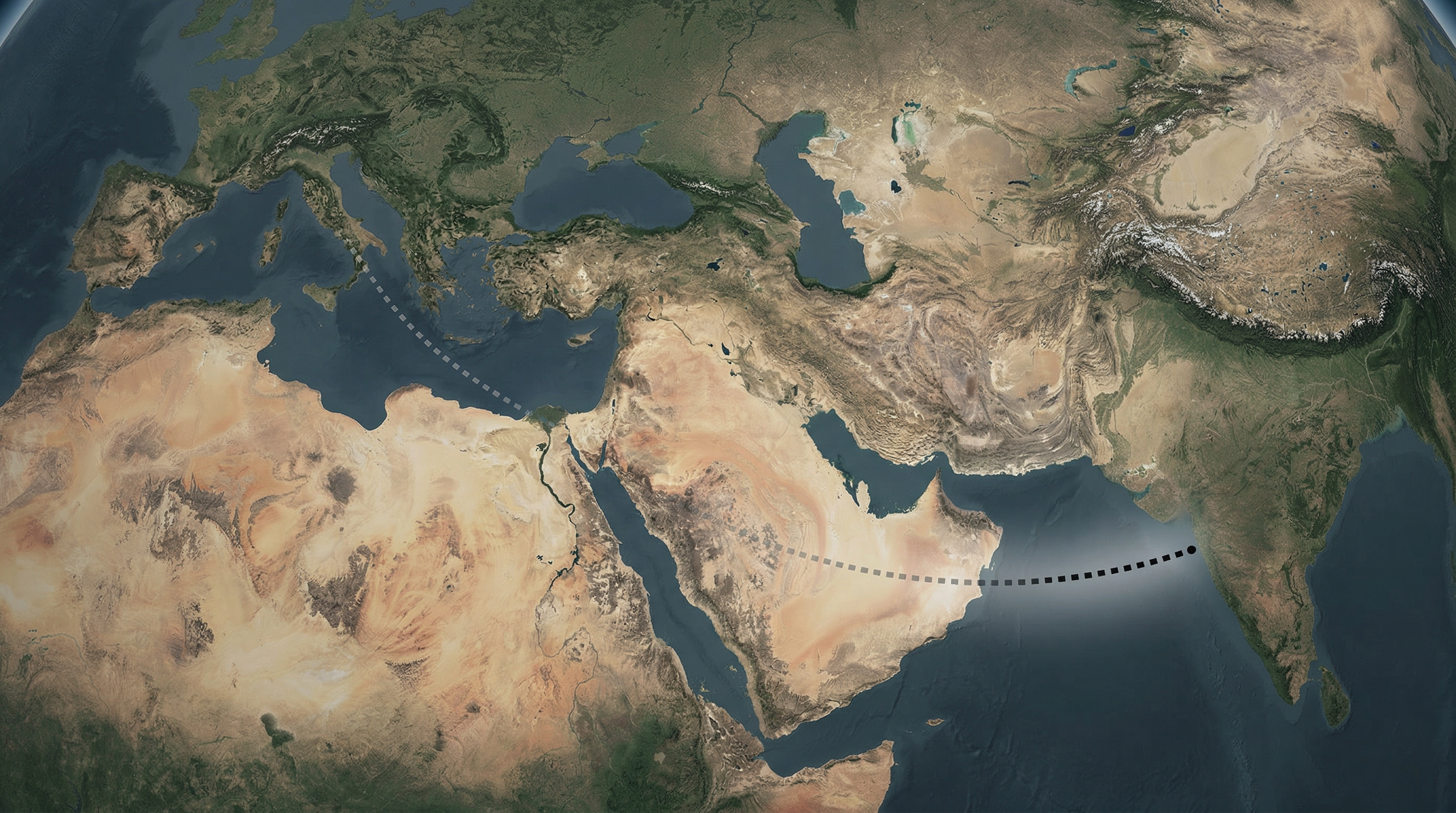
IMEC was designed as a multimodal corridor comprising two legs:
The Eastern Corridor -- linking India to the Arabian Gulf (UAE, Saudi Arabia) via maritime routes, with integrated rail connectivity across the Arabian Peninsula.
The Northern Corridor -- linking the Arabian Gulf to Europe (via Jordan, Israel, and ultimately to Mediterranean ports in Greece or Italy), with rail, road, submarine cables, hydrogen pipelines, and electricity interconnects.
The vision was comprehensive: not just a trade route but a data corridor, an energy corridor, and a strategic counter-narrative to China's BRI. Where BRI offered developing nations debt-laden infrastructure, IMEC would offer high-standard, rules-based connectivity built on partnership rather than dependency.
It was an excellent thesis. It remains an excellent thesis. The problem is that theses do not move containers.
What Has Actually Happened
No implementing body. Unlike BRI, which is coordinated through China's National Development and Reform Commission and backed by the Asian Infrastructure Investment Bank, IMEC has no dedicated institutional architecture. There is no IMEC secretariat. There is no project management office. There is no single point of accountability for turning the MoU into engineering drawings.
No committed funding. The financial architecture of IMEC remains undefined. Who pays for the rail links? Who finances the submarine cables? Who subsidises the hydrogen pipeline? These questions have been discussed at diplomatic meetings. They have not been answered with cheque books.
The Israeli segment is inoperable. The Northern Corridor routes through Israel. Since October 2023, the security situation in Israel and along its northern border with Lebanon has made this segment, in the words of multiple analysts, physically and politically inoperable. No private investor will commit capital to infrastructure in an active conflict zone with no resolution timeline.
Turkey is hostile. President Erdogan has publicly criticised IMEC, warning that "there can be no corridor without Turkey." He is not wrong geographically -- Turkey is the natural land bridge between Asia and Europe. Bypassing it was always politically risky. Turkey has actively positioned itself as a spoiler.
UAE-Saudi competition. The two Gulf partners in IMEC have divergent strategic priorities. The UAE's economic model is built on being a logistics hub. Saudi Arabia's Vision 2030 aspires to the same. Both want the corridor to route through them -- preferably as the primary node. This competition has complicated rather than accelerated coordination.
The BRI Comparison India Dislikes
China's Belt and Road Initiative was announced in 2013. By 2026, BRI has:
- Invested over USD 1 trillion across 140+ countries
- Built operational railways in Kenya, Laos, Indonesia, and Pakistan
- Constructed ports in Sri Lanka, Pakistan, Greece, and Djibouti
- Financed power plants, highways, and digital infrastructure across Africa and Southeast Asia
- Created institutional financing through the Asian Infrastructure Investment Bank and the Silk Road Fund
BRI has serious problems. Debt distress in Sri Lanka, Zambia, and Pakistan. Geopolitical strings attached to every loan. Environmental damage. Labour practices that import Chinese workers rather than employing locals. These criticisms are valid and consequential.
But BRI is real. IMEC is not. And in the infrastructure of global trade, real beats virtuous every time.
What Would Make IMEC Real
The path from paper to steel is not mysterious. It is unfashionable:
An implementing body with a full-time secretariat, engineering staff, and the authority to commission feasibility studies, negotiate contracts, and disburse funds. Not a diplomatic working group. An engineering organisation.
Committed funding from the partner nations -- not pledges, not MoUs, but capitalised funds in a dedicated financing vehicle. The AIIB was capitalised at USD 100 billion. IMEC's financing vehicle does not exist yet.
A routing alternative that does not depend on Israeli territory. The Jordan-to-Mediterranean segment needs a contingency route -- potentially through Egypt or directly to Greek ports -- that can function regardless of the security situation in the Levant.
A timeline with milestones. Not "by 2030." Not "in the medium term." Specific segments, specific dates, specific budgets, specific contractors. The way infrastructure actually gets built.
The Honest Assessment
IMEC is a good idea that India announced at the right moment and has not executed. The G20 announcement was diplomatically brilliant -- it positioned India as the architect of an alternative to Chinese hegemony. But diplomacy without engineering is oratory, and oratory does not carry freight.
Two and a half years is enough time to have at least one segment under construction. The UAE-India maritime route already exists commercially. A dedicated rail link within the UAE or Saudi Arabia connecting port to port is not technologically challenging. A submarine cable along the corridor route could have been commissioned. Something tangible could have been built.
Instead, IMEC remains what it was in September 2023: a memorandum. A very important memorandum. But a memorandum nonetheless.
The corridor needs contractors, not communiques.
This is Part 4 of "The Delivery Deficit" series examining India's announcement-execution gap.
Sources: TRENDS Research & Advisory, Atlantic Council, Euronews, Eurasia Review, Modern Diplomacy