By Ramachandran Rajeev Kumar — 2026-02-17
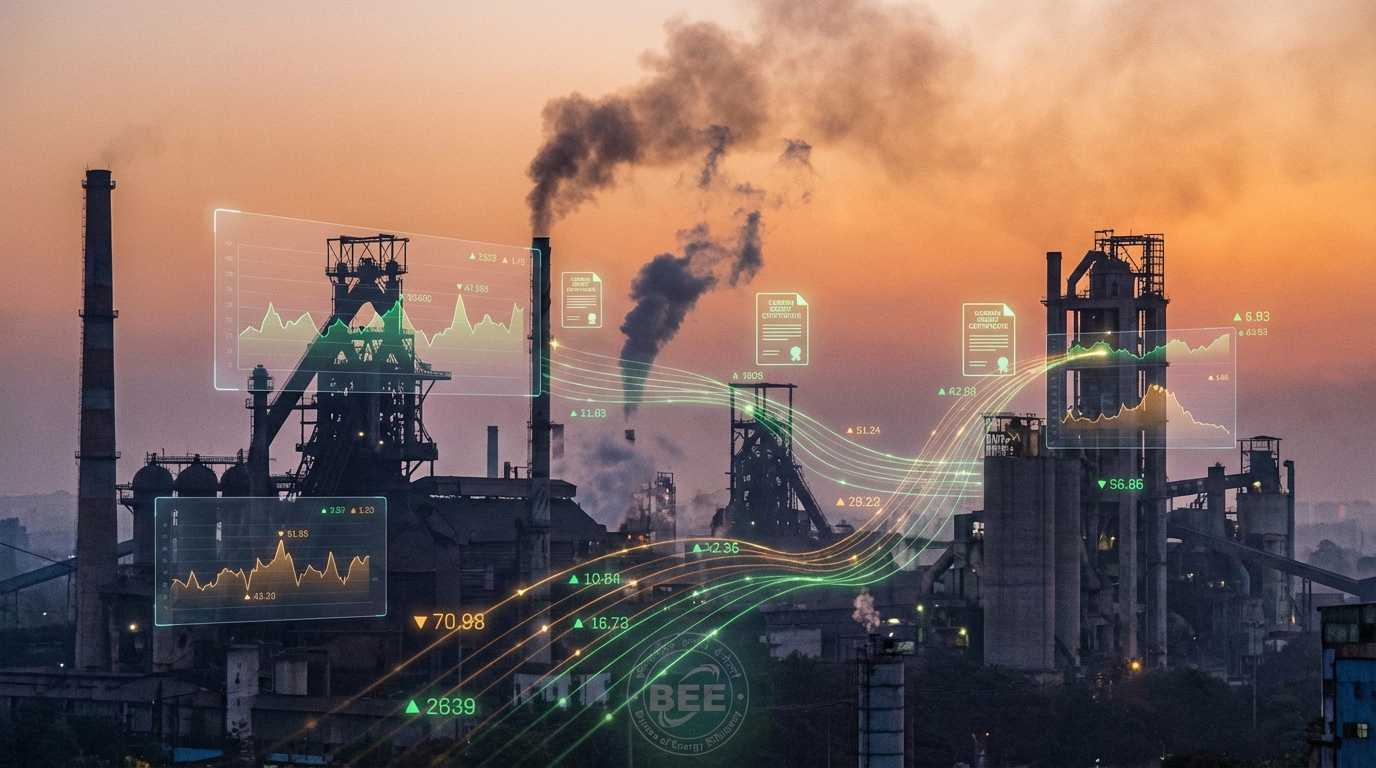
There was no press conference. No summit announcement. No hashtag campaign. On a January morning in 2026, the Ministry of Environment, Forest and Climate Change quietly notified greenhouse gas emission intensity targets for three more industrial sectors -- refinery, petrochemicals, and textiles -- bringing 208 additional carbon-intensive entities under India's Carbon Credit Trading Scheme. The total number of obligated industrial plants now stands at 490, with a further 250 expected to follow before the compliance mechanism is fully operational.
By October 2026, India expects to execute its first official trades of compliance-based Carbon Credit Certificates. When it does, it will join China, Japan, and South Korea in operating a compliance carbon market -- meaning that by the end of this year, the four largest Asian economies, collectively responsible for roughly 40 percent of global carbon dioxide emissions, will all have operational emissions trading systems.
This is the quiet earthquake that the voluntary carbon market conferences have been too busy to notice.
From PAT to CCTS
India's compliance carbon market did not emerge from a vacuum. It evolved from the Perform, Achieve and Trade scheme -- a mandatory energy efficiency programme that has been running since 2012, covering over 1,000 entities across thirteen energy-intensive sectors. PAT worked on a simple premise: set energy consumption targets for large industrial facilities, let overachievers earn tradeable certificates, and penalise underperformers.
PAT was useful but limited. It measured energy efficiency, not greenhouse gas emissions. The Carbon Credit Trading Scheme, established through the Energy Conservation Amendment Act of 2022, takes the PAT infrastructure and repurposes it for a fundamentally different objective: carbon pricing.
The transition is pragmatic. Rather than building a compliance market from scratch -- an exercise that took the EU over a decade and cost billions in institutional design -- India is retrofitting an existing system. The monitoring, reporting, and verification infrastructure built for PAT is being adapted. The industrial entities are already enrolled. The regulatory relationships are established. What changes is the unit of account: from energy saved to tonnes of CO2 equivalent reduced.
The Architecture
The CCTS operates as an intensity-based baseline-and-credit system. The distinction matters. Unlike the EU Emissions Trading System, which sets an absolute cap on total emissions and lets the market determine the price through allowance trading, India's system sets emission intensity targets -- tonnes of CO2 equivalent per unit of product output. Entities that beat their targets earn Carbon Credit Certificates. Entities that miss them must buy certificates from those who succeeded.
Nine sectors form the initial compliance pool: aluminium, chlor-alkali, cement, fertiliser, iron and steel, pulp and paper, petrochemicals, petroleum refining, and textiles. Together, they account for approximately 16 percent of India's total emissions and over 700 million tonnes of CO2 equivalent. Coal-fired power generation -- India's largest single source of emissions -- is slated for inclusion at a later stage.
The targets are not gentle. Reduction ranges span from 2.8 percent for some aluminium facilities to 15 percent for pulp and paper plants, with a deliberate back-loading: 40 percent of the required reduction must be achieved in 2025-26, and the remaining 60 percent in 2026-27. This compression forces early action rather than last-minute scrambling.
Carbon Credit Certificates will trade on India's existing power exchanges under the supervision of the Central Electricity Regulatory Commission. The Grid Controller of India operates the registry. Unlimited banking of certificates is permitted; borrowing is not. The design reflects a lesson learned from the EU's early experience: allow firms to save surplus credits for future use, but do not let them mortgage against reductions they have not yet achieved.
Pragmatic, Not Performative
India's choice of intensity targets over absolute caps is a deliberate policy decision that will draw criticism from Western climate advocates and approval from Indian industrial lobbies. Both reactions miss the point.
An absolute cap would be politically impossible for a country where industrial output is still growing at 7 to 8 percent annually. Setting a hard ceiling on total emissions would effectively cap economic growth -- a trade-off that no Indian government can make while 200 million citizens remain below the poverty line. Intensity targets accomplish something subtler: they decouple emissions from output. A steel plant can produce more steel, provided each tonne of steel generates fewer emissions. Growth continues; the carbon intensity of that growth declines.
The pragmatism extends to the voluntary offset mechanism that operates alongside the compliance market. Non-obligated entities -- smaller firms, service companies, agricultural operations -- can register projects for greenhouse gas reduction and earn their own Carbon Credit Certificates, tradeable on the same exchanges. This expands market liquidity without imposing compliance burdens on firms that lack the capacity to absorb them.
The system is imperfect. The risk of lenient target-setting -- where industry lobbying produces benchmarks too easy to meet -- is real. If targets are too soft, the market will be flooded with surplus certificates, prices will collapse, and the incentive to decarbonise will evaporate. The Institute for Energy Economics and Financial Analysis has already flagged this concern, recommending that India embed a price stability mechanism from the outset rather than retrofitting one after the market has already bottomed out.
The Asian Carbon Convergence
Zoom out from the technical architecture and the strategic picture becomes clear. Japan's GX-ETS went mandatory in April 2026. South Korea's K-ETS has been operational since 2015. China's national ETS -- the world's largest by volume -- covers the power sector and is expanding to cement and aluminium. India's CCTS completes the circuit.
By December 2026, every major industrial economy in Asia will have a functioning compliance carbon market. The combined coverage exceeds 10 billion tonnes of CO2 equivalent annually -- more than the EU ETS and every other Western carbon market combined.
The implications for global carbon pricing are profound. When voluntary markets dominated the Asian landscape, carbon credits were cheap, fragmented, and often dubious in quality. Compliance changes the calculus entirely. Entities must hold valid certificates or face regulatory penalties. Demand becomes predictable. Price discovery becomes possible. And crucially, the credits generated under these systems carry the regulatory credibility that voluntary credits have spent years trying to earn.
For India's heavy industry -- the steel plants, cement kilns, and refineries that face EU CBAM charges on their exports -- the CCTS provides a domestic carbon price that can be set against border adjustment levies. The EU has committed 590 million dollars to help India decarbonise under the recent FTA. A functional Indian carbon market with transparent pricing makes that commitment operationally meaningful rather than merely diplomatic.
The Quiet Builders
India did not announce its carbon market at a climate summit. It did not launch it with a celebrity campaign or a ministerial press tour. It notified emission intensity targets through gazette orders, expanded sectoral coverage through technical committees, and built trading infrastructure on existing power exchanges. The Bureau of Energy Efficiency, an institution most Indians have never heard of, is the architect.
This is how serious climate infrastructure gets built: not with speeches, but with statutory instruments. India is wiring 740 industrial plants into a carbon pricing system that covers 700 million tonnes of emissions, and it is doing so with the administrative unglamour of a country that has learned to build at scale without asking for applause.
The first trade is expected in October. By then, the architecture will speak for itself.