By Ramachandran Rajeev Kumar — 2025-12-17
Can AI save India's failing schools - or will it deepen the divides?
The Village School
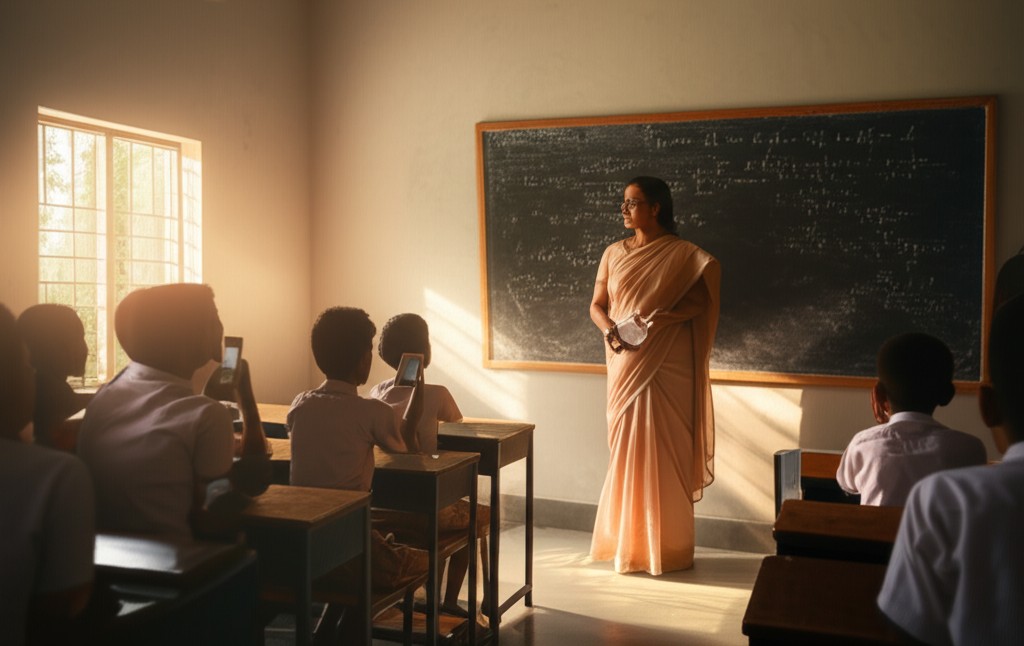
In a village in Bihar's Vaishali district, a single teacher named Priya manages 87 students across five grades.
Every morning, she walks two kilometers from her home to a concrete schoolhouse with no fans, no computers, and patchy electricity. She teaches Hindi to Class 1 while Class 4 works on math problems she wrote on the blackboard the day before. Class 5 helps Class 2 with reading. It's chaos, but it's all they have.
Priya is not an exception. She is India.
Nearly 100,000 schools across the country operate with just one teacher. One million teaching positions sit vacant. And according to the latest ASER report, 76% of Class 3 students in government schools cannot read a Class 2-level text.
India has achieved near-universal enrollment. Getting children into classrooms is no longer the problem. The problem is that many of those classrooms have no one qualified to teach them.
And now, a seductive promise arrives: artificial intelligence.
The Promise
In a converted warehouse in California, engineers at Khan Academy are building what founder Sal Khan calls "the great equalizer."
It's called Khanmigo - an AI tutor powered by the same technology behind ChatGPT, but designed with a crucial difference: it doesn't give answers. It guides students toward answers themselves, with infinite patience, available 24 hours a day, in any language.
"We're at the cusp of using AI for probably the biggest positive transformation that education has ever seen," Khan declared in a TED talk that has been viewed millions of times.
In pilot programs across 260 American school districts, the results are promising. A J-PAL evaluation found "meaningful improvements" in standardized math scores. Bill Gates, after visiting a classroom using the technology, called it "catching a glimpse of the future."
Now Khan Academy is offering Khanmigo free to teachers in 40 countries. India - with 260 million students, a million teacher vacancies, and 89% smartphone penetration among teenagers - seems like the perfect proving ground.
The math is simple, advocates say: You cannot train 1.5 million teachers in a decade. But you can deploy AI tutors to every smartphone.
The Ruins
To understand India's skepticism, you must understand Byju's.
In 2022, Byju Raveendran was India's most celebrated entrepreneur, his face on magazine covers, his company valued at $22 billion - more than the GDP of some nations. Byju's was proof that India could build world-class EdTech.
Two years later, Raveendran's net worth was zero. His company was worthless. And families across India were still paying EMI loans for courses their children had stopped using.
The collapse was spectacular. Bankruptcy proceedings. $533 million in unaccounted loan proceeds. A founder ousted by his own board. The company's app delisted from app stores over unpaid bills.
But Byju's wasn't an isolated failure. The company was the culmination of a business model - venture-funded growth at all costs, measuring engagement rather than learning, targeting economically vulnerable families with high-pressure sales tactics.
Behind Byju's lie 2,150 other failed EdTech startups. The grave is crowded.
So when Silicon Valley arrives promising that THIS time will be different, that THIS technology will transform education, India has heard it before.
The Divide Within the Divide
Here's what the "89% smartphone access" statistic doesn't tell you.
In a slum in Hyderabad, fifteen-year-old Lakshmi shares her mother's phone with two younger siblings. She gets it for homework after her brother finishes gaming and before her mother needs it for work. The data runs out by the third week of the month. There's no quiet place to study - five people share two rooms. The phone's screen is cracked, the battery dying.
In a suburb of Mumbai, fifteen-year-old Ananya has her own laptop, iPad, and smartphone. Her room has a desk, air conditioning, and high-speed wifi. When she struggles with math, her mother - a software engineer - can help. On weekends, she attends tutoring classes that cost more than Lakshmi's mother earns in a month.
Both have "smartphone access." Both would appear in the same ASER statistic.
Give them both an AI tutor. Predict who benefits more.
This is the central paradox of technology in unequal societies. The same tool amplifies existing advantages. Those who can use it effectively - with supporting infrastructure, quiet study space, parental help, time and energy - will pull further ahead. Those without will technically "have access" while falling further behind.
It's happened with television. With computers. With the internet. Why would AI be different?
The Teacher's Fear
Priya, our teacher in Bihar, has heard about AI tutors. Her principal showed a video at a district meeting. The technology is impressive, she admits. A child can ask any question and get patient explanation.
"But who will ensure the child asks questions at all?" she says. "Who will notice when a girl stops coming to school because her family needs her at home? Who will talk to the parents? Who will know that the quiet boy in Class 3 is being beaten by his father?"
Education, she argues, is not content delivery. It's relationship. It's noticing. It's the thousand small interventions that no algorithm can make.
And there's another fear she won't say directly, but which haunts teachers across India: if AI can teach content, what happens to us?
Already, 69% of teachers work on contracts without job security. Salaries are low. Respect is lower. The teaching profession is in crisis - not because India doesn't need teachers, but because it doesn't value them.
AI arrives as convenient justification. Why hire expensive permanent teachers when AI handles "content delivery"? Teachers become classroom managers - babysitters, really - while algorithms do the "real" teaching.
This isn't paranoia. It's how cost-cutting works. Follow the budget. Watch what happens to teacher recruitment funding when AI is declared a success.
The Other Side
And yet.
In that same village in Bihar, what is the alternative?
Priya cannot clone herself. She cannot teach five grades at once with full attention. When she's sick, school effectively stops. When she retires, who will replace her? The vacancy has been posted for three years.
Meanwhile, 89% of her students do have smartphone access in their families. DIKSHA - the government's digital platform - has served 3.5 billion content plays. Children are already learning on phones, just not learning well.
What if - instead of replacing Priya - AI could be her army of teaching assistants? What if, when she teaches Class 5, an AI tutor could work with Class 3 on reading? What if every child could get personalized practice at their actual level, not just grade level?
What if Priya could finally focus on what humans do best - inspiration, mentorship, noticing the quiet boy who's being beaten - while AI handles the repetitive drill?
This is the proposition's strongest argument: not AI instead of teachers, but AI multiplied by teachers.
And the math is unforgiving. India needs 1.5 million more teachers. Training pipelines cannot produce them for a decade. Every year of waiting is another cohort of children failed.
Is perfect the enemy of better?
The True Divide
Here's what both sides miss.
The debate about AI in Indian education is really a debate about political will.
India spends 4.6% of GDP on education - below the global average, below the NEP 2020 target of 6%. The defense budget is five times the education budget. Teacher vacancies persist not because India can't afford teachers, but because filling them isn't a priority.
The proposition says AI is the only scalable solution. But Cuba - not a wealthy country - achieved universal literacy and high-quality education without AI. Finland has excellent schools with no AI tutors. The solution exists. It's called: funding education, respecting teachers, building infrastructure.
The opposition says AI will deepen divides. But the current system already produces obscene divides. A child in Kerala has vastly different prospects than one in Bihar - same country, different planet educationally. Opposing AI doesn't fix this.
What if both AI and investment are needed? What if the real fight isn't AI vs. no-AI, but who controls it, who benefits, and who decides?
If AI is deployed by government with genuine equity focus - free access, local languages, teacher integration, privacy protection, accountability for outcomes - it could help.
If AI is deployed by venture-funded companies with growth targets and data extraction motives - as Byju's was - it will harm.
The technology doesn't determine the outcome. The politics does.
The Experiment
In 2024, the government of Andhra Pradesh quietly launched a pilot program.
In 500 rural schools, AI-powered practice sessions were introduced for math and Telugu reading. Teachers received training - not replacement. The AI tracked student progress and flagged those falling behind for teacher attention. Internet connectivity came through a partnership with Jio, with offline capability built in.
The results are still being evaluated. But early reports suggest something interesting: the biggest gains came not from students using AI directly, but from teachers using AI-generated insights to identify and help struggling students.
The AI wasn't the teacher. It was the diagnostic tool that helped the teacher teach.
Maybe this is the model. Not AI tutors replacing human connection, but AI tools amplifying human judgment. Not a revolution, but a prosthetic for an overwhelmed system.
The Children
Let's return to Priya's school in Bihar.
There's a boy named Rahul in her Class 3 who cannot read. He's nine years old, bright-eyed, eager. But his parents are illiterate. No one reads to him at home. He missed a year of school during COVID. He's two grades behind, and the gap grows daily.
Under the current system, Rahul will fall through the cracks. Priya has 86 other students. She sees his struggle but cannot give him the individual attention he needs. He'll be passed along, grade to grade, until he drops out - another statistic in India's learning crisis.
An AI tutor - available on his neighbor's smartphone, patient, adaptive to his level, available when Priya cannot be - might be the difference between Rahul learning to read and Rahul joining the millions of functionally illiterate graduates.
Or the AI might be poorly designed, harvest his data, provide him inferior instruction compared to wealthy students with better devices, and become another failed promise.
We don't know which it will be. That's not a reason to reject the technology. It's a reason to demand that it be deployed justly.
The Choice
India stands at a crossroads.
One path: reject AI education as dangerous, protect the status quo, and hope that traditional solutions eventually work. Given the track record, this path fails millions of children while we wait.
Another path: embrace AI education uncritically, hand it to venture capitalists, and hope the market works. Given the track record (Byju's, 2,150 failures), this path exploits millions of children while enriching few.
A third path exists, harder than either: deploy AI with intention. Make it public, accountable, teacher-supporting. Require bias audits. Protect children's data. Fund it as infrastructure, not as charity. Measure learning outcomes, not engagement. And simultaneously - not alternatively - fill teacher vacancies, raise teacher pay, build schools.
This third path requires what India's education system has never had: sustained political will.
But 260 million children cannot wait for us to muster it.
The Classroom
There's another way to see Priya's school.
Not as a site of failure, but as a site of possibility.
Every day, against impossible odds, one woman tries to teach 87 children. She's underpaid, under-resourced, unsupported. And still she shows up. Still she tries.
What if we gave her tools worthy of her dedication? What if AI were her ally, not her replacement? What if technology finally served the teacher instead of threatening her?
The classroom that never closes isn't one where AI teaches and children consume. It's one where Priya - armed with AI insights, supported by AI tutoring, freed from some of the impossible load - can finally do what she became a teacher to do.
See each child. Know each struggle. Make each one believe they can learn.
That's not a technology problem. It's a society problem.
And it's one we can solve - if we choose to.
For Priya. For Rahul. For 260 million reasons.