By Ramachandran Rajeev Kumar — 2026-01-30
The CBAM Challenge
How Tamil Nadu Is Building India's First Climate Technology Hub
On January 1, 2026, the European Union's Carbon Border Adjustment Mechanism moved from transition to full implementation. For Indian exporters, the clock started ticking on what may be the most significant trade barrier since WTO formation.
The numbers are stark: €826 million in annual compliance costs. A potential 35% price increase on Indian goods entering Europe. Steel and aluminum exports—comprising two-thirds of India's EU-bound volume—suddenly subject to carbon pricing that Indian manufacturers never anticipated.
India bears 18% of total global CBAM costs. Only China faces a larger burden.
But in Tamil Nadu, a different response is taking shape. Not protest. Not lobbying for exemptions. Instead: building the infrastructure to compete in a carbon-constrained world.
The Knowledge Park Vision
At the India Global Education Summit in Chennai on January 28, 2026, an unusual partnership took center stage.
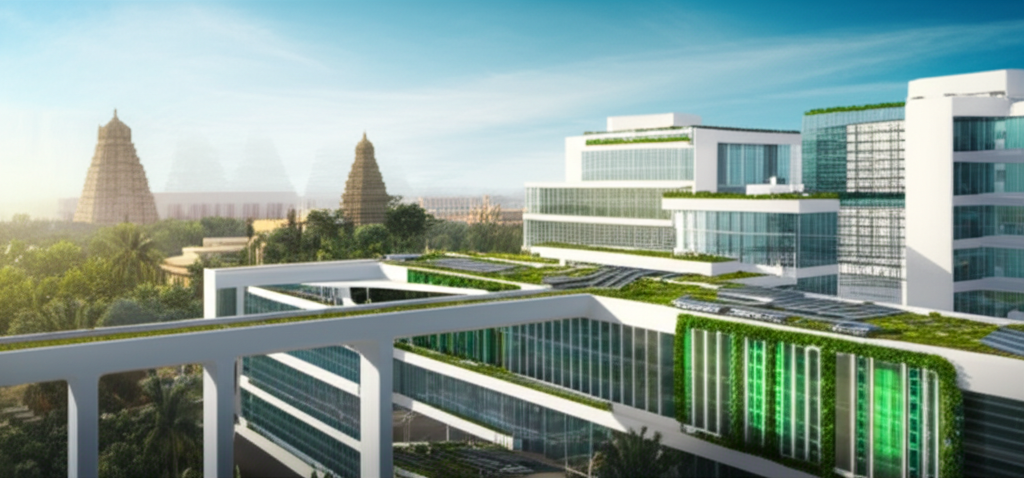
TIDCO—the Tamil Nadu Industrial Development Corporation—signed an agreement with Aarksee Group, a Saudi Arabia-headquartered climate technology company, to establish a Climate Technology R&D Centre at Knowledge Park in the Ponneri-Minjur region north of Chennai.
The project isn't a simple technology transfer. It's an attempt to build something India doesn't currently have: a dedicated ecosystem for developing, testing, and commercializing decarbonization technologies at industrial scale.
The proposed centre will house research facilities for algae-based carbon capture, circular bioeconomy applications, and emissions monitoring systems. More significantly, it will include pilot-scale testing facilities where technologies can be validated before deployment to industrial clients facing CBAM exposure.
Chief Minister M.K. Stalin's government has positioned the initiative as part of Tamil Nadu's broader Knowledge City vision—creating employment while building export-competitive clean technology capabilities.
Why Tamil Nadu
The choice of location isn't accidental.
Tamil Nadu hosts India's largest concentration of CBAM-exposed industries. The state's steel, aluminum, and cement sectors export significantly to European markets. Chennai's port handles substantial EU-bound cargo. The proximity of problems to solutions matters.
But there's a deeper strategic logic.
Tamil Nadu already leads India in renewable energy deployment. The state generates over 18 GW from wind and solar. Its manufacturing base includes electric vehicles, renewable equipment, and electronics. The infrastructure for clean technology development exists.
What's missing is the R&D layer—the capacity to develop indigenous solutions rather than importing them. The TIDCO-Aarksee partnership aims to fill that gap.
The Technology Stack
Aarksee's approach centers on what it calls "carbon capture for the real economy"—technologies deployable at existing industrial facilities without requiring complete process redesign.
The flagship technology involves engineered algae systems that capture CO2 from industrial emissions while producing valuable biomass. Unlike geological carbon storage, which requires specific geological formations, algae-based capture can operate anywhere with sunlight and CO2 sources.
The biomass outputs feed into circular bioeconomy applications: biofuels, bioplastics, animal feed, fertilizers. Revenue from these products offsets capture costs, potentially making decarbonization profitable rather than purely compliance-driven.
The company also brings expertise in emissions monitoring and verification—the measurement infrastructure that CBAM compliance requires. European importers need certified emissions data from their suppliers. Currently, most Indian manufacturers lack the monitoring systems to provide it.
The Article 6 Angle
Beyond CBAM compliance, the partnership positions Tamil Nadu for a different opportunity: international carbon markets under Article 6 of the Paris Agreement.
Article 6.2 enables bilateral trading of emission reductions between countries. Article 6.4 creates a centralized market mechanism. Both require verified, additional emission reductions—exactly what the proposed R&D centre would help generate.
Tamil Nadu's industrial base could become a supplier of carbon credits to European buyers seeking to offset their own emissions. The same technologies that enable CBAM compliance could generate tradeable assets.
Aarksee's presence in Saudi Arabia—a major player in Article 6 negotiations—adds another dimension. The Gulf states are building significant carbon credit demand as they pursue net-zero commitments. A Chennai-based R&D hub could serve markets in both directions.
The Execution Challenge
Vision documents are easy. Execution is hard.
The Knowledge Park project requires land allocation, infrastructure development, regulatory approvals, and coordination between state and central governments. TIDCO's track record on large projects is mixed. Timeline slippage is common.
Technology validation takes time. Algae systems that work in laboratories don't always scale to industrial deployment. Process integration with existing facilities presents engineering challenges. Cost projections made in proposals rarely survive contact with reality.
And CBAM compliance has immediate deadlines. Full carbon pricing begins in 2026. Indian exporters need solutions now, not in three years when R&D facilities become operational.
The partnership announcement at NISAU 2026 represents intent. Converting intent into operational capability requires sustained commitment from both partners and the state government.
The Competitive Landscape
Tamil Nadu isn't alone in recognizing the opportunity.
Gujarat has announced its own clean technology initiatives. Maharashtra is pursuing hydrogen hubs. Karnataka has positioned Bangalore as a sustainability technology centre.
Internationally, Vietnam and Indonesia are building CBAM-response capabilities. China's manufacturers are further along the decarbonization curve, with more experience deploying capture technologies at scale.
The window for establishing competitive advantage isn't infinite. First movers in CBAM-compliant manufacturing will capture European market share that laggards forfeit. Supply chains are already restructuring.
Tamil Nadu's bet is that concentrated R&D capability creates spillover benefits across industries—that building the ecosystem matters more than individual facility-level compliance. It's a long-term play in a market demanding short-term responses.
What Happens Now
The TIDCO-Aarksee MoU moves to detailed planning in Q1 2026. Land allocation discussions continue. Technical specifications for the R&D centre are being finalized.
Meanwhile, Tamil Nadu's exporters face CBAM costs today. The €826 million burden doesn't wait for R&D centres to become operational. Stop-gap solutions—purchasing carbon credits, partnering with European offset providers, accepting margin compression—fill the immediate gap.
The Knowledge Park project represents a different timeline: not solving today's problem, but building capacity for tomorrow's competition. Whether Tamil Nadu can execute fast enough to matter remains the central question.
The CBAM challenge isn't going away. It's expanding—other countries are considering similar mechanisms. The technologies developed in Chennai could find markets far beyond Europe.
India's response to carbon trade barriers will shape its industrial competitiveness for decades. In Tamil Nadu, one version of that response is taking form.
The EU's CBAM mechanism began full implementation on January 1, 2026. Tamil Nadu's Climate Technology R&D Centre is planned for development at Knowledge Park, Ponneri-Minjur region.