By Ramachandran Rajeev Kumar — 2026-01-10
Defense Minister Rajnath Singh has approved the establishment of a new Indian Navy base at Haldia in West Bengal. It's not a large facility - approximately 100 officers and sailors, focused on fast attack craft and coastal patrol. But its strategic significance extends far beyond its modest footprint.
Haldia sits on the Hooghly River, 130 kilometers from the deep-sea Sandheads area that opens to the Bay of Bengal. It offers direct access to one of the world's most contested maritime spaces, bypassing the time-consuming transit through the river's upper reaches.
In the Bay of Bengal battlespace, geography is destiny. And Haldia's geography makes it invaluable.
The Bay of Bengal Transformation
The Bay of Bengal has transformed from a maritime backwater into a strategic frontier. Over 100 warships from extra-regional navies now routinely operate in these waters. China's expanding naval presence has fundamentally altered the security calculus.
India's eastern seaboard - long the neglected flank compared to the Arabian Sea and Pakistan-focused western coast - now demands attention.
The threats are multiple:
- Expanding People's Liberation Army Navy (PLAN) activities
- Deepening Chinese defense engagement with Bangladesh
- Pakistan Navy vessels operating from Bangladesh (PNS Saif, a 3,000-tonne Chinese-built guided missile frigate, deployed there in November 2025)
- Maritime infiltration routes from Bangladesh used by illegal immigrants and potentially hostile actors
- The looming shadow of China's "String of Pearls" - the network of strategic ports ringing the Indian Ocean
Haldia addresses the most immediate of these: securing the northern Bay of Bengal.
String of Pearls vs. Necklace of Diamonds
China's String of Pearls strategy has encircled India with strategic port facilities:
- Gwadar in Pakistan: Deep-water port with Chinese control
- Hambantota in Sri Lanka: 99-year lease to Chinese companies
- Kyaukphyu in Myanmar: Part of the China-Myanmar Economic Corridor
- Chittagong in Bangladesh: Growing Chinese infrastructure investment
India's counter-strategy - sometimes called the "Necklace of Diamonds" - involves building its own network of access and influence:
- Military access agreements with Oman (Duqm port)
- Basing rights in Seychelles and Mauritius
- Strategic access to Indonesia's Sabang port
- Expanded facilities in the Andaman and Nicobar Islands
- The nuclear submarine base at Rambilli (Project Varsha)
Haldia adds another node to this network - a modest one, but positioned to monitor traffic between the Bay of Bengal and the vital Malacca Strait chokepoint.
What Haldia Will Host
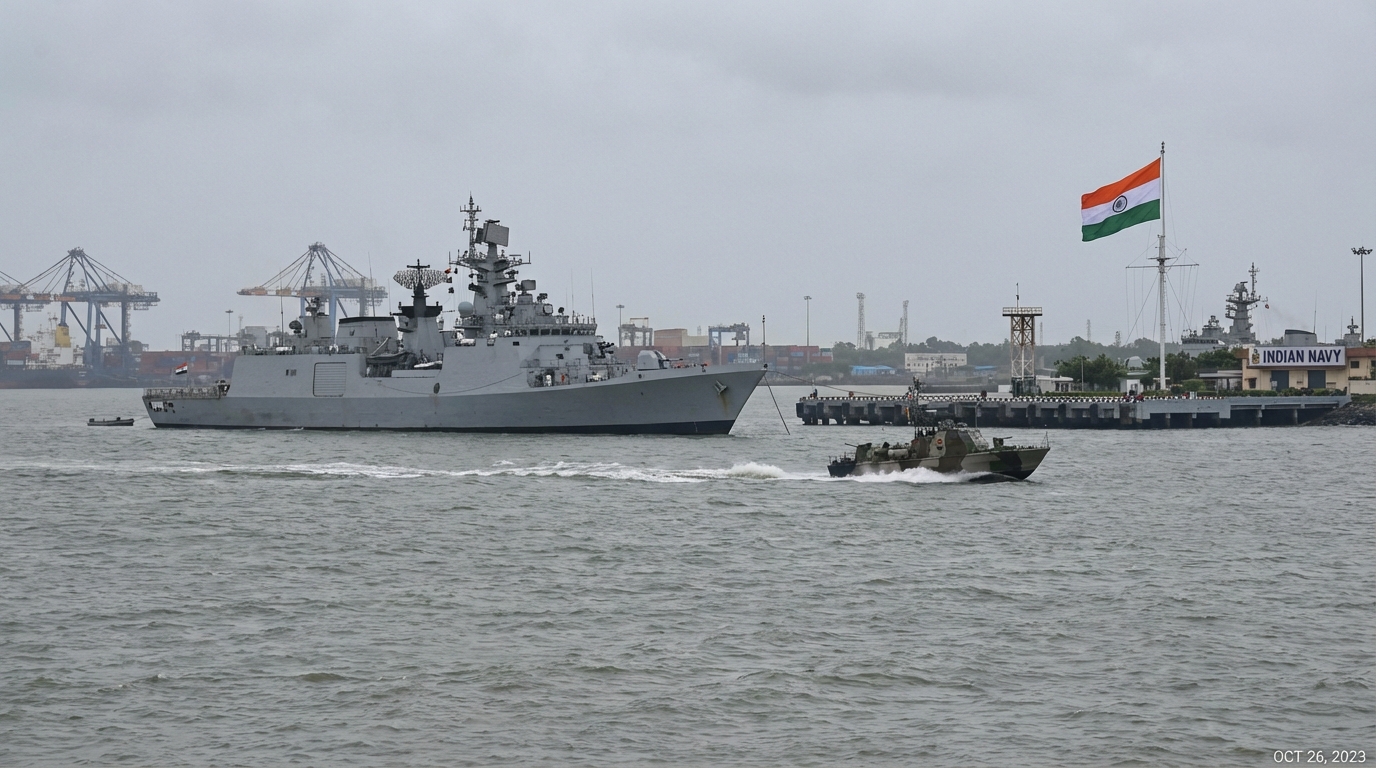
The base will deploy fast attack craft optimized for rapid response:
Fast Interceptor Crafts (FICs)
- Displacement: ~100 tonnes
- Speed: 40-45 knots
- Crew: 10-12 personnel
- Armament: CRN-91 guns
New Water Jet Fast Attack Crafts (NWJFACs)
- Displacement: ~300 tonnes
- Speed: 40-45 knots
- Advanced systems: Loitering munition capability (Nagastra system)
- Mission profile: Precision strike and surveillance
The Defense Acquisition Council approved 120 FICs and 31 NWJFACs in 2024. Some will deploy to Haldia. Their mission: coastal patrol, anti-infiltration, harbor defense, and special operations.
This isn't about projecting power across oceans. It's about controlling India's immediate maritime approaches.
The 2026 Naval Surge
Haldia is part of a larger story. The Indian Navy is commissioning 19 warships in 2026 - the largest single-year force accretion in its history. From 2026 onward, India will induct roughly one warship every six weeks.
The fleet projection:
- 2030: 150-160 warships
- 2035: 200+ naval vessels
Much of this expansion is indigenous. Indian shipyards have matured to the point where the navy can build most of its requirements domestically. The days of complete dependence on foreign suppliers are ending.
Technology transfers and partnerships remain important - Akula-class submarines from Russia, Scorpene collaboration with France, Barak-8 missiles from Israel, coordination with the US under iCET. But the industrial base is increasingly Indian.
The Bangladesh Factor
Haldia's location speaks to a specific concern: Bangladesh.
Relations with Dhaka have deteriorated since the August 2024 political turmoil that brought a caretaker government to power. Anti-India sentiment has risen. China has deepened its engagement. Pakistan has deployed naval assets to Bangladeshi waters.
The maritime border between India and Bangladesh is porous. Illegal crossings occur regularly. The potential for hostile actors to exploit these routes exists.
Haldia's fast attack craft can respond to incidents in the northern Bay of Bengal within hours rather than days. The base provides early warning, rapid interception, and a visible deterrent presence.
None of this means India expects conflict with Bangladesh. But prudent defense planning accounts for contingencies, not just current relationships.
Economic Spillovers
Naval bases aren't just military installations. They're economic anchors.
Haldia is already an established industrial hub with functioning port infrastructure. The naval facility will add:
- Employment in maintenance, logistics, and ancillary services
- Demand for supplies and services from local businesses
- Enhanced disaster relief capability (the Bay of Bengal experiences frequent cyclones)
- Infrastructure improvements that benefit civilian shipping
West Bengal's economy could use the boost. The state has lagged in industrial investment compared to southern and western India. A permanent naval presence creates sustained demand.
What Haldia Signals
To China, Haldia says: We're watching the Bay of Bengal. Your expansion will be monitored. Your partners in the region will not operate unopposed.
To Bangladesh, it says: Our relationship matters, but we will secure our waters regardless of political fluctuations.
To Pakistan, it says: Your naval deployments to the Bay of Bengal have been noted. We're positioned to respond.
To the region, it says: India is serious about becoming the dominant maritime power in the Indian Ocean. The eastern seaboard is no longer neglected.
The Larger Picture
Haldia is a small base. But it fits into a larger strategic architecture that positions India to:
- Monitor maritime traffic from the Persian Gulf to the Malacca Strait
- Deter adventurism by hostile powers in Indian waters
- Secure critical sea lanes that carry India's energy imports and trade
- Project influence across the Indian Ocean littoral
- Respond rapidly to humanitarian crises, evacuations, and regional contingencies
The Bay of Bengal is no longer a sleepy backwater. It's a contested space where great power competition is playing out in slow motion. China builds ports. India builds bases. Both accumulate naval power.
In this competition, geography matters. And Haldia's geography - 130 kilometers from deep water, positioned to control the northern Bay - gives India an advantage worth defending.
A compact base with fast boats might seem modest. In the Bay of Bengal's new strategic reality, it's exactly what India needs.