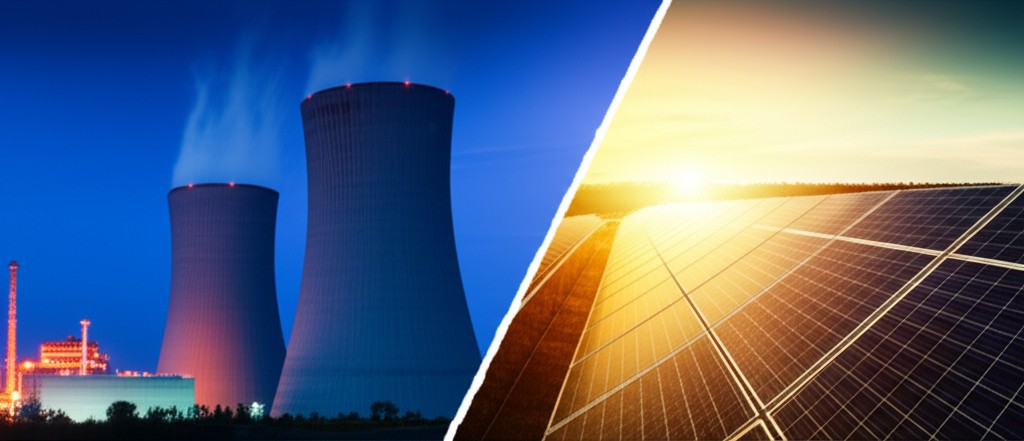
By BarathVector Editorial — 2025-12-18
The Bill That Changed Everything
On December 17, 2025, while the opposition marched out in protest, India's Parliament passed a law that had been waiting for sixty-three years.
The SHANTI Bill - an acronym that means "peace" - ended the state monopoly on nuclear power that had existed since 1962. For the first time, private companies could build and operate nuclear reactors. Foreign suppliers, who had stayed away for fifteen years over liability fears, could finally participate. The Rs 3,000 crore liability cap made India look, on paper, like France or America.
Outside Parliament, a different India existed. In Jaitapur, Maharashtra, fishermen who had been protesting since 2010 lit candles. In Kudankulam, Tamil Nadu, activists who had faced police firing a decade ago renewed their vows to fight. In the finance ministry, officials calculated how to find $26 billion. In a control room in Kalpakkam, engineers continued their twenty-one-year effort to finally commission India's first fast breeder reactor.
And in Rajasthan, in a small town called Banswara where Prime Minister Modi had laid a foundation stone three months earlier, residents wondered whether their children would grow up in the shadow of a nuclear plant or a solar farm.
India had chosen. The world watched. The question remained: Had India chosen wisely?
The Numbers That Don't Lie
Here is what India has:
8.88 gigawatts of nuclear capacity. Twenty-five reactors across seven sites. The highest generation ever recorded - 56,681 million units in 2024-25. Enough to avoid 49 million tonnes of CO2. About 3.1% of the country's electricity.
Here is what India wants:
100 gigawatts by 2047. An eleven-fold increase in twenty-two years. Roughly 4.15 gigawatts per year, every year, for two decades.
Here is India's track record:
Since 1971, when Tarapur first generated power, India has added nuclear capacity at an average rate of 0.16 gigawatts per year. The target requires twenty-six times this rate.
The math, as they say, doesn't math.
Or does it?
The Woman in Bihar
Let's start somewhere concrete. Patna, Bihar. A textile factory. 2 AM.
Sunita runs the night shift. Two hundred workers, industrial looms, climate-controlled yarn storage. The machines cannot stop - a power cut means ruined thread, missed deadlines, lost contracts.
At 2 AM, there is no sun. The wind in Bihar is unreliable. The nearest solar farm is dark. But 400 kilometers away, in Rawatbhata, Rajasthan, a nuclear reactor hums. It has been humming for months without pause. Tarapur Unit-3 ran for over a year continuously.
This is what nuclear proponents mean by "baseload." Not a theoretical concept but a physical reality: power that works at 2 AM, during monsoons, on cloudy days, when the grid operator calls.
Sunita doesn't care about thorium or the SHANTI Bill. She cares about uninterrupted power. And right now, at 2 AM, nuclear is one of the few carbon-free sources that can give it to her.
The Fisherman in Konkan
Now let's go somewhere else. Jaitapur, Maharashtra. A fishing village on the Konkan coast.
Ramesh has been fishing these waters for thirty years, like his father before him. The waters are warm - a coastal ecosystem that supports some of the richest fishing grounds in western India.
For fifteen years, he has been told a nuclear plant is coming. The world's largest - six French reactors generating 10,000 megawatts. The cooling water discharge would warm the ocean by several degrees. The construction would displace his village. The seismic zone makes him nervous.
Ramesh has protested. His neighbors have protested. Farmers who would lose their land have protested. In 2017, 10,000 people marched. In 2022, the plant's environmental clearance expired. In 2025, it still hasn't been renewed.
But the SHANTI Bill was written, in part, to unlock Jaitapur. Without it, the French supplier EDF faced unlimited liability for any accident. With it, EDF might finally say yes.
Ramesh didn't vote in Parliament. But Parliament voted on his future. And he was not consulted.
The Elephant Named Economics
Both Sunita and Ramesh have legitimate concerns. But perhaps the largest question isn't about baseload or consent - it's about money.
In 2024, India's solar developers bid electricity at Rs 3.15 per unit. Wind came in around Rs 4. These prices have fallen 90% in fifteen years. They will likely fall further.
Nuclear? The best estimates put new Indian nuclear at Rs 4.50 to Rs 8 per unit. The stalled Jaitapur project was projected at over Rs 9.
"But wait," say nuclear advocates. "Solar only works four hours a day. Add storage and the cost doubles."
They have a point. Firm power - available 24/7 - costs more than intermittent power. When you add battery storage, pumped hydro, or hydrogen production, solar's delivered cost rises significantly.
But battery costs have fallen 90% since 2010, from $1,100 per kilowatt-hour to $139. They continue falling. Nuclear costs, globally, have been flat or rising - Flamanville in France is twelve years late and four times over budget; Vogtle in America is $17 billion over; Hinkley Point in Britain has become a cautionary tale.
The economics, in short, are contested. Depending on which assumptions you make about storage costs, grid integration, and construction timelines, you can make nuclear look essential or obsolete.
Which brings us to the real question: Does India have the luxury of certainty?
The Three-Stage Dream
In a building in Mumbai, there is a blueprint. It was drawn in 1954 by a visionary named Homi Bhabha. It describes a three-stage nuclear program that would make India energy-independent forever.
Stage I: Pressurized heavy water reactors using natural uranium. Mature. Operational.
Stage II: Fast breeder reactors using plutonium from Stage I to breed uranium-233 from thorium.
Stage III: Thorium reactors using that uranium-233. Self-sustaining. Abundant. India has 25% of the world's thorium reserves.
The dream is magnificent. The timeline has been... challenging.
Bhabha predicted thorium utilization by the 1980s. The Prototype Fast Breeder Reactor at Kalpakkam was supposed to be commissioned in 2010. It is now expected in late 2026 - sixteen years late.
Stage III? "Decades away," officials say. They have been saying this for decades.
To nuclear skeptics, this is evidence of fundamental incompetence. To nuclear believers, every first-of-kind reactor faces delays - France's EPR took seventeen years at Flamanville.
The truth is somewhere between. India's nuclear establishment has genuine technical capability - the 700 MW PHWR design is world-class. But it has also failed to deliver on timelines, repeatedly, for seventy years.
Can a program that took 54 years to build 8.88 gigawatts build 91 more in 22? History suggests no. Ambition demands yes. The gap between them is where policy lives.
The Ghost of Bhopal
On December 3, 1984, a chemical plant owned by Union Carbide released 40 tonnes of methyl isocyanate gas into the air of Bhopal. Estimates of the dead range from 3,800 to over 16,000. Hundreds of thousands were affected. The CEO, Warren Anderson, was never extradited. The compensation settlement - $470 million - worked out to a few thousand dollars per death.
India has never forgotten Bhopal. It is why, in 2010, when the Civil Liability for Nuclear Damage Act was passed, legislators insisted on Section 17(b) - the "right of recourse." If a nuclear accident occurred due to faulty equipment, the operator could sue the supplier for damages.
Foreign suppliers hated it. Westinghouse walked away from Indian projects. EDF stalled Jaitapur. GE stayed out. The American government lobbied against it. Industry associations warned India was making itself "uninvestable."
For fifteen years, nothing happened. Then came SHANTI.
The new bill removes the right of recourse. If a French turbine blade fails at Jaitapur and causes a meltdown, the operator (likely NPCIL) pays up to Rs 3,000 crore. That's $350 million. Fukushima's cleanup has cost over $200 billion.
"International norm," say proponents. The Convention on Supplementary Compensation - which has eleven member states - channels liability to operators.
"Corporate bailout," say critics. India's regulatory capacity, judicial speed, and corporate accountability mechanisms are weaker than America's or France's. We need more protection, not less.
The BJP, ironically, was the party that insisted on supplier liability in 2010. Manish Tewari, Congress MP, stood in Parliament and read the BJP's own speeches from fifteen years ago. The ruling party said context had changed. The opposition said principles hadn't.
Who is right? That depends on whether you trust that safety standards will be enforced without the threat of supplier lawsuits. India's track record on corporate regulation is... mixed.
The Case for Nuclear
Strip away the politics, and the pro-nuclear case is straightforward:
Physics: An industrial economy needs firm, weather-independent power. Steel mills, aluminum smelters, semiconductor fabs - these cannot pause for clouds. Nuclear provides this at scale.
Climate: India emits 2.9 billion tonnes of CO2 annually. Coal provides 74% of electricity. Nuclear avoided 49 million tonnes in one year. If India is serious about net-zero by 2070, it needs every zero-carbon source available.
Density: A nuclear plant produces 1,000 MW on one square kilometer. Solar needs ten times the land for equivalent firm power. In a country with 1.4 billion people and fierce competition for land, density matters.
Security: India imports 85% of its oil and significant coal. A kilogram of uranium equals 22,000 kilograms of coal in energy content. Nuclear reduces import dependence.
Capability: India is one of four or five countries with complete nuclear fuel cycle mastery. Walking away means abandoning decades of scientific investment.
These arguments are not trivial. They represent legitimate engineering, economic, and strategic considerations.
The Case Against
Strip away the politics, and the anti-nuclear case is also straightforward:
Economics: Solar at Rs 3 per unit is real, today, at scale. Nuclear at Rs 6+ per unit is theoretical, delayed, and over budget globally. Every rupee spent on nuclear is a rupee not spent on cheaper alternatives.
Track Record: India's nuclear establishment has never demonstrated the capacity for rapid deployment. Promising 91 GW in 22 years from a program that averaged 0.16 GW per year is magical thinking.
Consent: Every nuclear site in India has faced sustained local opposition. Jaitapur has been blocked for fifteen years by democratic protest. Overriding this consent is authoritarian.
Liability: Removing supplier accountability puts citizens at risk. If Bhopal taught anything, it's that corporations flee responsibility. SHANTI enables this.
Alternatives: Modern grids with storage, demand management, and interconnection can handle high renewable penetration. "Baseload" is an obsolete concept from the era of inflexible generators.
These arguments are also not trivial. They represent legitimate economic, democratic, and technological considerations.
What India Actually Needs
Here is the uncomfortable truth that neither side wants to admit:
India probably needs both.
The all-nuclear vision - 100 GW by 2047 - is almost certainly fantasy. The construction rates required have no historical precedent in any democracy.
The all-renewable vision - 100% solar and wind with storage - is technically possible but expensive and land-intensive at India's scale.
The optimal path is likely somewhere between: Aggressive renewable deployment (which is already happening at 18 GW per year) combined with modest nuclear expansion (which provides firm baseload) combined with massive investment in storage and grid modernization.
This is boring. It doesn't fit on a campaign banner. It doesn't satisfy ideological purists on either side.
But it reflects reality. And policy should be about reality.
The Morning After
December 18, 2025. The morning after SHANTI passed.
In Parliament, the opposition files protests and demands the bill be sent to committee. It won't be.
In Jaitapur, fishermen gather at the shore, watching the waters they may soon lose.
In Kalpakkam, engineers continue calibrating the PFBR, hoping that this time, finally, it will achieve criticality.
In Rajasthan, solar developers wake up to news that their competitor just got a massive boost.
And somewhere, a baby is born who will graduate from college in 2047 - the year India has promised to have 100 GW of nuclear power.
Will she live in a country that met its climate targets? That powered its industry? That respected its citizens' consent?
Or will she look back at 2025 and wonder why we bet so heavily on one technology when the sun was right there, free for the taking?
We don't know. That's the problem with policy - you don't get to see the ending before you choose.
What we know is this: India has made a choice. The atom and the sun are now both officially in play. How they balance - how we balance - will determine the future of 1.4 billion people.
The debate isn't over. It's just beginning.
For Sunita, who needs power at 2 AM. For Ramesh, who needs to be heard. For the baby born on December 18, 2025, who will inherit what we choose.