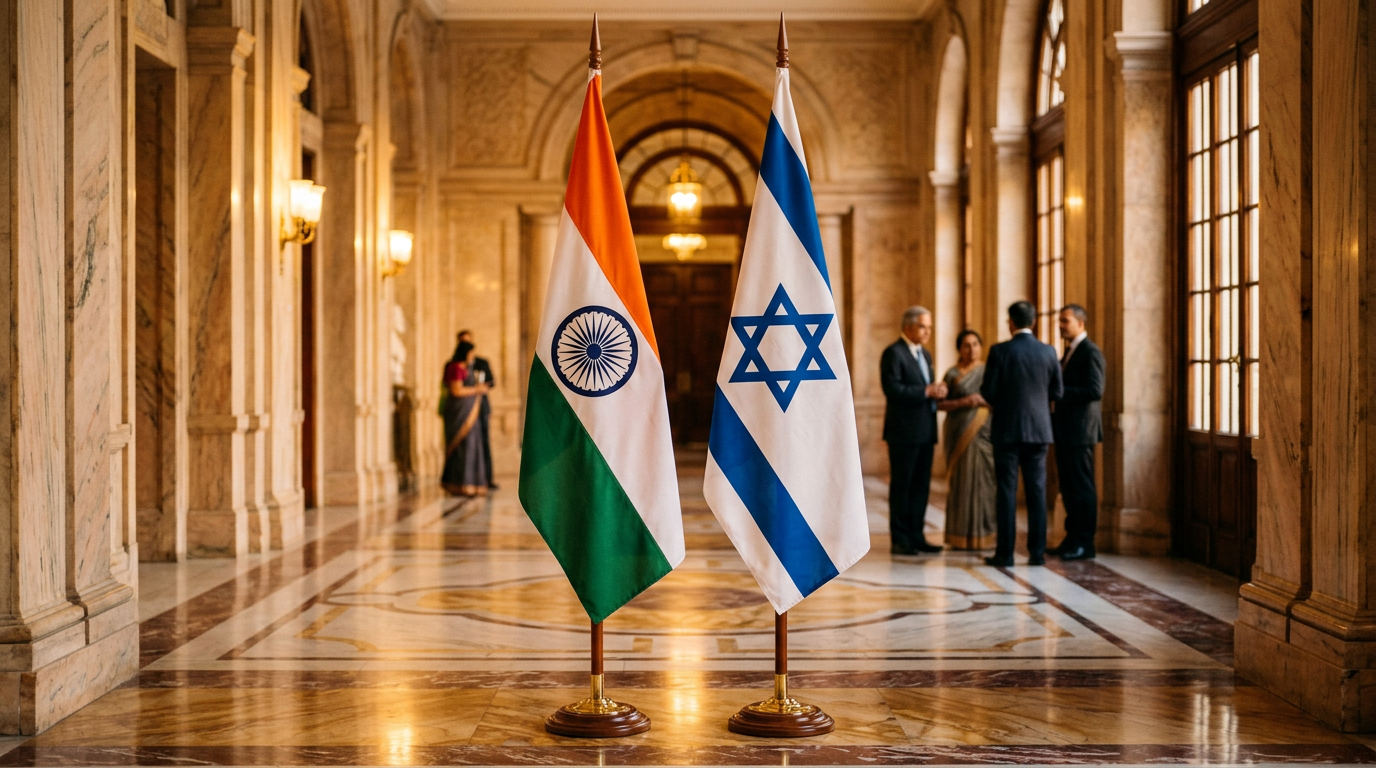
By Ramachandran Rajeev Kumar — 2026-02-28
The Ancient Allies: Two Civilizations Finally Stop Pretending They Aren't Friends
Sixteen pacts, one standing ovation, and the burial of a seventy-year diplomatic fiction
When Narendra Modi stood at the podium of the Knesset on February 25, 2026, and concluded his address with the words "Am Yisrael Chai"--the people of Israel live--he was not merely being diplomatic. He was ending a charade.
For seventy-eight years since Indian independence, New Delhi had maintained one of the most absurd diplomatic postures in modern statecraft: recognizing a nation in 1950, refusing to establish full relations until 1992, building one of the world's most consequential defence partnerships through the back door, and continuing to vote against that same partner at the United Nations General Assembly with clockwork regularity. India and Israel were allies in everything but name--clandestine lovers in a neighbourhood that disapproved of the match.
That era is now over. Definitively, unambiguously, and with sixteen signed agreements to prove it.
The Weight of Sixteen Signatures
The agreements signed during Modi's two-day state visit to Israel on February 25-26 are not mere memoranda of understanding destined for filing cabinets. They constitute the architectural blueprint of a relationship that both nations have decided to build in the open, without apology.
Consider the breadth: artificial intelligence, cybersecurity, quantum computing, critical minerals, defence joint production and technology transfer, agriculture innovation, fisheries and aquaculture, education through AI, UPI-linked cross-border payments, labour mobility for 50,000 Indian workers, commercial arbitration, securities regulation, cultural exchange, horizon scanning, and the framework for a Free Trade Agreement whose first round of negotiations concluded on the same day in New Delhi.
This is not a diplomatic photo opportunity. This is the infrastructure of a generational partnership being laid in a single visit.
The elevation of bilateral ties to a "Special Strategic Partnership for Peace, Innovation, and Prosperity" gives it a formal title. But titles are ceremony. The substance lies in what India and Israel have agreed to build, produce, and share--together.
The Defence Transformation
For decades, the India-Israel defence relationship operated under an unspoken compact: Israel sells, India buys, and neither side talks about it too loudly. India became Israel's largest arms customer, accounting for roughly 37 percent of Israel's total arms exports. Cumulative defence trade from 2012 to 2023 exceeded $20 billion. The Barak anti-missile system, the Phalcon AWACS, the Heron drones, the SPICE guidance kits--these systems quietly became the backbone of Indian military capability across all three services.
But the buyer-seller dynamic was always a ceiling, not a floor. And on February 26, that ceiling was smashed.
The joint statement commits both nations to "advance towards joint development, joint production, and transfer of technology" in defence. This is the language that transforms a transactional relationship into a strategic one. India will no longer merely purchase Israeli weapons systems. It will co-develop them, manufacture them on Indian soil, and--critically--absorb the technology that makes them lethal.
Reports suggest that deals worth between $8 billion and $10 billion are on the table or in advanced negotiation. The shopping list reads like a catalogue of precision warfare: Rafael's SPICE 1000 guidance kits, Elbit's Rampage air-to-ground missiles, Ice Breaker naval cruise missiles, and IAI's supersonic Air LORA missiles. Serious discussions around Iron Dome technology transfer--not a straight purchase, but the transfer of the knowledge to build India's own layered air defence--are reportedly underway.
The Defence Research and Development Organisation and Israel's Directorate of Defence Research and Development have signed a Bilateral Innovation Agreement covering joint work on drones, robotics, artificial intelligence, and quantum technology for military applications.
This is not two nations trading hardware. This is two nations merging their defence innovation ecosystems.
The Technology Bet
The establishment of the Critical and Emerging Technologies Partnership--led by both nations' National Security Advisors--tells you exactly how seriously this is being taken. This is not a commercial technology exchange. It is a security architecture.
AI, quantum computing, semiconductors, biotechnology, cybersecurity, space exploration--these are the domains that will determine which nations lead and which nations follow in the coming decades. India has scale. Israel has depth. The marriage of 1.4 billion people's market with the innovation density of a nation that produces more startups per capita than any country on earth is, on paper, one of the most potent technology partnerships imaginable.
A Letter of Intent was signed for an Indo-Israel Cyber Centre of Excellence in India, accompanied by a multi-year programme encompassing capacity building, applied research, security-by-design principles, and joint cyber exercises. India's contribution to India-Israel joint research calls was increased from $1 million to $1.5 million per call. The Joint Committee Meeting on Science and Technology was elevated to the ministerial level.
And then there is UPI. Netanyahu publicly appreciated India's fintech revolution, and an MoU between NPCI International and Israel's MASAV will explore linking India's Unified Payments Interface with Israel's fast payment system. For a country that has already exported UPI to Singapore, the UAE, and France, the Israeli linkage is both a validation and an expansion of India's most successful digital public infrastructure.
The Agricultural Quiet Revolution
Less dramatic than fighter jets but potentially more consequential: the establishment of the India-Israel Innovation Centre for Agriculture. The partnership between ICAR and MASHAV will focus on precision farming, satellite-based irrigation, advanced machinery, integrated pest management, germplasm exchange, post-harvest solutions, and capacity building.
Israel makes deserts bloom. India feeds 1.4 billion people but loses a staggering proportion of its harvest to inadequate post-harvest infrastructure. The complementarity is almost too obvious. Israel's drip irrigation technology, already deployed in parts of Rajasthan and Gujarat through earlier bilateral programmes, has demonstrated the capacity to double or triple yields in arid conditions. Scaling this across India's 140 million hectares of cultivated land--even partially--would constitute an agricultural revolution.
This is where the relationship moves from headlines to harvests. And it may ultimately prove more transformative than any missile system.
Why Now? The Seventy-Year Hesitation Explained
India recognized Israel in September 1950--one of the first non-Western nations to do so. Then it proceeded to behave as though it hadn't.
The reasons were a cocktail of Cold War alignment, domestic vote-bank politics, oil dependency on Arab states, and a genuine ideological commitment to the Palestinian cause that was, for all its sincerity, also extraordinarily convenient. The Non-Aligned Movement's solidarity with Arab states, the large Indian Muslim electorate's sensitivities, the millions of Indian workers in Gulf states whose remittances sustained entire state economies, the flow of crude oil from nations that considered Israel an existential enemy--all of these created powerful incentives to keep the relationship quiet.
Full diplomatic relations were not established until January 29, 1992--forty-two years after recognition. Even then, the relationship grew through its defence and agricultural dimensions while the political surface remained cautious. Indian leaders visited Ramallah but not Jerusalem. Votes at the UN followed the Arab consensus. The relationship was real, deep, and consequential--but never acknowledged at its true weight.
What changed? Several things, but three above all.
First, India's energy dependence on the Gulf has been diversified. Russian crude, American LNG, domestic renewables--India is no longer held hostage to a single region's approval.
Second, the Gulf states themselves normalised relations with Israel through the Abraham Accords and subsequent moves. The UAE, Bahrain, Morocco, and Sudan crossed the line. Saudi Arabia is widely expected to follow. The Arab world's unanimous rejection of Israel is no longer unanimous. India's cover story collapsed.
Third, and most importantly, the domestic political calculus shifted. The BJP-led government under Modi has shown a consistent willingness to pay political costs for strategic clarity. The 2017 visit to Israel--the first by any Indian Prime Minister--broke the ice. The 2026 visit melts it entirely.
The Hexagon and the Corridor
Modi did not come to Jerusalem merely to sign bilateral agreements. He came to stitch India into a regional architecture.
The India-Middle East-Europe Economic Corridor--IMEC--announced at the G20 in New Delhi in September 2023, proposes an integrated rail and shipping network connecting India through the UAE, Saudi Arabia, Jordan, and Israel to Europe. It is an alternative to China's Belt and Road, and Israel is its lynchpin in the eastern Mediterranean.
The I2U2 grouping--India, Israel, the UAE, and the United States--established in July 2022, provides the diplomatic scaffolding for economic and strategic collaboration across the region.
And then there is Netanyahu's "Hexagon of Alliances"--a proposed regional bloc bringing together Israel, India, Greece, Cyprus, and potentially other African, Arab, and Asian partners to counterbalance what he calls the "radical axes" in the region. Whether this specific framework materialises or not, the direction is unmistakable: India is being positioned--and is positioning itself--as a foundational pillar of the emerging West Asian security architecture.
For a nation that spent decades agonising over whether to shake hands with Israel in public, this is a tectonic shift.
The Pakistan Calculus
Nobody in Islamabad is pretending this doesn't matter.
Pakistan's Foreign Office stated that it remains "seized of the defence ties between Israel and India, including systems and platforms used by New Delhi against Islamabad." The Pakistan Senate passed a resolution signalling strategic discomfort over the India-Israel axis. Analysts across Pakistan's security establishment have been candid: every advanced Israeli system embedded within India's military architecture alters the deterrence balance.
They are right to be concerned.
The India-Israel defence partnership is no longer about selling radars and drones. It is about joint development of next-generation weapons systems, integrated air defence architectures, AI-driven battlefield management, and the kind of deep technology collaboration that produces capabilities money alone cannot buy.
Consider the strategic geometry. Operation Sindoor in May 2025 demonstrated that India possesses the will and the capability to conduct precision strikes inside Pakistan's borders. Israeli-origin SPICE guidance kits, Heron surveillance drones, and Phalcon AWACS platforms were reported to have played roles in that operation. Now imagine the next iteration of that capability--co-developed, co-produced, and optimised for the specific threat environment India faces.
Pakistan's security establishment calculates power in terms of deterrence balance. Advanced Israeli systems embedded within India's military architecture alter that balance--not dramatically in a single stroke, but incrementally and cumulatively in ways that are far harder to counter than a single weapons purchase. You can match a missile with a missile. You cannot easily match an entire innovation ecosystem.
And the implications extend beyond the bilateral. If the I2U2 and IMEC and the Hexagon frameworks eventually crystallise, Pakistan risks being sidelined from the region's emerging economic and security architecture entirely. Multiple West Asian nations aligning with New Delhi and Tel Aviv for strategic and economic cooperation would leave Islamabad with fewer friends, fewer options, and a declining ability to play the various poles against each other--the strategy that has sustained Pakistani foreign policy for decades.
The Knesset Moment
There is one image from this visit that will endure longer than any agreement.
Modi standing in the Israeli parliament--the first Indian leader ever to address the Knesset--receiving a standing ovation. Israeli opposition members who had staged a walkout over a domestic dispute with Netanyahu returned specifically to hear Modi speak, out of respect for the alliance and appreciation for the Indian Prime Minister's solidarity with Israel.
Modi said India stands with Israel "firmly, with full conviction, in this moment and beyond." He condemned the October 7, 2023 attack as "barbaric," adding that "no cause can justify the murder of civilians." He was conferred the Speaker of the Knesset Medal--the highest honour of the Israeli parliament.
For a country that once voted against Israel's very creation at the United Nations in 1947, this is not incremental progress. This is a different country, pursuing a different foreign policy, in a different world.
The Road Ahead
The sixteen agreements are a beginning, not an end. The Free Trade Agreement is still under negotiation. The defence co-production arrangements must be translated from MoUs into assembly lines. The technology partnerships must survive the transition from announcements to laboratories. The 50,000-worker labour mobility arrangement must navigate bureaucracies on both sides.
But the direction is now locked. India and Israel have chosen to build together, openly, across every domain that matters in the twenty-first century--defence, technology, agriculture, finance, education, culture, and trade. Two of the world's oldest civilizations, both survivors of partition and displacement, both forged in the fire of hostile neighbourhoods, both possessed of a stubborn refusal to be diminished by circumstance, have decided that the future is better faced together than apart.
The pretence is over. The waiting is done. And for those who prospered in the ambiguity of India's uncommitted middle ground--particularly in certain neighbourhoods to the west--the clarity spells a long and uncomfortable reckoning.
Two civilizations that have endured everything history could throw at them--invasion, partition, exile, terrorism, and the condescension of neighbours who wished they would simply disappear--have finally chosen to build the future in plain sight. Some alliances are forged in convenience. This one was written in survival. It took seventy-eight years to say it out loud. The wait was not wasted. It was preparation.