By Ramachandran Rajeev Kumar — 2026-02-17
On Saturday night, as India demolished Pakistan by 61 runs in Colombo, something remarkable happened three thousand kilometres away. In Jalalabad and Kandahar, Afghans poured into the streets, dancing and bursting crackers as though India's victory were their own. In Quetta, Balochistan, videos went viral of young men celebrating in defiance of their own country's team. These were not Indian expatriates. They were Afghans and Baloch who had chosen, spontaneously and joyfully, to identify with Indian cricket.
On the same weekend, India's Ministry of External Affairs quietly processed the latest tranche of development assistance to Bangladesh -- a country where anti-Indian sentiment has been rising for years, where Indian flags have been burned at protests, and where a generation of young Bangladeshis views New Delhi not as a liberator but as an overbearing neighbour.
The contrast contains a lesson that India's foreign policy establishment has been reluctant to learn: money does not buy goodwill. Method does.
The Balance Sheet
The Union Budget for 2026-27 allocated approximately 637 million dollars for grants and loans to foreign governments, continuing India's position as a significant -- if often unacknowledged -- development partner to its neighbourhood. The distribution tells a familiar story: Bhutan receives the largest share at 249.7 million dollars, reflecting the unique bilateral relationship and India's role in Bhutanese hydropower development. Nepal follows at 87.3 million dollars. Sri Lanka receives 43.6 million dollars. Bangladesh, notably, saw its allocation halved to approximately 65 million dollars from the previous year's 130 million.
These are not small numbers for a country with 200 million citizens below the poverty line. India is effectively transferring resources from its own poor to build roads in Bhutan, railways in Nepal, and power plants in Bangladesh. The question that no ministry review will ask -- but should -- is simple: what is India getting in return? Not in strategic terms, where the calculus is complex and defensible, but in public sentiment, where the returns are catastrophic.
The Afghan Exception
The celebrations in Afghanistan and Balochistan after India's cricket victory were not accidents of enthusiasm. They were the product of years of genuine cultural investment that India made almost incidentally.
India's cricket board has trained Afghan cricketers and provided facilities for their development programme since the early 2010s. Afghan youngsters have received coaching, IPL exposure, and tournament opportunities that their own war-ravaged country could never provide. Rashid Khan, Afghanistan's most celebrated sportsman, learned his craft in Indian domestic cricket. When Afghanistan qualified for the T20 World Cup, Indian fans adopted the team as a second favourite, and the affection was reciprocated across Afghan society.
This was not a calculated soft power strategy. No bureaucrat designed it. No aid package funded it. It happened because cricket created a genuine emotional connection -- one built on shared joy, mutual respect, and the simple act of helping someone else get better at something they love. The cost was negligible compared to India's annual development budget. The goodwill it generated is immeasurable.
India's rapid response to the 2023 Herat earthquake, when Indian Air Force transport aircraft were among the first to land with relief supplies, reinforced this connection. But notice the crucial distinction: the earthquake response was visible, immediate, and directly experienced by ordinary Afghans. It was not a line item in a budget that nobody reads.
The Big Brother Problem
Contrast this with Bangladesh, a country India helped liberate in 1971 at the cost of Indian blood and treasure. Fifty-five years later, anti-Indian sentiment in Bangladesh is not a fringe phenomenon. It is mainstream, particularly among the young.
The reasons are not mysterious. They are specific, documented, and largely self-inflicted.
The Teesta water-sharing dispute has festered for over a decade. Bangladesh's northern districts suffer water shortages while India diverts the river upstream. Every dry season, the resentment deepens. India's periodic onion export bans -- triggered by domestic price concerns with zero consideration for Bangladeshi consumers who depend on Indian supply -- have become a recurring humiliation. Indian media coverage of Bangladesh oscillates between patronising and dismissive, a tone that social media amplifies into Bangladeshi living rooms in real time.
The cumulative effect is what scholars call the Big Brother syndrome: a relationship where the larger partner's every action, however well-intentioned, is interpreted through a lens of domination and condescension. The 65 million dollars in development aid does not offset a single viral clip of an Indian television anchor lecturing Bangladesh on gratitude.
Nepal presents a similar pattern with different specifics. India's 2015 blockade -- imposed during Nepal's post-earthquake humanitarian crisis, ostensibly over constitutional concerns affecting Madhesi communities -- remains the defining memory of bilateral relations for an entire generation of Nepalis. No amount of subsequent aid has erased it. Nepal's constitution was perceived as an internal matter, and India's intervention was seen as precisely the kind of Big Brother overreach that smaller neighbours fear most.
What Actually Works
The lesson from Afghanistan is not that India should stop giving aid. It is that aid, by itself, is neither a robust nor a failproof mechanism for building public support in neighbouring countries. Transferring money through government channels builds infrastructure. It does not build affection.
What builds affection is the kind of people-to-people connection that cricket created with Afghanistan: visible, emotional, non-transactional, and experienced directly by ordinary citizens rather than filtered through bureaucratic intermediaries. Bollywood has done this for decades across South Asia -- not because anyone planned it, but because entertainment creates bonds that no aid package can replicate.
The operational implications are straightforward. India's neighbourhood policy needs to prioritise two things it currently neglects.
First, fix the irritants. The Teesta dispute, the onion ban reflexes, the media condescension -- these are not intractable geopolitical problems. They are policy failures with identifiable solutions. Every rupee spent resolving the Teesta water-sharing agreement would generate more goodwill than a hundred million dollars routed through development budgets that neither Bangladeshi citizens nor Indian taxpayers can track.
Second, communicate what you do. India's disaster response record in the region is genuinely impressive -- first responders in Nepal's earthquake, Sri Lanka's economic crisis, the Maldives water emergency. But silent generosity is, strategically speaking, wasted generosity. This does not mean boastfulness. It means ensuring that the local populace in recipient countries knows who showed up and why, communicated in a manner that suits their temperament and does not trigger Big Brother anxieties.
The Real Return on Investment
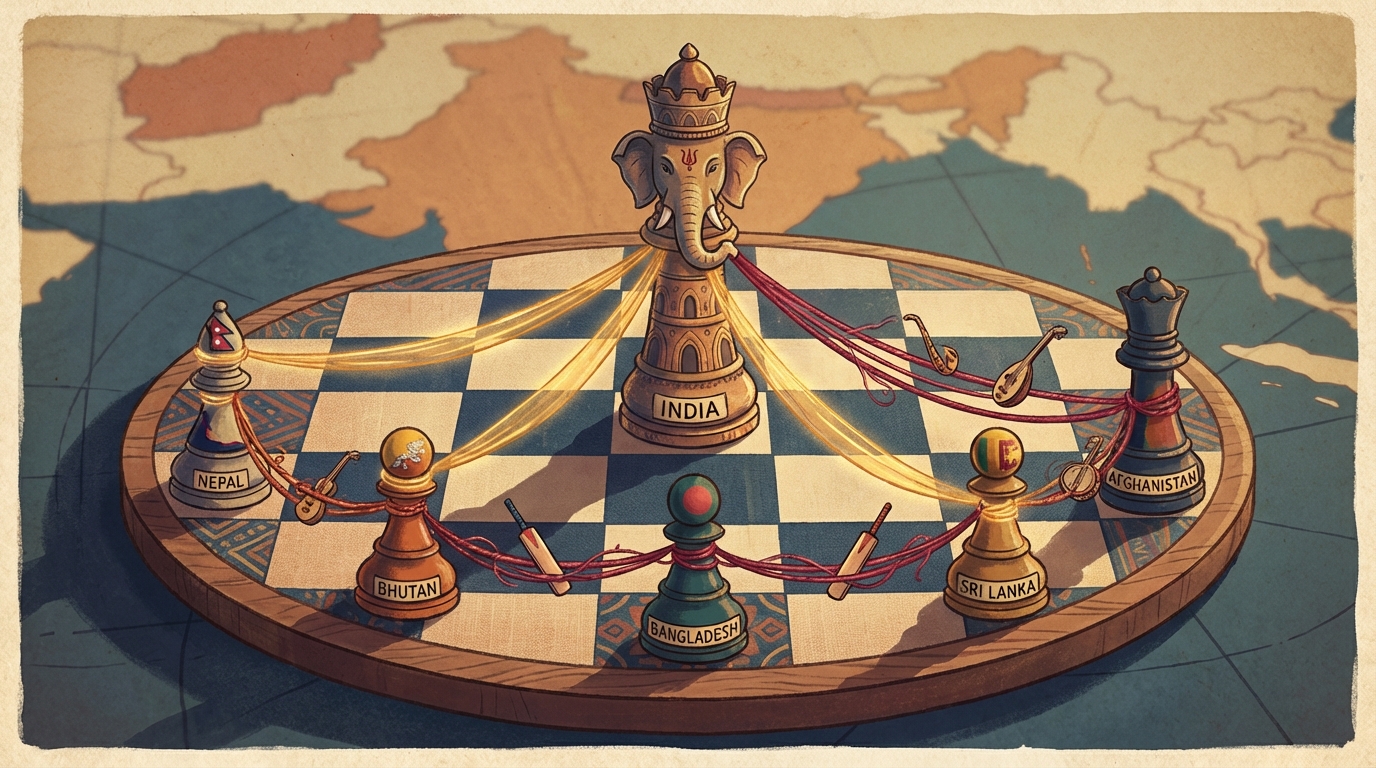
India's aid chessboard is not short of resources. It is short of strategy. The country spends hundreds of millions annually on development assistance while simultaneously generating anti-Indian sentiment through policy clumsiness that costs nothing to fix.
Afghanistan dances for India because India gave Afghanistan something more valuable than money: respect expressed through cricket, through cultural exchange, through showing up without conditions. Bangladesh burns Indian flags not because India has been stingy -- the aid numbers prove otherwise -- but because the relationship framework communicates dominance rather than partnership.
The aid chessboard requires not more pieces but better moves. And the best move India can make is the one it has been avoiding: understanding, honestly and without defensiveness, why countries that receive its money still resent its presence. The causes are often simple. The fixes are often cheap. And the returns on fixing them would dwarf anything that another hundred million in untraceable aid could ever deliver.