By BarathVector Editorial — 2026-02-24
The Crash That Asked the Right Question
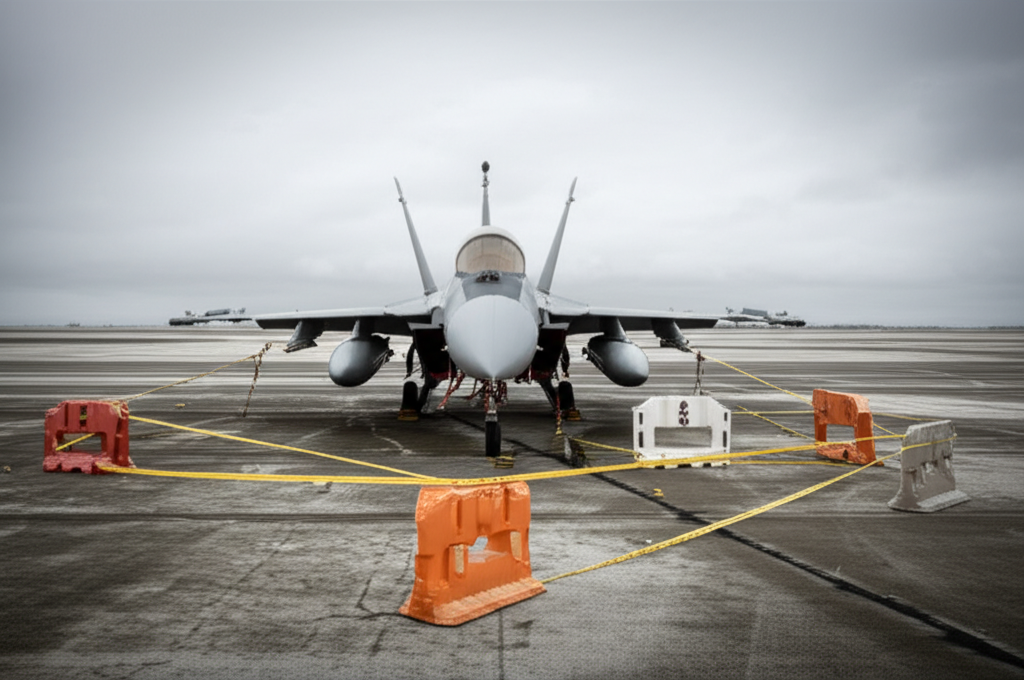
On February 7, 2026, a TEJAS Mark 1 fighter jet crashed during a routine training sortie, reportedly due to a suspected brake failure. The pilot ejected safely. The Indian Air Force responded by grounding the entire fleet of approximately 30 single-seat TEJAS aircraft pending investigation. It was the third major accident involving India's indigenous light combat aircraft.
The grounding itself is not the crisis. Grounding fleets after accidents is standard protocol worldwide -- a sign of institutional caution, not institutional failure. The crisis is what the grounding reveals about the institution that built the aircraft: Hindustan Aeronautics Limited, India's state-owned aerospace monopoly.
Forty Years and Counting
The Light Combat Aircraft programme was sanctioned in 1983. Let that number settle. Forty-three years ago, India set out to build a light combat aircraft to replace the ageing MiG-21 fleet. The MiG-21s, incidentally, are still flying -- and still killing pilots.
The first prototype flew in 2001, eighteen years after the programme began. The aircraft received Initial Operational Clearance in 2013 -- thirty years after sanction. Final Operational Clearance came in 2019, thirty-six years later. Series production deliveries to the IAF began trickling in, with HAL consistently missing delivery timelines.
Compare this with any private sector defence manufacturer globally. Lockheed Martin developed the F-35 from concept to first flight in roughly ten years. Dassault's Rafale went from programme launch in 1986 to first flight in 1991 -- five years. South Korea's KAI developed the KF-21 Boramae from programme start to first flight in about six years.
HAL took eighteen years just to get a prototype airborne.
The PSU Problem
The question is not whether Indian engineers can design a fighter jet. They demonstrably can -- the TEJAS, for all its troubles, is a functional fourth-generation light combat aircraft with a quadruplex digital fly-by-wire system. Indian engineering talent is not the bottleneck.
The bottleneck is institutional structure. HAL is a Public Sector Undertaking -- a government-owned enterprise where the incentive structures of competitive private enterprise do not apply. Consider what this means in practice:
No competitive pressure. HAL has no domestic competitor for fighter aircraft production. The Indian Air Force cannot take its business elsewhere. When your only customer has no alternative supplier, urgency becomes optional.
No consequences for failure. When TEJAS deliveries slip by years, when cost estimates balloon from the original projections, when quality issues ground entire fleets -- who is held accountable? No CEO is fired. No contract is cancelled. No competitor swoops in. The programme continues, the budgets are renewed, and the timelines are quietly revised.
Bureaucratic decision-making. PSU culture means decisions pass through layers of government approval processes designed for risk avoidance, not innovation. Every technical decision that a private company's chief engineer could make in a day requires committee approvals, file notings, and ministerial oversight at HAL.
Talent drain. HAL's salary structures, while improved in recent years, still cannot compete with the private sector -- either domestic IT firms or global aerospace companies. The best aerospace engineers in India have options that HAL struggles to match. What remains is dedication without adequate reward, and institutional knowledge without institutional authority.
The Accountability Deficit
The TEJAS programme has cost the Indian exchequer thousands of crores over four decades. The exact figure is disputed, with estimates ranging widely depending on what is included in the accounting. But the principle is clear: no private enterprise could have consumed this level of investment over this period, with this delivery record, and survived.
In the private sector, a 43-year development programme for a light combat aircraft would be a bankruptcy filing. At HAL, it is a success story celebrated in annual reports. When the bar for success is merely not shutting down, excellence becomes impossible.
The third TEJAS crash is not an anomaly. It is the natural output of a system where quality control operates without the existential pressure that competition provides. When losing a contract is not a possibility, meeting the highest safety standards becomes aspirational rather than mandatory.
The Aatmanirbhar Contradiction
India's Aatmanirbhar Bharat (self-reliant India) policy in defence is strategically sound. Dependence on foreign suppliers for critical defence platforms is a vulnerability that India cannot afford. The 2022 Russia-Ukraine conflict demonstrated how quickly supply chains for spare parts and ammunition can be disrupted by geopolitical shifts.
But Aatmanirbhar does not mean Aatmanirbhar-through-PSU-monopoly. Self-reliance built on a government monopoly is not true self-reliance -- it is dependency transferred from a foreign government to a domestic bureaucracy. Both create single points of failure. Both lack the competitive pressure that drives innovation and quality.
The Defence Acquisition Procedure 2026, recently released in draft form, prioritises indigenous procurement -- 75% of capital acquisition budgets are earmarked for domestic industry. This is welcome. But "domestic industry" must include the growing Indian private defence sector: Tata Advanced Systems, Bharat Forge, Larsen & Toubro Defence, Adani Defence, Mahindra Defence Systems. These companies bring private capital discipline, global partnerships, and accountability to shareholders.
What Would Reform Look Like?
The solution is not to shut down HAL. It is to end its monopoly.
Competitive tendering for indigenous programmes. When India commissions its next fighter programme -- the Advanced Medium Combat Aircraft (AMCA) -- it should be structured as a competition between HAL and private sector consortia. Let HAL compete on merit, not on birthright.
Private sector integration in current programmes. The TEJAS Mark 2 programme should incorporate private sector suppliers not just for components, but for critical subsystems. Competition at the subsystem level drives quality upward.
Performance-linked consequences. HAL's management must face genuine consequences for missed timelines and quality failures. This means restructuring HAL's governance to include independent directors with defence industry expertise, binding delivery timelines with financial penalties, and genuine performance reviews.
Strategic partnerships with accountability. India's partnership with France on Rafale technology transfer, with the US on jet engine technology (the GE F414 for TEJAS Mark 2), and with other nations should include knowledge transfer mechanisms that build private sector capability, not just HAL capability.
The Real Defence Crisis
India's defence crisis is not that the TEJAS crashed. Aircraft crash. Engineering is iterative. The crisis is that after 43 years and three crashes, the institutional response will likely be another committee, another timeline revision, and another budget increase -- with the same monopoly structure, the same absence of competition, and the same absence of consequences.
The IAF needs indigenous fighter jets. India has the engineering talent to build them. What India does not have -- and urgently needs -- is an institutional framework where that talent operates under competitive pressure, with genuine accountability, and with consequences for failure that go beyond a paragraph in a CAG report.
No one gets fired at HAL. Until that changes, the TEJAS programme will remain what it has been for four decades: a monument to what Indian engineering could achieve, trapped inside a system designed to ensure it never fully does.