By Ramachandran Rajeev Kumar — 2026-01-01
The Su-57 Question: Should India Bet on Russia's Fifth-Generation Fighter?
A comprehensive analysis of Russia's stealth fighter and India's options
In the aftermath of Operation Sindoor, as India contemplates the next phase of its air power modernization, an unexpected option has resurfaced: the Sukhoi Su-57 Felon, Russia's troubled but evolving fifth-generation stealth fighter.
Reports indicate that New Delhi is negotiating for additional S-400 systems and exploring Su-57 acquisition. The May 2025 conflict with Pakistan - where Russian-made S-400s achieved their combat debut with devastating effect - has renewed interest in Moscow's military offerings despite years of supply chain concerns.
But does the Su-57 make sense for India? The answer requires examining the aircraft's capabilities, Russia's production realities, India's alternatives, and the strategic implications of deepening defense dependence on a sanctioned power.
The Su-57: Technical Profile
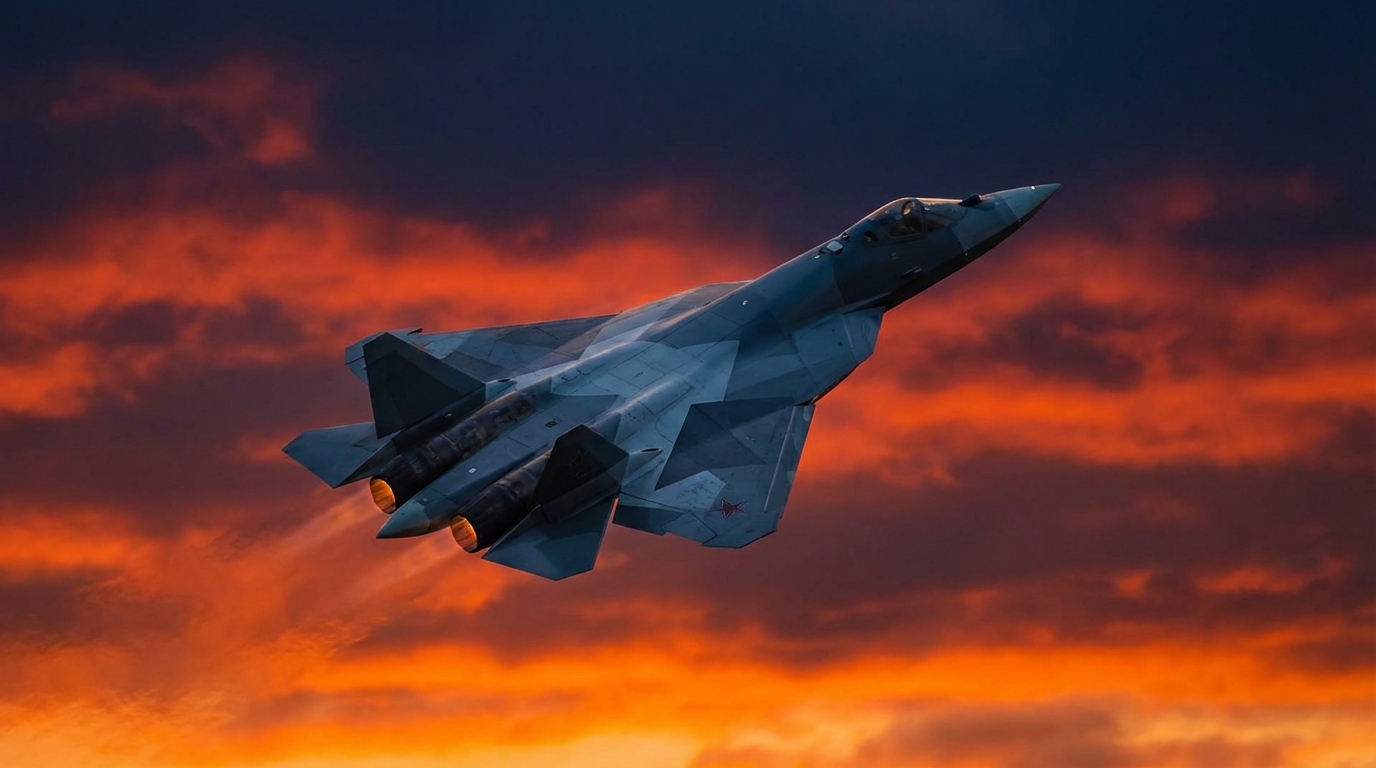
The Su-57 (NATO reporting name: Felon) is Russia's answer to the American F-22 Raptor and F-35 Lightning II. Development began in 2002, with the first prototype flying in 2010. Serial production finally commenced in October 2025 after years of delays.
Specifications
| Parameter | Value |
|---|---|
| Length | 20.1 meters |
| Wingspan | 14.1 meters |
| Maximum Speed | Mach 2.45 (altitude), Mach 2 (with afterburners) |
| Maximum Takeoff Weight | 35,000 kg |
| Payload Capacity | 10,000 kg |
| Engines | 2x Saturn AL-41F1 (current) / AL-51 (Su-57M) |
| Combat Radius | ~1,500 km |
| Armament | 30mm autocannon, 8 internal hardpoints |
Stealth Characteristics
The Su-57 incorporates several stealth features:
- Composite materials: Approximately 25% of airframe
- Radar-absorbing coatings: Applied to key surfaces
- Internal weapons carriage: Concealed bays for stealth missions
- Faceted surfaces: Redirect radar returns away from source
- Buried engines: Reduced infrared and radar signature
However, Western analysts have consistently rated the Su-57's stealth capabilities below its American counterparts. The rear aspect, in particular, is considered "more akin to a fourth-generation fighter" due to engine nozzle design.
The Su-57M1 Upgrade (May 2025)
Russia unveiled the upgraded Su-57M1 variant with significant enhancements:
- Saturn AL-51 engines: Improved thrust and fuel efficiency
- AI-assisted systems: Enhanced situational awareness and targeting
- Advanced radar: N036 Byelka AESA with L-band arrays for detecting stealth aircraft
- "Intelligent skin": Distributed sensors providing 360-degree awareness
The AL-51 engine, if delivered as promised, would provide supercruise capability - sustained supersonic flight without afterburners - a key fifth-generation attribute.
Production Reality: The Elephant in the Hangar
Russia's ability to deliver the Su-57 in meaningful numbers is the critical question.
Current Status
| Metric | Figure |
|---|---|
| Aircraft fielded (mid-2025) | 25-32 units |
| Annual production (2022) | ~10 aircraft |
| Annual production (2023) | ~11 aircraft |
| Serial production commenced | October 2025 |
By mid-2025, Russia had equipped only the 23rd Guards Fighter Aviation Regiment, with plans to establish two additional regiments. This is a glacial pace compared to American F-35 production (100+ annually).
Ukraine War Impact
The conflict has devastated Russian aerospace manufacturing:
- Sanctions: Western components (electronics, composites) cut off
- Labor diversion: Skilled workers redirected to immediate wartime production
- Resource constraints: Priority given to drones, missiles, and ground equipment
- Combat losses: Pressure to replace conventional aircraft
Reports indicate Russia is struggling to maintain production of existing aircraft types, let alone scale up Su-57 manufacturing.
Export Reality
Algeria became the first confirmed Su-57 export customer in February 2025, with a contract for six aircraft signed in November 2024. Deliveries are expected by end-2025 - a timeline that, given historical delays, should be viewed skeptically.
India's experience with Russian delivery timelines is instructive: S-400 squadrons 4 and 5, originally scheduled for 2024, are now expected in 2026.
The FGFA Ghost: Lessons From History
India's interest in fifth-generation Russian fighters is not new. The Fifth Generation Fighter Aircraft (FGFA) program, launched in 2007 as a joint development project based on the Su-57 platform, was supposed to deliver a customized variant for the Indian Air Force.
Why FGFA Failed
| Issue | Detail |
|---|---|
| Cost escalation | From $6 billion to $25+ billion |
| Technology transfer | Russia reluctant to share critical tech |
| Work share | India's role reduced to financing |
| Performance concerns | IAF unhappy with stealth and engine specs |
| Timeline | Repeated delays eroded confidence |
India formally withdrew from FGFA in 2018 after investing approximately $250 million in preliminary design. The program's collapse left deep scars in the defense establishment and made many wary of repeating the experience.
India's Alternatives
Option 1: Indigenous AMCA
The Advanced Medium Combat Aircraft (AMCA) represents India's homegrown fifth-generation ambitions.
| Milestone | Timeline |
|---|---|
| CCS Approval | March 2024 (Rs 15,000 crore) |
| Full-scale model revealed | Aero India 2025 |
| Prototype rollout | 2028-2029 |
| First flight | 2029 |
| Service entry | 2034 |
| Series production | 2035-2036 |
| Planned quantity | 120 aircraft |
Key Development: In May 2025, the Ministry of Defence approved a public-private partnership (PPP) execution model, moving away from Hindustan Aeronautics Limited's (HAL) traditional monopoly due to its "not-so-great delivery track-record."
The AMCA Mk-1 will use GE F414 engines (98 kN), while the Mk-2 requires a more powerful 110-120 kN engine being co-developed with France's Safran or UK's Rolls-Royce.
Verdict: The AMCA is the right long-term answer but won't arrive until the mid-2030s.
Option 2: More Rafales
The Dassault Rafale has proven itself in IAF service since 2020. India currently operates 36 aircraft.
Pros:
- Combat-proven platform
- Existing infrastructure and training
- Western technology standards
- Reliable supply chain (non-sanctioned)
Cons:
- Not a true fifth-generation aircraft (4.5-gen)
- Full acquisition cost ($250+ million per unit with package)
- French political considerations
Expanding the Rafale fleet to 72-90 aircraft would provide a capable stopgap while the AMCA matures.
Option 3: American Options
F-35 Lightning II: The gold standard of fifth-generation fighters, but:
- Requires CAATSA waiver for S-400 operators
- Unprecedented technology sharing with India unlikely
- Political strings attached
- Interoperability issues with Russian systems
F-15EX Eagle II: A 4.5-generation alternative with massive payload capacity, but not stealthy.
Given current US-India tensions over tariffs, American fighter acquisitions face political headwinds.
Option 4: The Su-57 Path
Returning to Russia's offering after the FGFA debacle would require:
- Guaranteed technology transfer (lessons from FGFA)
- Realistic production timelines (lessons from S-400 delays)
- Lifecycle support commitments (lessons from spare parts crisis)
- Competitive pricing (lessons from FGFA cost escalation)
Post-Operation Sindoor, the S-400's performance has rebuilt some confidence in Russian systems. But missiles are simpler than fighters.
Strategic Considerations
The Dependence Dilemma
India's defense relationship with Russia presents a paradox:
| Russian Systems in IAF | Dependency Level |
|---|---|
| Su-30MKI fleet | ~270 aircraft |
| MiG-29 variants | ~60 aircraft |
| MiG-21 (retiring) | ~100 aircraft |
| S-400 air defense | 5 squadrons |
Adding Su-57s would deepen this dependence at precisely the moment Russia has demonstrated supply unreliability. The December 2025 halt in spare parts production was a wake-up call.
Interoperability Concerns
The IAF increasingly operates with Western partners - Quad exercises, US joint operations, French cooperation. Su-57 acquisition would create interoperability challenges with NATO-standard systems already in service (Rafale, C-17, P-8I, MQ-9B).
Regional Balance
| Threat | Fifth-Gen Capability |
|---|---|
| China | J-20 (operational), J-35 (development) |
| Pakistan | None (F-16 Block 70 is 4.5-gen) |
China's J-20 fleet is growing rapidly. Waiting until 2034 for AMCA means a decade-plus gap in fifth-generation capability against the primary adversary.
This is the strongest argument for an interim solution - whether Su-57, additional Rafales, or an unexpected Western offer.
The Verdict: Proceed With Extreme Caution
The Su-57 is not the disaster some Western analysts claim. The platform has matured significantly since the FGFA debacle. The Su-57M1 with AI integration and AL-51 engines represents genuine fifth-generation capability.
However, India should approach any acquisition with hard-learned lessons:
If India Proceeds, It Must Demand:
- Iron-clad delivery timelines with penalty clauses
- Full technology transfer including source codes
- Indigenous production rights under Make in India
- Guaranteed spare parts supply independent of Russia's wartime constraints
- Competitive pricing reflecting development partner status
The Realistic Path Forward
| Priority | Action |
|---|---|
| Immediate (2025-2028) | Expand Rafale fleet to 72+ aircraft |
| Medium-term (2028-2034) | Accelerate AMCA development |
| Contingency | Negotiate Su-57 option as hedge |
| Long-term (2034+) | Transition to AMCA-centric fleet |
The Su-57 should be viewed as a potential hedge, not a primary solution. If AMCA development falters or regional threats escalate, having a negotiated framework with Russia provides flexibility.
But betting India's air power future on a sanctioned supplier with proven reliability issues would repeat the mistakes of the past.
Conclusion: The Real Fifth-Generation Question
The Su-57 debate ultimately reflects a deeper question: Can India achieve genuine defense self-reliance, or will it remain dependent on foreign suppliers - whether Russian, French, or American?
The AMCA represents the correct answer. A nation of India's size, ambitions, and threat environment cannot remain perpetually dependent on imported platforms.
The May 2025 shift to public-private partnership for AMCA execution signals recognition of this imperative. The question is whether political will and industrial capability can match strategic ambition.
Until then, India must navigate between flawed options: deepening dependence on an unreliable Russia, expanding Western purchases that come with political strings, or accepting a capability gap against China's growing J-20 fleet.
There are no good choices. Only less bad ones.
The author is Founder & Editor-in-Chief of BarathVector.