By Ramachandran Rajeev Kumar — 2026-05-05
Strategic Autonomy Cannot Mean Strategic Paralysis
India's UAE moment
On the afternoon of 4 May 2026, in the Fujairah Petroleum Industries Zone on the Gulf of Oman coast of the United Arab Emirates, a single drone slipped past the air-defence interception that knocked down 12 ballistic missiles, three cruise missiles and three other drones, and ignited a fire on the perimeter of an oil-storage facility. Three Indian workers were taken to hospital. They are, between them, the latest names on a list of 224 injured and 13 dead that has been growing, with intervals, since 28 February.
The Indian Ministry of External Affairs, asked for a response, called the strike unacceptable. The Prime Minister, in solidarity calls placed to King Abdullah of Jordan, King Hamad of Bahrain and Crown Prince Mohammed bin Salman of Saudi Arabia, condemned attacks on sovereignty without, in any of the three calls, naming the country whose Islamic Revolutionary Guard Corps had announced the strike. The Foreign Secretary, two months earlier, had signed a condolence book for the late Iranian Supreme Leader without referring to the circumstances of his death. India had, in the same period, dispatched two contingents of medical supplies to Tehran.
What follows is an attempt, in the spirit of constructive critique, to argue that this posture has reached the end of its usefulness. The argument is not that India should pick sides. It is that the doctrine of strategic autonomy, which has served India well for two generations, must not be allowed to harden into strategic paralysis. The two are different in their assumptions, in their actions and, increasingly, in their costs.
The scope of what is happening
A summary of the facts, before the analysis. The campaign opened on 28 February 2026, hours after a coordinated United States and Israeli strike on Iran. Iran's stated rationale is that the UAE played an active role in that operation. By 9 April, the UAE Ministry of Defence had publicly counted 537 ballistic missiles, 26 cruise missiles and 2,256 drones intercepted by the country's air-defence network. Multiple targets were not intercepted. The Ruwais refinery, with a 922,000-barrel-per-day capacity, was set on fire and is estimated to be a year from full operation. The Habshan and Ajban gas facilities took heavy damage. Emirates Global Aluminium at Al Taweelah suffered what UAE authorities called significant damage. Jebel Ali Port and the Port of Fujairah were disrupted. An AWS data centre and an Oracle building in Dubai were hit.
A United States and Iran ceasefire was announced on 8 April. On the day it was announced, 17 ballistic missiles and 35 drones were nonetheless launched at the UAE. Two Emiratis and one Indian were injured at Habshan. The 4 May strike on Fujairah, the one in which three Indian workers were hospitalised, came 26 days after the ceasefire and is the most serious post-ceasefire breach. The campaign's casualty list, as of this writing, includes one Indian national among 13 dead, and an unspecified but growing number of Indians among the 224 injured.
The economic transmission to India has been measurable. Brent crude rose from $80 a barrel to $120 between 2 and 9 March. LPG cylinder retail prices climbed by 60 to 144 rupees in domestic markets, with reported black-market prices hitting 4,000 rupees for a 14.2 kilogram cylinder. By mid-March, 1.6 million tonnes of crude, 320,000 tonnes of LPG and 200,000 tonnes of LNG were waiting on Indian-flagged vessels caught in the chokepoint. Gujarat's ceramic industry shut for three weeks. Reverse migration of urban workers was reported by April.
The exposure is structural. 3.5 million Indian citizens live and work in the United Arab Emirates. Bilateral merchandise trade under the Comprehensive Economic Partnership Agreement reached $83.7 billion in financial year 2023-24, nearly double the $43.3 billion of 2020-21. Approximately 90 per cent of India's LPG imports transit the Strait of Hormuz. The structure is difficult to overstate.
The silence of New Delhi
Against this backdrop, the official response has been calibrated to a degree that critics, including a former Foreign Secretary writing recently in the trade press, have called surreal. India has used the word unacceptable. India has called for an immediate cessation of hostilities and for free and unimpeded navigation through the Strait of Hormuz. India has, through the Embassy in Abu Dhabi, engaged on the welfare of the three workers injured at Fujairah.
India has not, in any prime-ministerial or ministerial statement, named the country whose IRGC has claimed the strikes. India has not deployed a naval task force to the Gulf of Oman, although the 2025 Operation Sindhu, which evacuated 4,415 Indian nationals from the Iran-Israel theatre using Indian Air Force C-17 aircraft and the naval ships INS Kolkata and INS Sumitra, established that the capability exists and has been used recently. India has not, publicly, offered air-defence intelligence support through the I2U2 framework, of which it is one of four members alongside Israel, the UAE and the United States. India has not announced a diaspora contingency plan for the 3.5 million citizens whose homes and workplaces are inside the threatened zone.
The pattern is not new. After the January 2022 Houthi attack on Abu Dhabi which killed three people, two of them Indian, India's response was condolence-led and naming-averse. The pattern, however, is being applied in 2026 to a situation whose scale and persistence do not resemble 2022. More than 2,800 munitions over 67 days against a CEPA partner is not an isolated incident requiring isolated condolence. It is a campaign requiring a campaign-scale response.
The collapse of the omni-alignment doctrine
A useful frame, borrowed from a recent Jewish Institute for National Security of America report on the UAE's posture, is the concept of omni-alignment. The Emirates spent the period from 2021 to early 2026 attempting to be a friend to all parties in the Gulf, including Iran. The strikes have ended that experiment in the bluntest possible way: by demonstrating to Abu Dhabi that, in the words of the report, there is no neutral position. The UAE has closed its embassy in Tehran, withdrawn its ambassador, revoked the licences of five Iranian schools, cancelled Iranian residency permits, and accelerated procurement of Israeli Iron Dome components and Ukrainian counter-drone systems. The country exited the Organization of the Petroleum Exporting Countries on 28 April to escape production caps. These are not the moves of a state that believes the omni-alignment posture survived the campaign.
If the Emirati version of the doctrine has been retired by the country whose calculus invented it, India's version is on watch for the same fate. India is not Abu Dhabi, and the variables that govern Indian foreign policy, including the Chabahar port investment, the International North-South Transport Corridor, the membership of the Shanghai Cooperation Organisation, and the imperative of maintaining purchasing options for crude, are not the variables Abu Dhabi balances. But the underlying logic, that one can be a friend to both the arsonist and the fire department while the wind shifts, has not been kinder to India than to the Emirates. It has merely been slower in producing the bill.
The capability and choice gap
A common defence of the silence is that India lacks the bandwidth to do more. The Operation Sindhu precedent disposes of that defence. India did, in 2025, demonstrably deploy IAF strategic lift and naval surface combatants to evacuate 4,415 of its citizens from a hostile zone, on schedule and without operational embarrassment. The capability exists. Its non-deployment in the present circumstance is, therefore, a choice rather than a constraint.
A second common defence is that India would compromise the Chabahar investment by naming Iran. The argument has surface plausibility and structural weakness. India's leverage with Tehran is not asymmetric in Tehran's favour; it is two-way. India is among the few credible alternative markets for Iranian crude in a sanctions regime, and the goodwill that has flowed in one direction since the Chabahar agreement has flowed in the other as well. Calibrated language that names the aggressor without burning the corridor is well within the diplomatic vocabulary of South Block. That language has been used with respect to other partners, including Russia, on other questions. Its absence here is a posture choice.
A third defence, the one offered most often in private conversation, is that the UAE itself maintains backchannels with Iran and might find an Indian unilateral move unwelcome. This deserves the most serious answer in this piece, because the answer shapes the prescription that follows.
A constructive prescription
The argument is not that India should act against the UAE's strategic preferences. It is that India should act in coordination with them, and that the coordination should produce three concrete outcomes within thirty days.
First, a calibrated diplomatic demarche that names Iran as the source of the strikes. The language can be cautious. The language can leave room for de-escalation. It cannot pretend the question of attribution is unresolved. The IRGC has claimed the strikes on its own platforms; the UAE has identified Iran by name; Saudi Arabia, Bahrain, Qatar, Jordan and Kuwait have done so jointly with the UAE, and the United States has done so separately. India's continued silence on attribution is not a position. It is the absence of one.
Second, the deployment, in coordination with the UAE Ministry of Defence and the United States Fifth Fleet, of an Indian naval task force to the Gulf of Oman with a clearly stated diaspora-contingency mandate. The task force does not need to participate in interception. It needs to be visibly present, visibly Indian, and visibly capable of executing the second Operation Sindhu if the evacuation order is given. The signal it sends to the 3.5 million Indian citizens in the UAE is that their state has reached the moment of forward presence.
Third, an offer, made in confidence to the UAE and the United States and announced publicly only with their concurrence, to share the I2U2 framework's air-defence intelligence and, where appropriate, Indian-developed counter-drone systems on terms that reinforce Abu Dhabi's existing escalation-management strategy. The principle is coordinated deterrence: India lends weight to a partner's posture rather than substituting its own. This respects the UAE's calculus while taking India out of the corner the silence has placed it in.
These three steps are not aggressive. They are corrective. They translate the language of solidarity, which the Prime Minister has used in three solidarity calls, into the action that solidarity, as a verb, demands.
The cost of continuing as we are
The cost of doing nothing is not zero, and it is climbing. Pakistan has spent the campaign positioning itself as a backchannel between Washington and Tehran. The diplomatic narrative that has grown around that positioning, fairly or not, treats India as the regional power that ceded the brokerage role through silence. The other founding members of BRICS, including Russia, China and Brazil, denounced the wider war in unambiguous language. India's quieter posture has been read, in some commentary, as alignment by absence. Domestic critics in the Indian press, including a former Foreign Secretary and at least one major opposition spokesperson, have used language considerably sharper than the analytical case justifies. None of this is fatal. All of it is avoidable.
The deeper cost is to India's case for itself as a leading power. Leading powers do not have the luxury of choosing between Indian and the obligations a 3.5 million-strong diaspora in a single foreign jurisdiction creates. They do not have the luxury of treating the security of CEPA partners as someone else's problem. They do not have the luxury, when their own citizens are hospitalised by drones launched from a country they refuse to name, of issuing condolence notes through the embassy and continuing the rest of the day's diplomatic schedule unchanged. Leading powers act. India's foreign-policy doctrine of strategic autonomy has always understood this. The current implementation has, on the evidence of 4 May, mislaid the understanding.
The image to hold
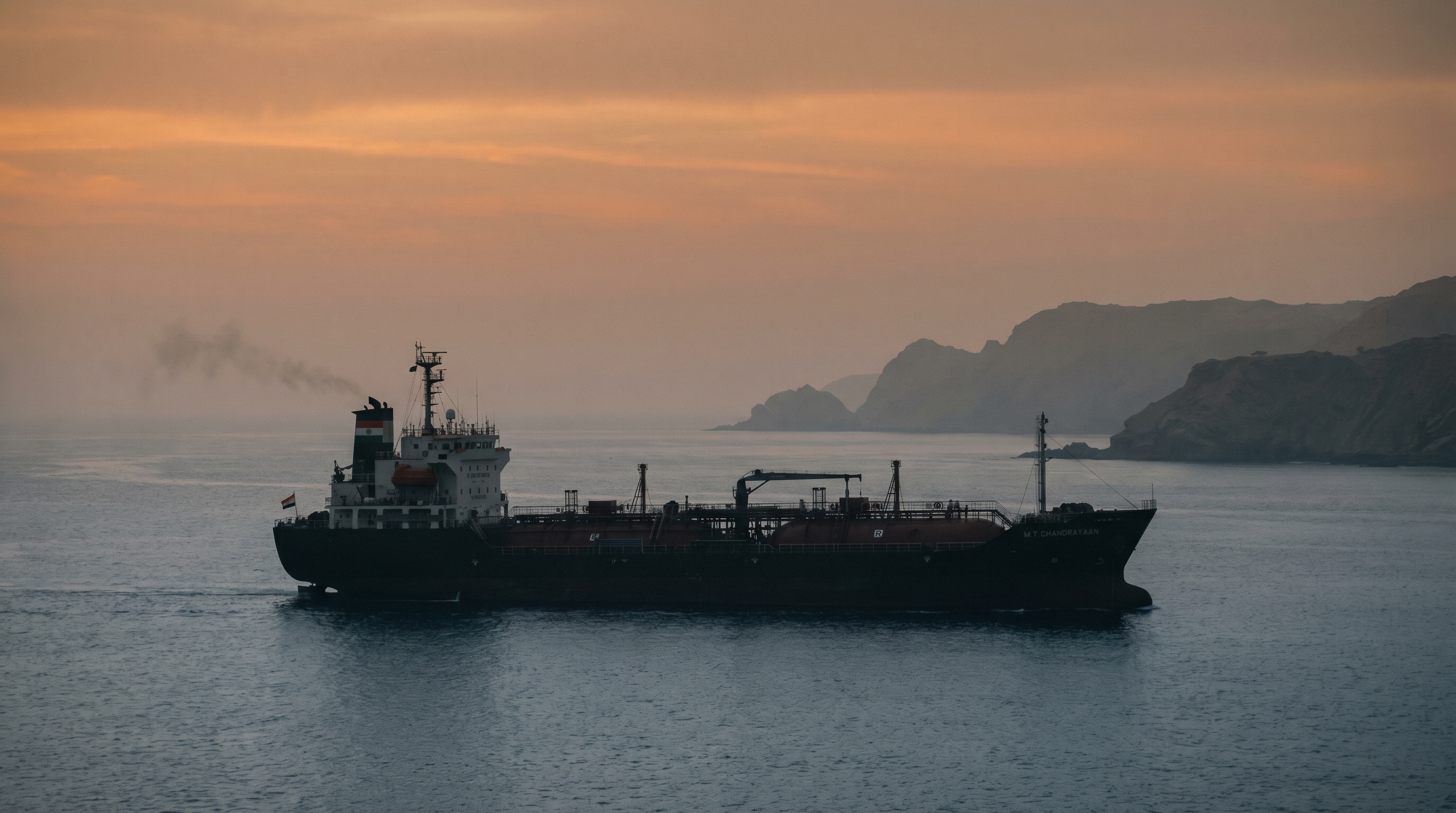
Hold, finally, the image that frames the choice. An Indian-flagged tanker, 12,000 tonnes deadweight, carrying the LPG cylinders that will arrive in kitchens in Gujarat and Tamil Nadu and Maharashtra in two weeks, navigating the chokepoint on the eastern shore of the country whose missiles have, this season, set fire to a refinery and to three Indian workers. The tanker passes the chokepoint because the chokepoint has not, yet, been closed. The chokepoint has not been closed because deterrence, however imperfect, has held. Deterrence holds because the partners on the western shore have, in coordination with the United States, kept the architecture standing.
India's place in that architecture is real. India's contribution to it, on the present evidence, is not commensurate with the stake. Strategic autonomy is the doctrine that says India retains the right to choose its own posture. It is not the doctrine that says the posture must always be the smallest one available. The cylinder that arrives in the kitchen in Gujarat next month arrived because someone, somewhere, did not sit on the fence.
It is time, on the evidence of 4 May 2026, for India to step off it.