By Ramachandran Rajeev Kumar — 2026-04-19
The Strait Reopens, India Exhales — But the Test Was Real
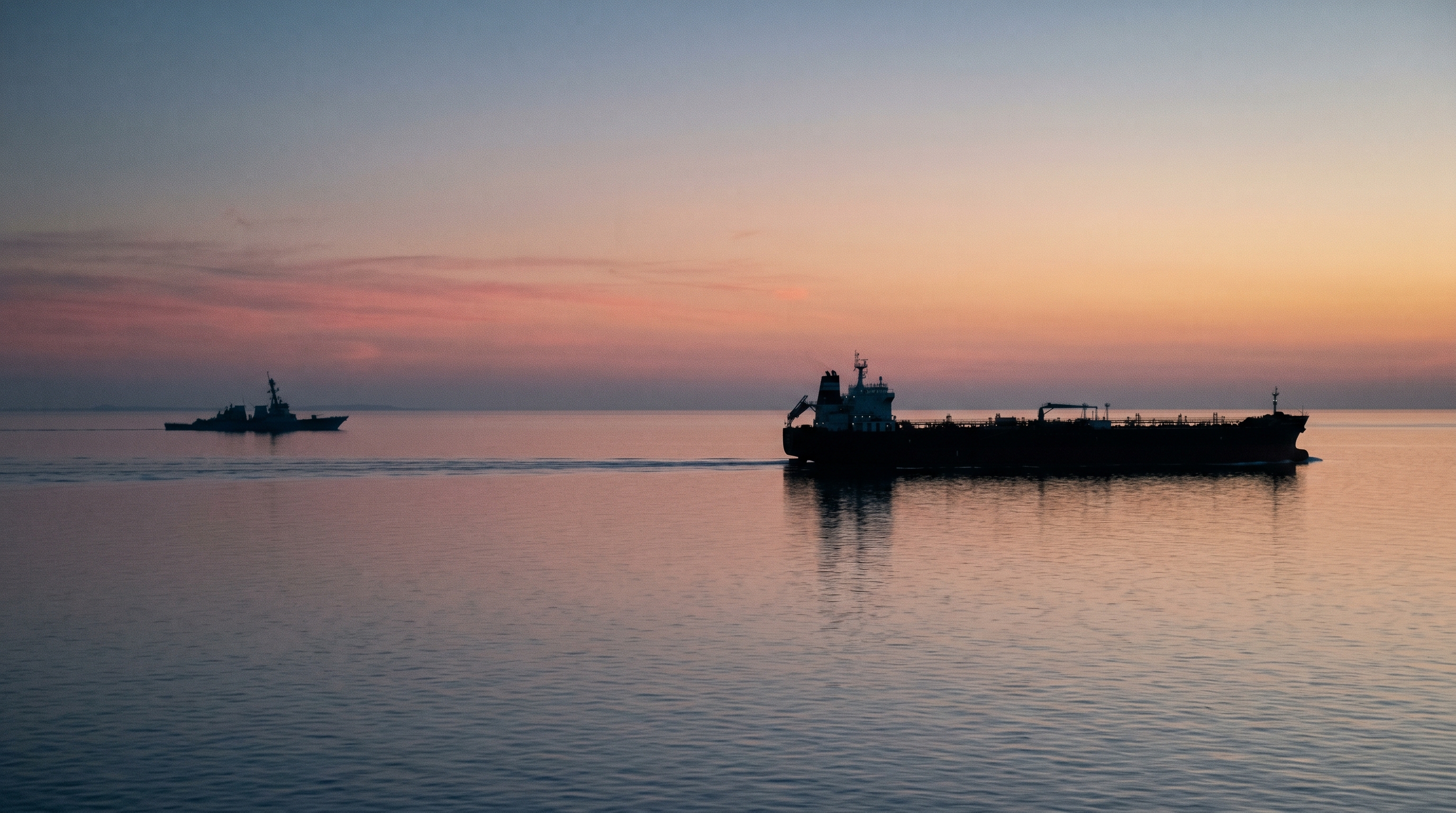
The Iranian foreign minister's statement on Friday afternoon was short and carefully worded. The Strait of Hormuz is open. Commercial shipping may transit. Insurance cover — which had risen fourteen-fold since February — began to ease within the hour.
President Trump's statement, issued from Washington ninety minutes later, was also short. The US naval blockade on Iranian-flagged vessels will continue. The non-Iranian commercial traffic is free to pass. The distinction was narrow, specific, and, for India, the operative text.
India imports roughly five million barrels of crude a day. About forty per cent of that volume passes through the Strait of Hormuz. The passage, from a standing start, is a six-hour chokepoint — twenty-one nautical miles at its narrowest — and it handles about twenty per cent of the world's traded oil and a third of its seaborne liquefied natural gas. For seven weeks, starting in late February, that passage had been variously constrained, threatened with closure, and subject to the risk premium of a war that had not ended.
On Friday evening, that premium came down. By Sunday morning, Brent had retreated from $104 to $92. The Indian crude basket, which had been tracking $3-4 below Brent, followed. Fuel prices at Indian pumps — which had been rising since early April — will ease over the next two weeks as the shipments bought at the higher end of the range flow through the supply chain.
This is relief. It is not, however, the end of the story. The seven weeks that preceded Friday's announcement were the first serious operational test of what India's foreign policy establishment has for a decade called "multi-alignment." The test went as well as any strategic doctrine could hope to — and the vulnerabilities it exposed are still there, waiting for the next test.
What the seven weeks revealed about the doctrine
The multi-alignment framework, as articulated most clearly by External Affairs Minister S. Jaishankar in his 2020 book and in subsequent speeches, rests on a specific claim: that India can maintain working, transactional, and in places cooperative relationships with countries that are in active conflict with each other, without becoming a proxy for any of them, and that this ability is itself a source of strategic autonomy.
The theory has been critiqued from multiple directions since 2022 — after the Russia-Ukraine war, after the Gaza conflict, after the India-Canada diplomatic rupture, after the Maldives pivot. The critiques have generally fallen into two camps. The first says that multi-alignment is a euphemism for hedging, and that hedging is unsustainable at scale. The second says that multi-alignment works in peacetime but collapses when major powers actively demand alignment.
The seven weeks of the Hormuz crisis are the first case where the doctrine was tested in a specific, measurable, and non-deferrable way. Iran and the United States were in active confrontation. India has active strategic relationships with both. India depends on sea lanes that both parties could influence. The test was not rhetorical. It was operational.
The record shows three things. India condemned Iranian escalation actions when they occurred (the Bandar Abbas strike window, the Hormuz closure threat) without condemning Iran as a state. India continued to purchase Iranian crude through legal channels throughout the seven weeks, at rates that were lower than pre-crisis volumes but never zero. India participated in quiet diplomacy — through the Oman channel, through Qatar, through back-channel communications with Tehran that were acknowledged in neither capital — while maintaining full public support for US and allied de-escalation efforts. At no point did any of the principal parties publicly accuse India of acting in bad faith.
This is not a small achievement. It is also not a replicable template for every future crisis. It depended on specific features of this crisis that will not always be present.
The three vulnerabilities the test exposed
Friday's good news should not obscure the audit.
The first vulnerability is physical. Forty per cent of Indian crude imports through a single strait is a concentration risk that no corporate treasury would accept and no strategic planner should. India has, over the past decade, diversified crude sourcing toward Russia, West Africa, and Latin America — but the Hormuz share, while down from 55 per cent in 2015, is still 40 per cent in 2026. The Strategic Petroleum Reserve now holds about 95 days of net import cover at the official level, with private commercial stocks adding roughly another 12. This was the cushion that allowed the seven weeks to be absorbed. The cushion exists. It is not infinite.
The second vulnerability is the absence of a credible domestic refining and chemical feedstock alternative to Gulf crude grades. Indian refineries are, for historical and technical reasons, configured for medium-sour Gulf grades. Switching to West African sweet grades or Latin American heavy grades involves yield losses that run into the billions of dollars annually at full substitution. The refining industry's multi-year plan to expand its configuration flexibility is real, but it is a ten-year investment, not a seven-week fix.
The third vulnerability is about payment systems. Through the seven weeks, the question of whether India could settle Iranian oil purchases in rupees (as per the 2022 bilateral arrangement) or needed to find rupee-ruble-dirham-yuan triangulation routes became operationally critical. The rupee-rial mechanism worked, but the triangulations were awkward. A future crisis that is longer, deeper, or involves secondary sanctions more aggressively than this one did would stress the payment architecture more than it has been stressed in this round.
The doctrine's quiet political dividend
One underexamined feature of the seven weeks is how little domestic political stress they generated. This is unusual in Indian energy-crisis history. The 1990 Gulf crisis caused a balance-of-payments near-default and contributed to the political collapse of the Chandra Shekhar government. The 2008 and 2011 oil spikes produced visible political debate and measurable electoral consequences. The 2022-23 Russian discount window became a domestic political asset for the ruling party.
The Hormuz crisis of 2026 produced almost none of this. Fuel prices rose, but the government maintained excise absorption through Week Six. Foreign exchange reserves were drawn down slightly but remain well above the crisis-cushion threshold. The rupee weakened, but did not break. Inflation ticked up in the CPI, but within the tolerance band. The RBI held rates. Parliament was in session through the critical weeks; the opposition raised the issue but did not press it beyond the standard register of questioning.
Why did the crisis remain contained politically? Two reasons. The first is that the crisis was short enough to be absorbed by the state's fiscal buffers. Seven weeks of Hormuz-disrupted crude was affordable; fifteen weeks would have moved the domestic politics materially. The second reason is that the multi-alignment doctrine, precisely by refusing to take a public side, did not create the domestic flanks that aligned positions create. There was no "pro-Iran" or "pro-US" political tide to surf. The government's position was transactional, which made it inexplicable in ideological terms, which made it hard to politicise.
This is the doctrine's quiet political dividend. It keeps foreign policy boring enough to survive electoral cycles. That boringness is a feature, not a bug.
What Friday does not settle
Three questions remain open.
First: what is the forward probability of another Hormuz-scale test? On the base case, with a resumed US-Iran diplomatic track and Iranian willingness to hold the Strait open, the probability over the next twelve months is low but non-trivial. On the tail case, with a breakdown in US-Iran diplomacy or a regional escalation (Israel-Hezbollah, Houthi resumption, Saudi-Iran tensions), another test is quite plausible.
Second: at what scale of crisis would the Indian absorption capacity break? The honest answer is that nobody knows. The seven weeks held. Fifteen weeks is an educated guess for the threshold where fiscal and foreign-exchange buffers would not be enough. But the threshold depends on the shape of the crisis — a sustained closure is different from intermittent disruption is different from a tanker-war targeting specific flags.
Third: what would a credible multi-alignment doctrine look like if tested by an Indo-Pacific crisis rather than a Middle East one? A China-Taiwan contingency would put India's doctrine under an order-of-magnitude more pressure than the Hormuz crisis did. A crisis in the East China Sea, a Taiwan Strait incident, or an escalation around the disputed South China Sea features would force India into choices that multi-alignment has, so far, been able to defer. The seven weeks of April 2026 are not a rehearsal for that. They are a demonstration that the doctrine exists and can absorb a Middle East shock. The Indo-Pacific exam has not been set yet.
The right lesson from the strait
India's strategic autonomy is a real thing. It is also an expensive thing to maintain, because it requires redundancy — fiscal buffers, reserve cushions, diversified sourcing, multiple diplomatic channels, quiet relationships with parties that do not speak to each other. The seven weeks of the Hormuz crisis drew down that redundancy without exhausting it.
The temptation, now that the strait is open again, will be to treat the episode as a vindication of the doctrine and move on. The better response is to treat it as a partial drill that ran well — and to use the recovery window to rebuild the buffers, expand the diversification, reinforce the payment channels, and think carefully about what the doctrine would look like under an Indo-Pacific stress that is measurably larger than this one.
Multi-alignment worked in April. Working once is not the same as working always. The next test will be drawn from a different section of the question paper, and the country should prepare as though it will be harder, because it most likely will be.
The strait is open. The exhale is real. The rebuilding starts now.
Sources: Iranian Ministry of Foreign Affairs statement (17 April 2026); White House briefing (17 April 2026); Ministry of External Affairs and Ministry of Petroleum data on crude imports and strategic reserve cover; Wikipedia: Current events April 2026; Reserve Bank of India April 2026 data release; public speeches and writings of EAM S. Jaishankar 2020-26; commentary at Gateway House, VIF, and Drishtikone Daily Geopolitics Brief.