By Ramachandran Rajeev Kumar — 2026-05-05
The Slaughter of the Default Incumbent
How India's voters rewrote five states in one day
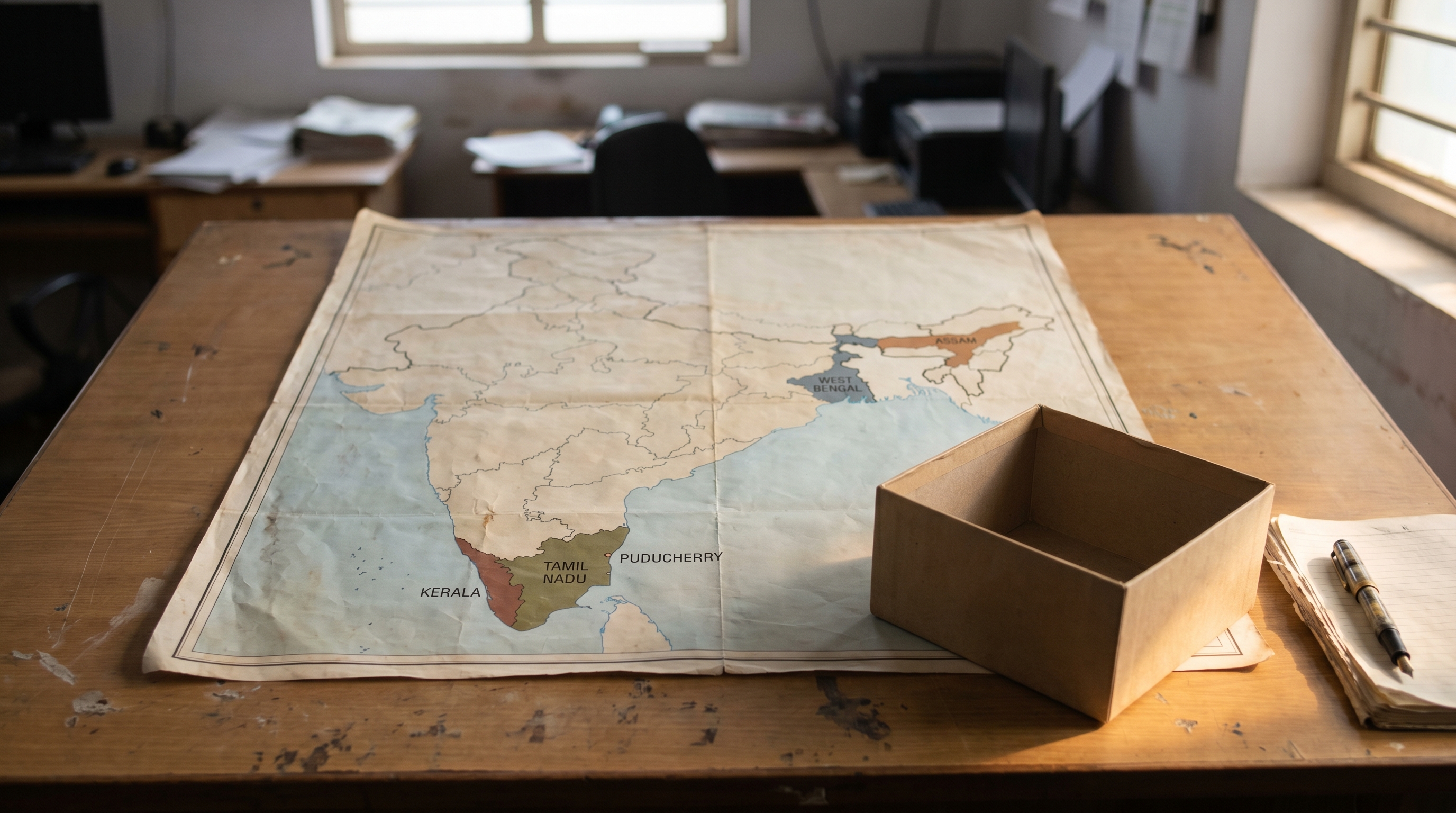
Counting day was 4 May 2026. The Election Commission had set up its tables in five jurisdictions: Tamil Nadu, West Bengal, Kerala, Assam and Puducherry. Eight hundred and twenty-four assembly seats were on the line. By dusk, four governments had been replaced, one had been forced into a hung-house negotiation it did not expect, and a single chief minister, in Assam, had survived to a third term.
It is tempting, on a day of so many simultaneous results, to read each state as its own story. Tamil Nadu had its actor-led upheaval. West Bengal had the fall of a fifteen-year regime. Kerala had the reassertion of its pendulum. Assam continued. Puducherry barely changed. Five different states, five different sets of headlines, five different press conferences. No single thread.
That reading is wrong, or at least incomplete. There is a thread, and it is the most important political fact India has produced in a decade. It is this: the Indian voter has decided, in synchronised fashion across linguistic, regional and ideological boundaries, that the era of the default incumbent is over.
The default incumbent is the office-holder who treats past victories as a shield rather than a target. Who assumes the demographic arithmetic that delivered the last verdict will deliver the next. Who confuses the durability of welfare schemes with the durability of trust. Who runs, in their bones, as if the question is whether the opposition is good enough to remove them, rather than whether they are good enough to keep the office. India's voters, on 4 May, gave the question a single answer in five different accents.
Bengal's breaking point
Begin with the most consequential result of the day. The Bharatiya Janata Party won approximately 207 seats in West Bengal on a vote share of 45.84 per cent. The Trinamool Congress, which had held the state for fifteen years, fell to roughly 80 seats, a loss of more than seven percentage points. The Indian National Congress drew a blank. The Left Front survived, narrowly, at 7.
The single most quoted moment of the day belongs to Bhabanipur, where the sitting Chief Minister, Mamata Banerjee, was defeated in person by Suvendu Adhikari. A loss of that nature, on home ground, after fifteen years in office, is not a swing. It is a verdict.
What does the verdict say? Three things, in the order they will be argued about for years.
First, governance fatigue is real and it is measurable. The Trinamool's last term was haunted by allegations of "cut money" and "syndicate" extraction at the level of the panchayat and the municipality. These are not abstractions; they are felt, weekly, by anyone trying to run a small business or build a one-storey house. Voters who tolerated the friction in 2021 in exchange for a sense of stability had, by 2026, exhausted the trade.
Second, the Special Intensive Revision of electoral rolls, which removed roughly nine million names in the months before polling, became the lightning rod the campaign organised itself around. The Trinamool framed it as disenfranchisement. The BJP framed it as clean-up. The polarisation that followed consolidated Hindu votes in a way Bengal's politics has, in recent decades, resisted. Whether the SIR was, at the technical level, justified is a question for the Election Commission to defend on its own terms. The political fact is that the campaign produced consolidation that an unrevised roll would not have.
Third, and most uncomfortable for the Trinamool's strategists, the personal-brand campaign that worked in 2021 backfired in 2026. "I am all 294 candidates" is an effective slogan when you are the insurgent. It is a poor one when you are the fifteen-year incumbent and the candidates the slogan is meant to absorb are precisely the ones voters have grown tired of. Mamata's loss in Bhabanipur is a microcosm of that miscalculation. The personality became the target.
Kerala's restored pendulum
Travel south to Kerala and the lesson reads identically in a different alphabet. The United Democratic Front, led by the Indian National Congress, won 102 seats, surpassing its previous best of 99 in 2001. The Left Democratic Front fell to 35. Ministers fell with it: V. N. Vasavan in Ettumanoor, Veena George, R. Bindu, J. Chinchu Rani, M. B. Rajesh, Ramachandran Kadannappally. Pinarayi Vijayan held his own seat in Dharmadam after trailing for the first seven rounds, and held it for the third time, but the office of Chief Minister did not travel with him.
Kerala's voters had, in 2021, broken the state's historic pattern of five-year alternation by returning the LDF to a second consecutive term. By 2026, the patience that produced that anomaly had run out. Three drivers explain the result, and they are all variations on the same theme.
The first is minority consolidation. Christian and Muslim voters moved decisively to the UDF, partly in response to anxieties around amendments to the Foreign Contribution Regulation Act and what those amendments meant for institutions long associated with Christian charitable work, partly in response to the perception that the LDF and the BJP had reached a quiet operational understanding the Left was unwilling or unable to dispel. The second is the historic alternation reasserting itself: a state that has, since 1980, refused to give any front a third consecutive term was unlikely to invent that habit now. The third is the erosion of the Kannur citadel. CPI(M) dissident leaders had spent the last term openly criticising the party's organisational direction. By 4 May, the cost was visible in the booths.
Kerala also produced, for the BJP, a real if marginal breakthrough. Three seats: Nemom, where Rajeev Chandrasekhar prevailed by a comfortable margin; Kazhakoottam, where V. Muraleedharan won by approximately three hundred votes; and Chathannoor, taken by B. B. Gopakumar. The seats are few, but they are not zero, and zero is what the BJP's number had been in Kerala since the state's formation. The arithmetic of "the South will not vote for the BJP" survives the cycle. The proposition that "no Keralite will ever vote for the BJP" does not.
The Assam exception
There was one incumbent on the ballot who survived: the BJP-led NDA in Assam, returning 102 seats out of 126 with a combined vote share of 48.01 per cent, an increase of 3.61 percentage points over 2021. Himanta Biswa Sarma was sworn in for a third consecutive BJP term.
The Assam result is the exception that proves the rule. Sarma did not survive by behaving as a default incumbent. He survived by campaigning, throughout the term, as if he were the challenger. The man who ran on flood response, on infrastructure delivery, on Bodoland peace and the BPF alliance that consolidated the BTAD region cleanly into the NDA's column, was not a man taking the office for granted. The opposition arithmetic helped him; the long-running tension between Congress and AIUDF over Muslim consolidation cost the alliance bloc tactical seats. But the deeper truth is that Sarma earned the third term by refusing to run a third-term campaign.
This matters for the wider thesis. The voters did not, on 4 May, declare war on continuity. They declared war on entitlement to continuity. The distinction is the entire story.
The federal micro-climates
A natural objection arises at this point. If five states voted on a single day and four incumbents fell, surely there is a national mood at work? Surely the lesson is, in the end, a top-down one?
The objection is plausible and wrong. The dominant political weather in May 2026 is, paradoxically, federal. Bengal's verdict was driven by Bengal's grievances: the cut-money complaint, the SIR controversy, Mamata's brand in its third decade. Kerala's verdict was driven by Kerala's politics: the FCRA anxieties, the LDF-BJP rumour, the Kannur dissent. Tamil Nadu's verdict was driven by Tamil Nadu's frustrations: the dynasty fatigue, the welfare ceiling, the absence of a credible non-Dravidian, non-BJP option. Assam's continuity was driven by Sarma's local performance and the BPF arithmetic. Puducherry's continuity was driven by N. Rangasamy's two-seat double-contest and the AINRC's command of the local NDA arrangement.
There is no national playbook here. There is a national disposition. The disposition is that local performance must speak louder than national branding, and where it does not, the voters will recalibrate. That is a different finding from "the BJP is sweeping" or "the Congress is reviving" or "the regional parties are dying". None of those summaries fit the data. What fits the data is that voters, in five separate jurisdictions, asked the same disciplined question of every incumbent and ally on the ballot: what have you actually done for me lately, and is the answer enough?
The death of the pan-India formula
A consequence of that finding is that there is no single formula a national party can carry intact from one state to the next.
Welfare did not save the DMK. Hindutva did not break the BJP into Tamil Nadu. The Left's organisational depth did not save the LDF in Kerala. Trinamool's panchayat machinery did not save Mamata in Bengal. The Congress's revival in Kerala did not transfer to Bengal, where the Congress went to zero. The BJP's wave in Bengal did not arrive in Tamil Nadu, where the party took one seat. Each state required the parties contesting it to win on the state's own terms.
For the national parties, this is a humbling fact. For the regional parties, it is a confirmation of relevance. For the new entrants, it is an invitation. Tamil Nadu's TVK, having taken 107 seats in its first contest, also took two seats in Puducherry. The principle that a credible regional vehicle can travel within its linguistic and cultural zone is now established. Whether it can be replicated in Karnataka, Maharashtra or West Bengal will be the next decade's question.
We resist, deliberately, the temptation to relitigate Tamil Nadu's verdict at length here. That story has its own structural depth and its own piece. For the purposes of this analysis, TVK is a data point: a fifth example of voters refusing the default option presented by legacy machines.
The silent pillar of peace
It is worth pausing, before the projections, to acknowledge the institution that made the day possible. The Election Commission of India organised polling across five jurisdictions, in some cases over two phases, in 92 per cent turnout in West Bengal and 85 per cent in Tamil Nadu, without producing a violence-led news cycle of any consequence. Eight hundred and twenty-four constituencies counted. Four governments fell. One held. No state slipped its constitutional moorings.
That is not nothing. In a year when much of the wider neighbourhood is contending with capacity attrition in the apparatus that runs democratic procedure, India's voters expressed displeasure on a continental scale and the displeasure was absorbed cleanly by the procedural infrastructure. The ballot box was, on 4 May, the great equaliser. It is also, increasingly, the great pressure valve. A democracy that gives its voters a credible periodic mechanism to redirect the country does not require its voters to redirect it through any other means. That is the deeper Bharathi reading: peace, in the long run, is what disciplined elections produce.
Rewriting 2029
The implications for the 2029 general election will be dissected for years. Three points are worth holding in mind now, with the caveat that state and national voting patterns diverge more often than commentators admit.
First, the BJP's acquisition of the Bengal state machinery is a logistical and administrative shift, not merely an electoral one. State governments command resources, calendars, district-level access and ground organisation that translate, with effort, into Lok Sabha capability. The BJP's path through Bengal in 2029 is materially easier than it was on 3 May 2026. The size of the dividend depends on the new state government's first-year performance.
Second, the INDIA bloc enters its 2029 negotiations with a structurally weakened hand. Its largest regional anchors, the Trinamool and the DMK, are diminished in their home states. The Left is reduced to a token. The Congress's only fresh state-level mandate is in Kerala, a state in which the bloc's allies in 2024 were against, not with, the senior partner. National alliance arithmetic depends on state-level credibility, and the credibility has changed.
Third, and most consequential, a third sub-national pole has crystallised in the South. TVK's Tamil Nadu performance, combined with its trans-border showing in Puducherry, raises the possibility of an anti-DMK, anti-BJP regional alignment in 2029 with thirty-nine Lok Sabha seats inside its core zone. Whether TVK joins the INDIA bloc, sits independent, or projects itself as the spine of an all-South third front is the single largest variable in the 2029 calculation.
The note in five accents
What India's voters wrote on 4 May was not, in the end, a vote for any particular party. It was a vote for a particular standard. The standard says, at its plainest, that incumbency is a job, not an inheritance. That welfare schemes are the floor, not the ceiling. That fifteen years is not, by itself, a defence. That a personal brand, however hard-won, must be redeployed as service rather than presumed as entitlement.
Five jurisdictions wrote that note in five accents on the same day. Every party that holds office today, in every state and at the centre, would do well to translate.