By Ramachandran Rajeev Kumar — 2026-06-04
India's SpaceX Moment Has a Date -- and a Verdict
Skyroot Aerospace became India's first space-tech unicorn last month. Its Vikram-1 rocket now waits at Sriharikota for a June launch that will test whether the country's space reforms produced a company that can actually fly, or just one that can raise money.
By Ramachandran Rajeev Kumar
A unicorn valuation is a promise. An orbital launch either keeps it or breaks it. Sometime this month, on the same sliver of coast where the Indian state has sent rockets up for half a century, a private company will find out which kind of company it is.
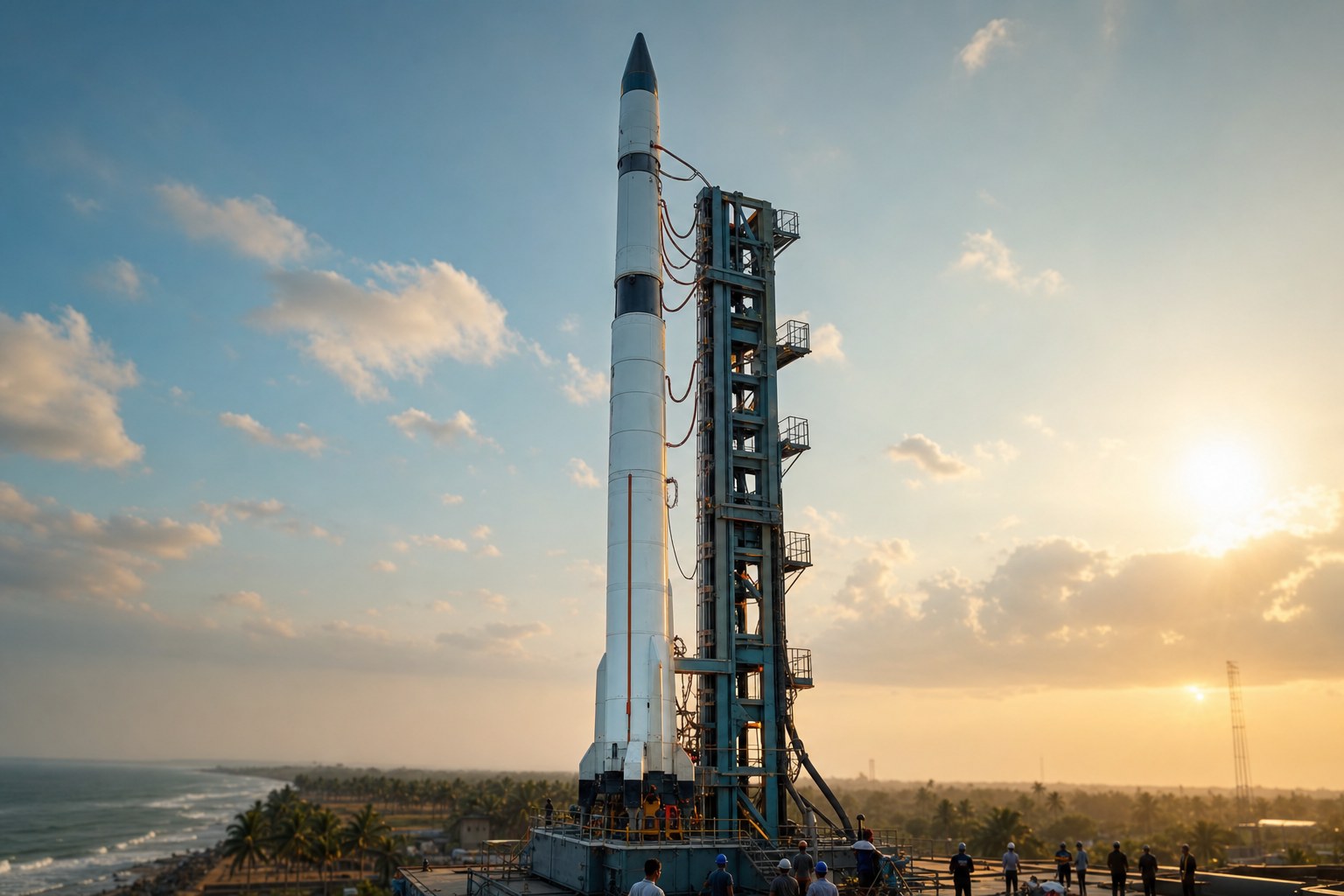
Skyroot Aerospace has moved its Vikram-1 rocket to the Satish Dhawan Space Centre at Sriharikota and is targeting a maiden orbital launch in June 2026, according to TechCrunch (May 7, 2026) and reporting from BusinessToday on the rocket's transfer to the launch site (April 25, 2026). If it works, it will be the first time a privately built Indian rocket reaches orbit. The flight has not happened yet, and the date is a window, not a guarantee.
The bet has already been placed
The money came first, which is how these stories usually go now. On May 7, 2026, Skyroot raised $60 million in a round co-led by Sherpalo Ventures and Singapore's sovereign fund GIC, lifting its valuation to $1.1 billion and making it India's first space-tech unicorn, per TechCrunch. That is the bet. Investors looked at a rocket sitting on a transporter and decided the company was worth more than a billion dollars before it had carried a single kilogram to orbit.
This is not a criticism. It is how the industry runs. SpaceX was valued richly long before its early Falcon flights stopped failing. Capital arrives on the strength of a thesis, and the launch is where the thesis gets graded. The interesting question for a Chennai reader watching a rocket leave from up the coast is not whether the valuation is high. It is whether the capability underneath it is real.
Why the answer matters beyond one company
For most of independent India's history, getting to space was something only the government did. The Indian Space Research Organisation built the rockets, owned the pads, and ran the missions. A private firm could supply a bolt or a circuit board, but it could not fly.
That changed when India opened the sector to private players and set up IN-SPACe as the regulator and facilitator for non-government space activity. The reform did something simple and consequential: it told an individual founder with an idea about rockets that the domain was now open to them. Skyroot, founded by former ISRO engineers, is the most visible test of whether that opening produced more than paperwork.
The scale of what is riding on it is easy to undersell. India now has roughly 400 space-tech startups, and the country's space economy is projected to grow from about $8.4 billion to $44 billion by 2033, per figures cited in TechCrunch's May 7 report. Those are the numbers of a sector that has decided it is going to be big. But a sector of 400 startups and a five-fold growth forecast still needs proof that an Indian private company can do the single hardest thing in the business: put a payload in orbit and have it stay there.
Vikram-1 is that proof, pending. It is designed to carry small payloads to a sun-synchronous orbit, the workhorse band for Earth-observation and small communications satellites, and the same market international small-launch firms are fighting over.
What a launch actually settles
Here is the honest distinction the valuation cannot make on its own. Raising money proves that smart people with capital believe in the team. Reaching orbit proves the team can build a machine that survives the few violent minutes between the pad and space. Those are different claims, and only one of them has been demonstrated.
Launch is unforgiving in a way fundraising is not. A pitch deck can be revised. A rocket that loses thrust at the wrong second cannot. This is why the date should be read as a window. Launch schedules slip, for weather, for a sensor reading nobody likes, for a hundred reasons that have grounded far more experienced operators on far better-funded programmes. A delay would not mean the bet was wrong. A failure on the pad or in flight would not mean the reforms failed. It would mean the company joined the long list of first attempts that taught their builders something expensive.
What it would settle, if Vikram-1 flies clean, is the thing the money has only assumed: that liberalisation produced operational capability, not just a funding event. That an individual founder, given access to a domain the state used to keep closed, can stand up something that works.
The Chennai view
There is a particular weight to where this happens. Sriharikota is not an abstraction in Tamil Nadu. It is up the coast, a place school groups visit, a name that has meant national achievement for generations of people who grew up watching ISRO launches on television. Now a private company is borrowing that ground for its own first attempt, and the engineers pointing the rocket skyward are, in many cases, the same kind of people who once would have done this only in government uniform.
That is the human story underneath the valuation. A state monopoly opened, and individuals walked through the door. Whether they can fly is about to stop being a matter of opinion.
The verdict is coming. It will arrive as a clean ascent or a hard lesson, sometime in a June window that could still move. Either way, the bet stops being a bet the moment Vikram-1 leaves the pad.