By Ramachandran Rajeev Kumar — 2026-04-19
Sixth, Not Fourth: Why India's GDP Story Needs an Honest Denominator
The International Monetary Fund released its April 2026 World Economic Outlook on 14 April. India's 2025-26 nominal GDP estimate was $4.15 trillion. The United Kingdom's was $4.26 trillion. Japan's was $4.38 trillion.
That sequence places India sixth. Behind the United States, China, Germany, Japan, and the United Kingdom. It is the lowest rank in the IMF's table that India has held since the second term of the Manmohan Singh government.
For roughly three years, official communications, broadcast graphics, and ministerial speeches had described India as "the world's fourth largest economy" or "the fifth largest, overtaking the UK." The April table retired that description. The question worth asking is not whether the retirement is politically awkward. It is whether the country will now adopt a more honest way of talking about its own size.
What changed, precisely
Two things. Neither of them was the economy slowing down.
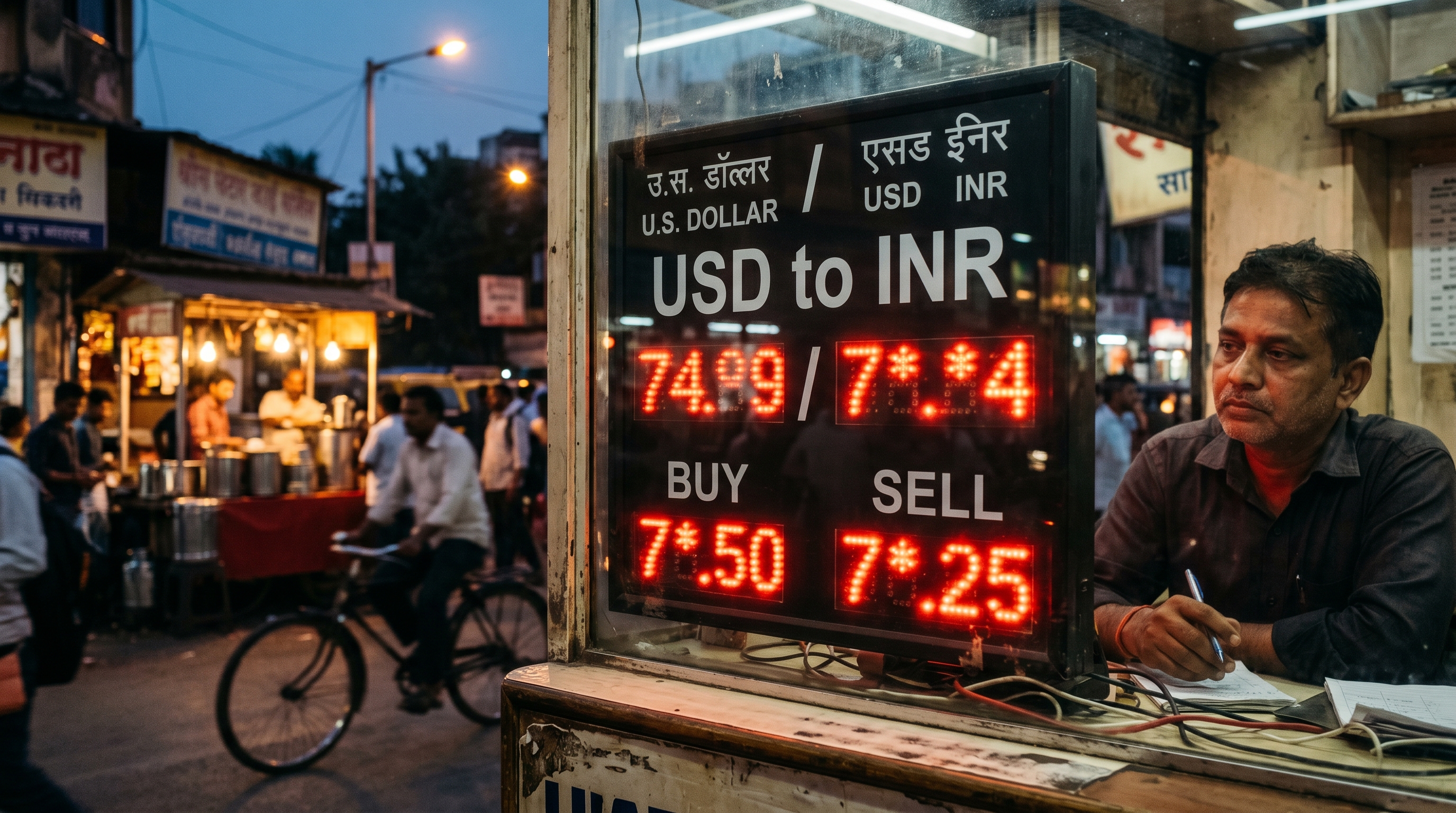
First, the rupee. In calendar 2024, the rupee closed around 84.6 to the US dollar. Through 2025, it weakened to 88.5. That is an 11 per cent depreciation against the measuring stick the IMF uses to compile its league table. India's economy grew by roughly 9 per cent in rupee terms over the same period. In dollar terms, the growth and the depreciation largely cancelled out, and the country's stock of output shrank slightly in the currency the rankings are written in.
Second, a statistical revision. The Ministry of Statistics and Programme Implementation completed a base-year update from FY12 to FY23 base and released the revised back-series in February. The revision pulled nominal GDP down by approximately 4 per cent across the recent years. It was a technical exercise, not a political one — every country runs base-year revisions on a cycle, and the direction of the revision (down, in this case) reflected a truer accounting of sectoral weights, not weakness.
Combine an 11 per cent currency depreciation with a 4 per cent base revision and you have the answer to the ranking change. The UK, with sterling roughly stable and no comparable revision, held its position. India fell below it.
The growth story is still the growth story
The same IMF document that showed India at sixth also showed India growing at 6.5 per cent in 2026 — the fastest rate among major economies. The World Bank, in its 9 April release, projected 6.6 per cent for FY27. These numbers are not disputed in the data. They describe a real economy producing real output, employing real people, paying real wages.
What they do not describe is the country's size on a ranking table denominated in a foreign currency that has been strengthening against almost every emerging-market denominator for three years. That is a different question, and it has a different answer.
The IMF's own projection has India returning to fourth by 2027 — $4.58 trillion, marginally ahead of the UK, assuming the rupee stabilises and the base-year effects wash out. If the rupee depreciates further, the return slips. If the rupee recovers, it arrives faster. The underlying economy's trajectory is not what moves this line. The exchange rate is.
Why the "fourth largest" claim ran into trouble
The most honest criticism of the government's messaging over the last three years is not that it was untrue at the moment it was made — a country's ranking can legitimately shift within a year as exchange rates move, and there were moments in 2023 and 2024 when the IMF's purchasing-power-parity table (a different measure) did put India fourth, and the current-dollar table did have India crossing the UK.
The difficulty was the framing. "Fourth largest economy" was repeated as though it were a permanent feature of the landscape, in speeches and in campaign literature and in the graphics that flashed behind ministers on television. When the denominator moved, as denominators do, the claim was exposed as tied to a currency moment rather than to a structural transition.
This is the difference between describing a country as "on track to become the fourth largest economy by 2027" and describing it as "the fourth largest economy." The first is a forecast, and forecasts are revised. The second is a claim of arrival, and claims of arrival are tested every April when the IMF publishes.
The deeper point about how we measure ourselves
India's economy in 2026 produces roughly seven and a half times what it produced in 2000. Per capita income has risen about 5.5 times. The share of the population living in extreme poverty has fallen from around 38 per cent to below 12 per cent. Life expectancy at birth has risen by seven years. The literacy rate has crossed 80 per cent. These are large, civilisational-scale numbers, and none of them are controversial.
None of them also depend on whether India is fourth, fifth, or sixth in a table denominated in a currency managed by another country's central bank.
The instinct to rank one's own country in an international league is not unique to India. Every rising economy goes through it, and most of them eventually grow out of it. China spent the 2000s obsessed with GDP rankings and the 2010s increasingly indifferent to them. The United States stopped caring about its place on tables around the time it stopped fearing the Soviet economy. Japan held its rankings as identity for a long time and is still unwinding the habit.
The question for India is not whether the IMF table is flattering this April. It is whether public discourse can carry more than one fact about the economy at the same time. The economy grew 9 per cent nominally in its own currency; the rupee weakened 11 per cent against the dollar; the base was revised down 4 per cent; and the country is now sixth on the table while being the fastest-growing major economy on the growth column. All four sentences are true. None of them contradicts any of the others.
What a more useful metric would look like
A few candidates deserve more airtime than the IMF current-dollar ranking.
Nominal GDP in local currency. Tells you how much the domestic economy actually produced. India grew. The rankings did not move because the ruler changed length, not because the object shrank.
GDP at purchasing power parity. Adjusts for the fact that a rupee buys more in Chennai than a dollar does in Chicago. On PPP, India is third, and has been third since 2018. This measure answers the question "what does the Indian economy actually produce in terms of goods and services?" better than the dollar measure does.
Per capita income. A country of 1.45 billion people with a $4.15 trillion economy has a per capita income of around $2,850. That number is a more useful description of average Indian prosperity than either the aggregate GDP or the ranking.
Growth rate. The rate at which the economy is expanding is the most predictive single number for everything from tax receipts to employment to the rate at which real wages rise.
None of these are as satisfying to flash on a screen as "fourth largest." That is the point. The numbers that matter are usually the ones that are harder to print on a banner.
The political question
Parties and governments discover, periodically, that claims anchored to volatile denominators are hostages to the next data release. The IMF will publish again in October. If the rupee recovers to 86 and the US dollar index softens, the ranking will shift back. If it does not, India will enter 2027 still at sixth and the narrative will have to accommodate that fact.
The mature response is not to stop announcing good economic news. It is to describe the news in terms that the next data release cannot contradict.
"India is the fastest-growing major economy" is a claim the April IMF numbers confirm. "India is the fourth-largest economy" is a claim the April IMF numbers withdraw. The first sentence was always the more accurate one. It was also always the one that did the heavier political work. Prosperity is a trajectory, not a trophy. The sooner the national conversation absorbs that, the less time it will spend relitigating rankings it cannot control.
Sources: IMF World Economic Outlook, April 2026 (released 14 April 2026); Ministry of Statistics and Programme Implementation base revision release, February 2026; Reserve Bank of India exchange rate data; World Bank India Economic Update, 9 April 2026; coverage by The Wire, BusinessToday, and PressInsider.